Description
Single-Cell RNA-Seq Course: Master scRNA-Seq Data Analysis Using R & Python
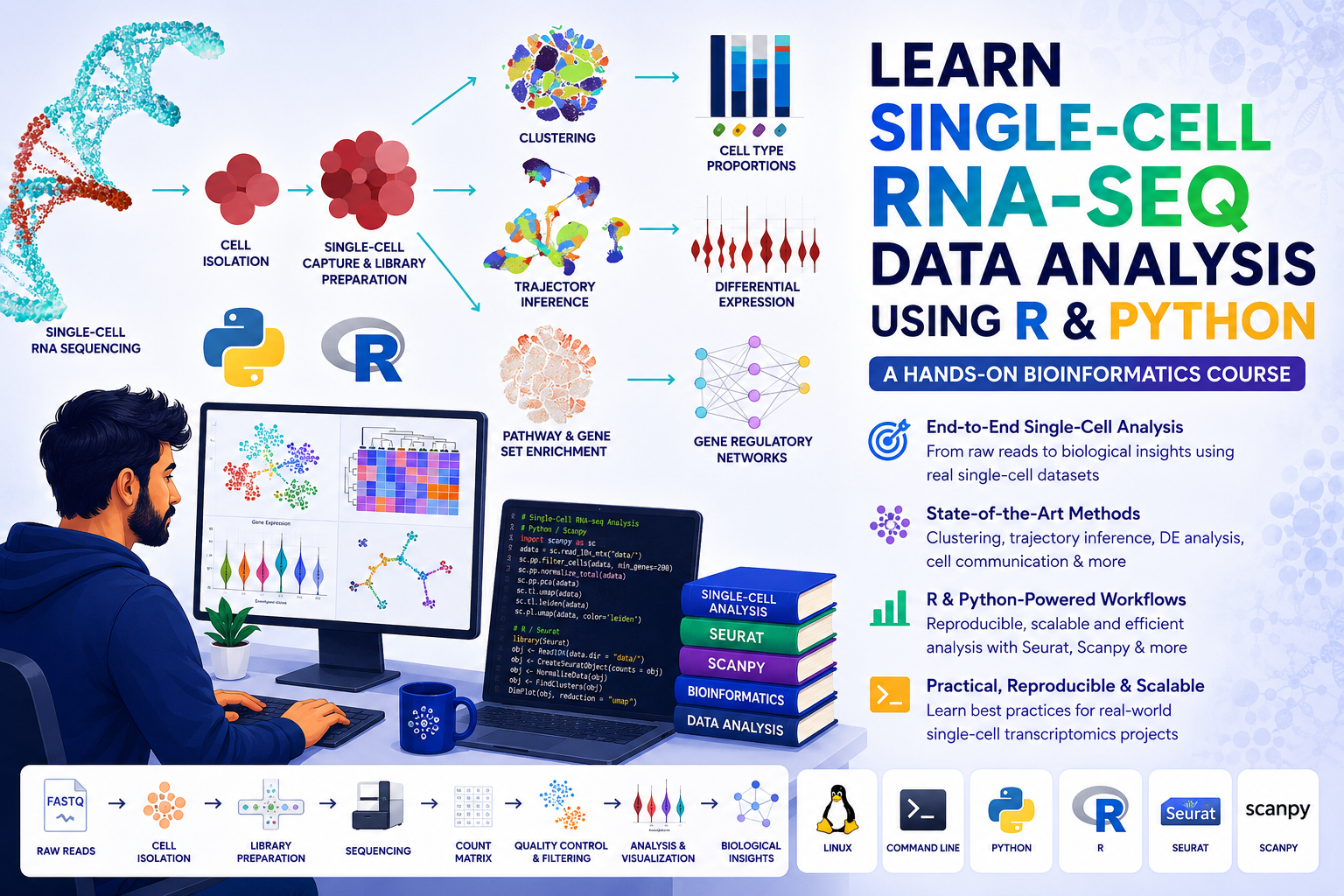
Single-Cell RNA-Seq Course is a comprehensive, hands-on training program designed to teach you how to analyze single-cell transcriptomics data using R, Python, and industry-standard bioinformatics tools. Whether you’re a student, researcher, or bioinformatician, this course will help you master the complete scRNA-Seq analysis workflow through practical projects and real-world datasets.
Single-cell RNA sequencing (scRNA-Seq) has revolutionized genomics by enabling researchers to study gene expression at the resolution of individual cells. Unlike traditional bulk RNA-Seq, Single-Cell RNA-Seq reveals cellular heterogeneity, identifies rare cell populations, uncovers developmental trajectories, and improves our understanding of diseases such as cancer, neurological disorders, and immune-related conditions.
In this Single-Cell RNA-Seq Course, you’ll learn the complete workflow—from raw sequencing data to quality control, normalization, dimensionality reduction, clustering, cell type annotation, differential expression analysis, trajectory inference, and biological interpretation. By the end of the course, you’ll be able to confidently analyze and interpret single-cell transcriptomic datasets used in modern research.
What You’ll Learn
By the end of this Single-Cell RNA-Seq Course, you will be able to:
- Understand the principles and applications of single-cell RNA sequencing.
- Process and analyze scRNA-Seq datasets using R and Python.
- Perform quality control and filtering of single-cell data.
- Normalize and integrate multiple datasets.
- Identify highly variable genes.
- Perform dimensionality reduction using PCA, t-SNE, and UMAP.
- Cluster individual cells and identify cell populations.
- Annotate cell types using known marker genes.
- Perform differential gene expression analysis between cell clusters.
- Conduct trajectory and pseudotime analysis.
- Visualize and interpret single-cell transcriptomic data.
- Build reproducible scRNA-Seq analysis pipelines.
Course Structure
The course is divided into practical modules covering:
- Introduction to Single-Cell RNA Sequencing
- Single-Cell Data Acquisition
- Quality Control and Filtering
- Data Normalization and Integration
- Feature Selection and Dimensionality Reduction
- Cell Clustering and Visualization
- Cell Type Annotation
- Differential Expression Analysis
- Trajectory and Pseudotime Analysis
- Hands-On Projects and Final Assessment
Each module includes step-by-step video lectures, practical demonstrations, assignments, downloadable datasets, and real-world case studies.
Hands-On Projects
Throughout this Single-Cell RNA-Seq Course, you’ll complete practical projects such as:
- Single-cell quality control
- Data normalization
- Cell clustering
- Cell type identification
- Marker gene analysis
- Differential expression analysis
- Trajectory inference
- Biological interpretation of single-cell datasets
These projects simulate workflows used in genomics, cancer biology, immunology, developmental biology, and precision medicine research.
Software and Tools You’ll Use
Gain hands-on experience with industry-standard software, including:
- R
- Python
- Seurat
- Scanpy
- RStudio
- Jupyter Notebook
- ggplot2
- UMAP
- t-SNE
- PCA
Who Should Enroll?
This course is ideal for:
- Bioinformatics students
- Biology and biotechnology students
- Master’s and PhD researchers
- Genomics and transcriptomics researchers
- Computational biologists
- Cancer and immunology researchers
- Life science professionals
- Anyone interested in learning Single-Cell RNA-Seq data analysis
Basic knowledge of RNA-Seq or R programming is helpful but not required, as the course provides step-by-step guidance throughout the workflow.
Why Choose This Single-Cell RNA-Seq Course?
- Learn the complete scRNA-Seq analysis workflow.
- Analyze real single-cell sequencing datasets.
- Master Seurat and Scanpy for single-cell analysis.
- Perform clustering, cell annotation, and trajectory analysis.
- Build reproducible analysis pipelines using R and Python.
- Develop practical skills for genomics, cancer research, immunology, and precision medicine.
Enroll today and master Single-Cell RNA-Seq data analysis through practical projects while learning the tools and workflows used in cutting-edge transcriptomics and biomedical research.
Reviews
There are no reviews yet.