Learn Genome-Wide Identification and Characterization of Plant Gene Families Using Bioinformatics
About Course
Genome-Wide Identification and Characterization of Plant Gene Families Using Bioinformatics
Understanding gene families is fundamental to modern plant genomics, functional genomics, evolutionary biology, and crop improvement research. Gene families regulate critical biological processes including plant growth and development, stress responses, hormone signaling, metabolism, disease resistance, and environmental adaptation. As high-quality plant genomes become increasingly available, genome-wide identification and characterization of gene families has emerged as one of the most widely adopted research approaches in plant bioinformatics.
This comprehensive course is designed to provide students, researchers, and professionals with a complete step-by-step workflow for conducting publishable genome-wide gene family analyses in plants using modern bioinformatics tools and publicly available genomic resources.
The course begins with the fundamentals of gene family research, helping learners understand how to select biologically significant gene families and identify suitable plant species for analysis. Students will then learn how to retrieve genomic and protein sequence data from major biological databases and perform homology-based searches to identify candidate gene family members across entire genomes.
Moving beyond identification, the course covers detailed functional and evolutionary characterization techniques used in contemporary genomics research. Participants will learn how to perform sequence similarity analysis, multiple sequence alignment, phylogenetic analysis, conserved motif discovery, protein domain identification, gene structure analysis, chromosomal localization studies, and physicochemical characterization of proteins.
To provide a deeper understanding of gene function and regulation, the course also introduces cis-regulatory element analysis, protein-protein interaction network analysis, and functional enrichment analysis using Gene Ontology and pathway databases. These approaches help researchers uncover biological functions, regulatory mechanisms, and evolutionary relationships among gene family members.
In addition to computational analysis, the course emphasizes research methodology and scientific communication. Students will learn how to conduct literature reviews, manage references using Mendeley, organize results according to publication standards, and write professional research manuscripts suitable for submission to peer-reviewed journals.
Throughout the training, learners will follow a complete genome-wide analysis pipeline that mirrors the workflow used in published plant genomics studies. By the end of the course, participants will possess the skills required to independently design, execute, interpret, and publish gene family research projects.
Whether you are working on a bachelor’s thesis, master’s dissertation, PhD research project, scientific publication, or professional genomics study, this course will provide the practical knowledge and hands-on experience needed to perform advanced plant gene family analysis with confidence.
What You Will Learn
• Understand the principles of genome-wide gene family identification and characterization
• Select appropriate gene families and plant genomes for research projects
• Retrieve genomic and protein sequence datasets from public databases
• Perform homology searches using sequence similarity approaches
• Identify and validate gene family members across plant genomes
• Conduct multiple sequence alignment and phylogenetic analysis
• Investigate evolutionary relationships among gene family members
• Discover conserved motifs and protein domains
• Analyze gene structure including intron-exon organization
• Calculate physicochemical properties of proteins
• Predict and interpret protein-protein interaction networks
• Identify cis-regulatory elements within promoter regions
• Map genes onto chromosomes and investigate duplication events
• Perform Gene Ontology and enrichment analysis
• Conduct literature reviews for research projects
• Manage references using Mendeley
• Write publication-quality genome-wide gene family research papers
Who This Course Is For
• Undergraduate students in Bioinformatics, Biotechnology, Genetics, and Plant Sciences
• MSc and MPhil students conducting research projects
• PhD researchers working in plant genomics and functional genomics
• Plant breeders and crop scientists
• Computational biologists and bioinformaticians
• Researchers interested in comparative genomics and evolutionary biology
• Scientists seeking to publish genome-wide gene family studies
Tools and Resources Covered
• NCBI Databases
• UniProt
• Ensembl Plants
• Phytozome
• BLAST
• MEGA
• MEME Suite
• TBtools
• STRING
• PlantCARE
• ShinyGO
• Mendeley
• Various genome annotation and visualization tools
Course Outcome
Upon successful completion of this course, students will be able to independently perform a complete genome-wide gene family analysis in plants and generate results suitable for academic theses, dissertations, conference presentations, and peer-reviewed scientific publications.
Course Content
Introduction to Gene Family Analysis
Introduction to Genome-Wide Gene Family Analysis
10:55
Project Planning and Gene Family Selection
Sequence Retrieval and Homology Identification
Sequence Validation and Alignment
Evolutionary Analysis
Functional Domain Characterization
Protein Characterization
Regulatory and Genomic Analysis
Functional Enrichment Analysis
Scientific Reporting
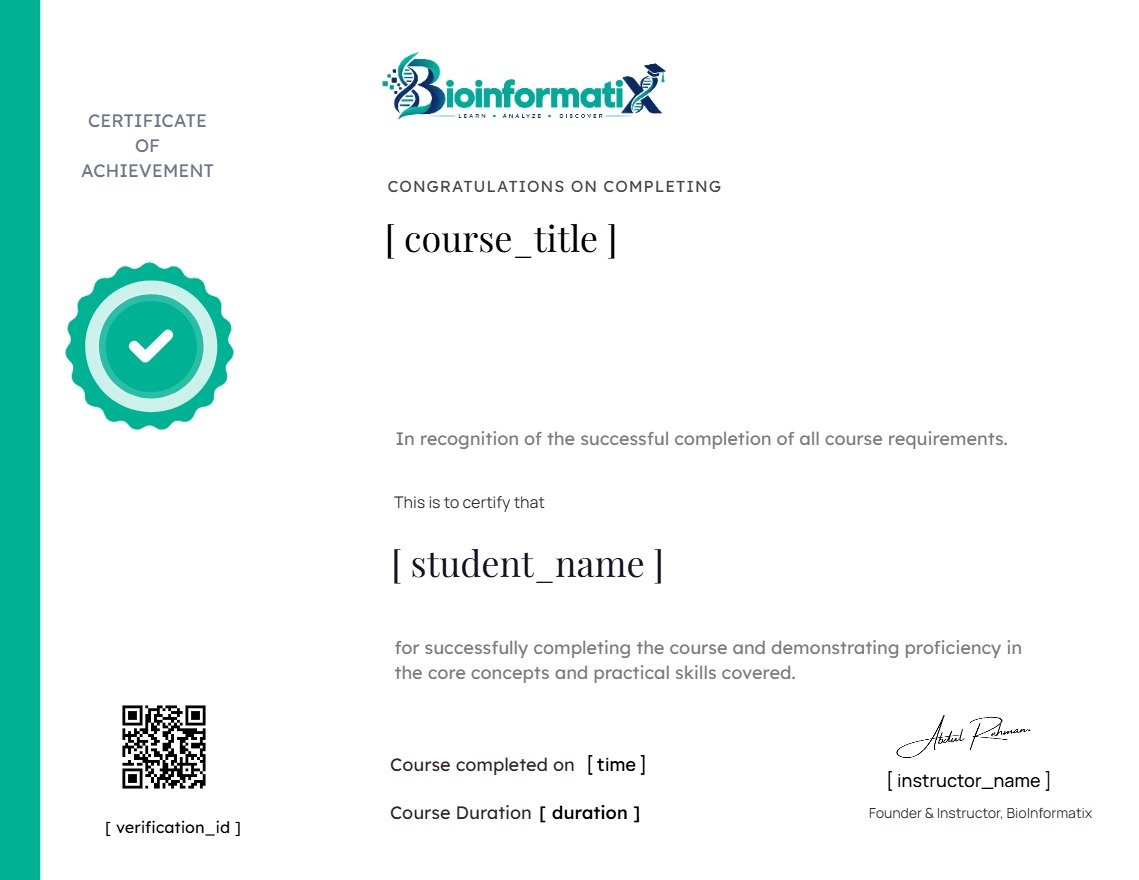
Get Certified in Bioinformatics
Showcase your achievement with a certificate recognized by students and researchers worldwide.
Student Ratings & Reviews

Your Instructor

Abdul Rehman Ikram
Bioinformatician | Data Analyst | Computational BiologistAbdul is a distinguished bioinformatician, data analyst, and computational biologist known for his exceptional contributions to the field of biomedical research. With a passion for integrating technology and biology, Abdul has carved a niche for himself, leveraging cutting-edge computational techniques to unravel complex biological data.
Driven by a curiosity to decode the complexities of life, Abdul believes in the power of interdisciplinary approaches. He is committed to mentoring the next generation of scientists, fostering a culture of innovation and continuous learning.