Description
Metagenomics Course: Master Microbiome Data Analysis Using Linux
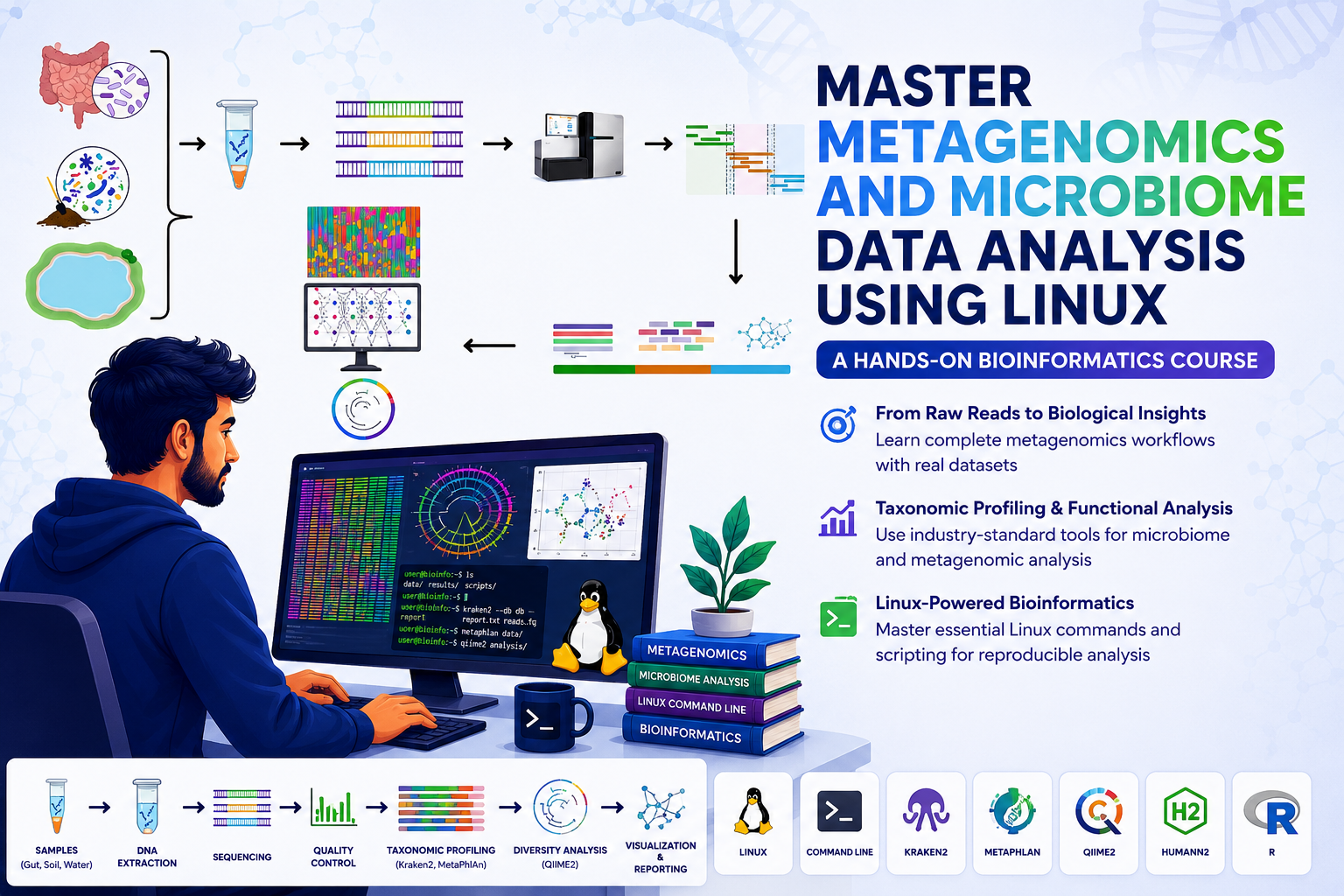
Metagenomics Course is a comprehensive, hands-on training program designed to teach you the complete workflow of microbiome and metagenomic data analysis using Linux and industry-standard bioinformatics tools. Whether you’re a student, researcher, or life science professional, this course will help you analyze complex microbial communities without the need for microbial culturing.
Metagenomics has transformed microbiology by enabling researchers to study the genetic material of entire microbial communities directly from environmental, clinical, agricultural, and industrial samples. From the human gut microbiome to soil, marine, and environmental ecosystems, metagenomic analysis plays a vital role in understanding microbial diversity, taxonomy, functional potential, and host–microbe interactions.
In this Metagenomics Course, you’ll learn the complete analysis workflow—from raw sequencing data to taxonomic classification, microbial diversity analysis, functional profiling, and biological interpretation. Through practical demonstrations and real-world datasets, you’ll gain the skills needed to perform microbiome data analysis with confidence.
What You’ll Learn
By the end of this Metagenomics Course, you will be able to:
- Understand the principles of metagenomics and microbiome analysis.
- Learn different metagenomic sequencing approaches and experimental workflows.
- Perform quality assessment and preprocessing of sequencing reads.
- Analyze metagenomic datasets using Linux.
- Classify microbial communities using Kraken2 and other taxonomic profiling tools.
- Perform microbiome diversity analysis.
- Generate taxonomic abundance reports and visualizations.
- Conduct functional profiling of microbial communities.
- Interpret microbiome analysis results for biological research.
- Build reproducible metagenomics analysis pipelines.
Course Structure
The course is organized into practical modules covering:
- Introduction to Metagenomics and the Microbiome
- Linux for Metagenomics
- Sequencing Data Quality Control
- Read Preprocessing
- Taxonomic Classification
- Microbial Community Analysis
- Functional Profiling
- Data Visualization and Interpretation
- Hands-On Projects and Final Assessment
Each section includes step-by-step video lectures, practical demonstrations, assignments, and real-world case studies.
Hands-On Projects
Throughout this Metagenomics Course, you’ll complete practical projects such as:
- Quality control of metagenomic sequencing data
- Taxonomic classification of microbial communities
- Microbiome composition analysis
- Diversity analysis
- Functional annotation of microbial datasets
- Biological interpretation of microbiome results
- Building complete metagenomics workflows using Linux
These projects simulate analyses commonly performed in microbiome, environmental, agricultural, and clinical research.
Software and Tools You’ll Use
Gain hands-on experience with widely used bioinformatics software, including:
- Linux
- FastQC
- Fastp
- Kraken2
- Bracken
- MetaPhlAn
- Krona
- MEGAHIT
- HUMAnN
- MultiQC
Who Should Enroll?
This course is ideal for:
- Bioinformatics students
- Microbiology students
- Biotechnology students
- Environmental scientists
- Microbiome researchers
- Master’s and PhD students
- Computational biologists
- Life science professionals
- Anyone interested in microbiome and metagenomics data analysis
No previous metagenomics experience is required. The course provides step-by-step guidance from fundamental concepts to advanced microbiome analysis workflows.
Why Choose This Metagenomics Course?
- Learn complete microbiome and metagenomics analysis workflows.
- Gain hands-on experience with real sequencing datasets.
- Master Linux-based bioinformatics pipelines.
- Work with industry-standard metagenomics software.
- Build practical skills for microbiome, environmental, agricultural, and clinical research.
- Beginner-friendly with project-based learning.
Enroll today and master metagenomics data analysis while building the practical skills needed to analyze microbial communities, interpret microbiome data, and perform research using modern bioinformatics tools.
Reviews
There are no reviews yet.