
Description
Variant Calling Course: Learn NGS Data Analysis from FASTQ to Variant Detection
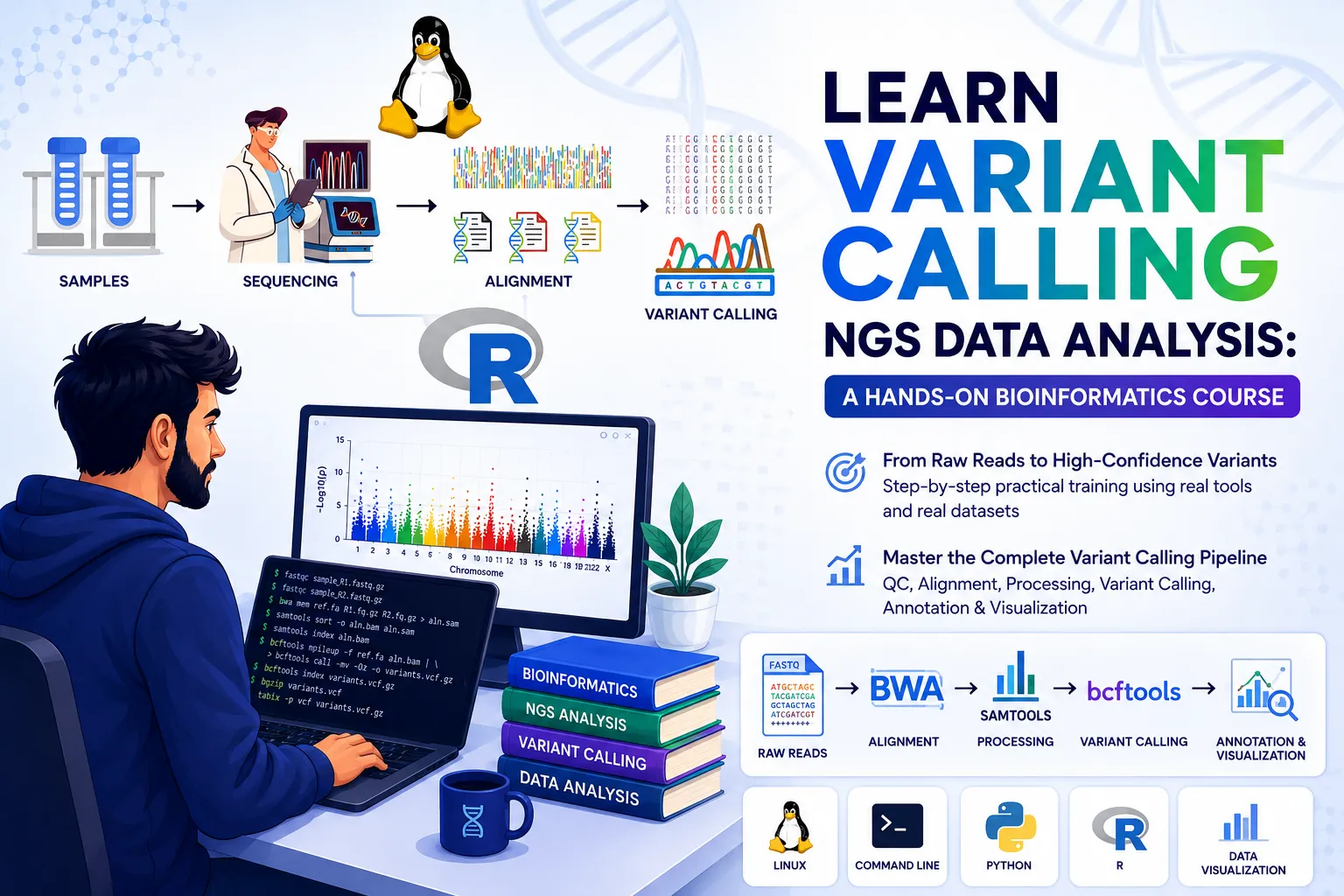
Variant Calling Course is a comprehensive, hands-on training program designed to teach you the complete Next-Generation Sequencing (NGS) variant calling workflow used in genomics, precision medicine, and bioinformatics research. Whether you’re a student, researcher, or life science professional, this course will help you analyze sequencing data and identify genetic variants using industry-standard bioinformatics tools.
Variant calling is one of the most important applications of NGS, enabling researchers to identify single nucleotide polymorphisms (SNPs), insertions and deletions (INDELs), and other genomic variations associated with diseases, evolution, and genetic diversity. In this Variant Calling Course, you’ll learn every step of the analysis pipeline—from raw FASTQ files to high-confidence variant identification and interpretation.
What You’ll Learn
By the end of this Variant Calling Course, you will be able to:
- Understand the fundamentals of variant calling and NGS analysis.
- Work with raw FASTQ sequencing files.
- Perform sequencing quality assessment using FastQC.
- Trim low-quality reads and adapters using Fastp.
- Align sequencing reads to a reference genome using BWA.
- Process BAM files using Samtools.
- Mark duplicate reads and prepare alignment files.
- Perform SNP and INDEL calling using GATK.
- Filter and evaluate genetic variants.
- Understand and interpret VCF files.
- Visualize variants using genome browsers.
- Build reproducible variant calling pipelines using Linux.
Course Structure
The course provides a step-by-step workflow covering:
- Introduction to Variant Calling and NGS
- Linux for Bioinformatics
- FASTQ Quality Assessment
- Read Preprocessing
- Genome Alignment with BWA
- BAM File Processing with Samtools
- Variant Calling with GATK
- Variant Filtering and Annotation
- VCF Interpretation and Result Analysis
- Final Project and Hands-on Pipeline
Each module includes practical demonstrations, downloadable datasets, assignments, and real-world exercises.
Hands-On Projects
Throughout this Variant Calling Course, you’ll complete practical projects that include:
- Quality control of sequencing data
- Genome alignment
- BAM file processing
- SNP and INDEL detection
- Variant filtering
- VCF analysis
- Building a complete variant calling workflow
These projects are designed to simulate workflows used in genomics research laboratories, biotechnology companies, and clinical bioinformatics.
Software and Tools You’ll Use
Gain hands-on experience with industry-standard bioinformatics software, including:
- Linux
- FastQC
- Fastp
- BWA
- Samtools
- GATK
- BCFtools
- VCFtools
- IGV (Integrative Genomics Viewer)
Who Should Enroll?
This course is ideal for:
- Bioinformatics students
- Biology and biotechnology students
- Genomics researchers
- Master’s and PhD students
- Computational biologists
- Healthcare and precision medicine researchers
- Anyone interested in learning NGS variant analysis
No previous experience in variant calling is required. The course provides step-by-step guidance from beginner to advanced workflows.
Why Choose This Variant Calling Course?
- Complete NGS variant calling workflow from FASTQ to VCF.
- Hands-on training with real sequencing datasets.
- Learn industry-standard bioinformatics tools.
- Build practical Linux-based analysis pipelines.
- Beginner-friendly with step-by-step instruction.
- Develop job-ready skills for genomics, precision medicine, and bioinformatics research.
Enroll today and master variant calling through practical projects while learning the complete workflow for identifying and interpreting genetic variants from next-generation sequencing data.

Reviews
There are no reviews yet.