
Description
AMR Analysis Course: Learn Antimicrobial Resistance Detection Using Linux
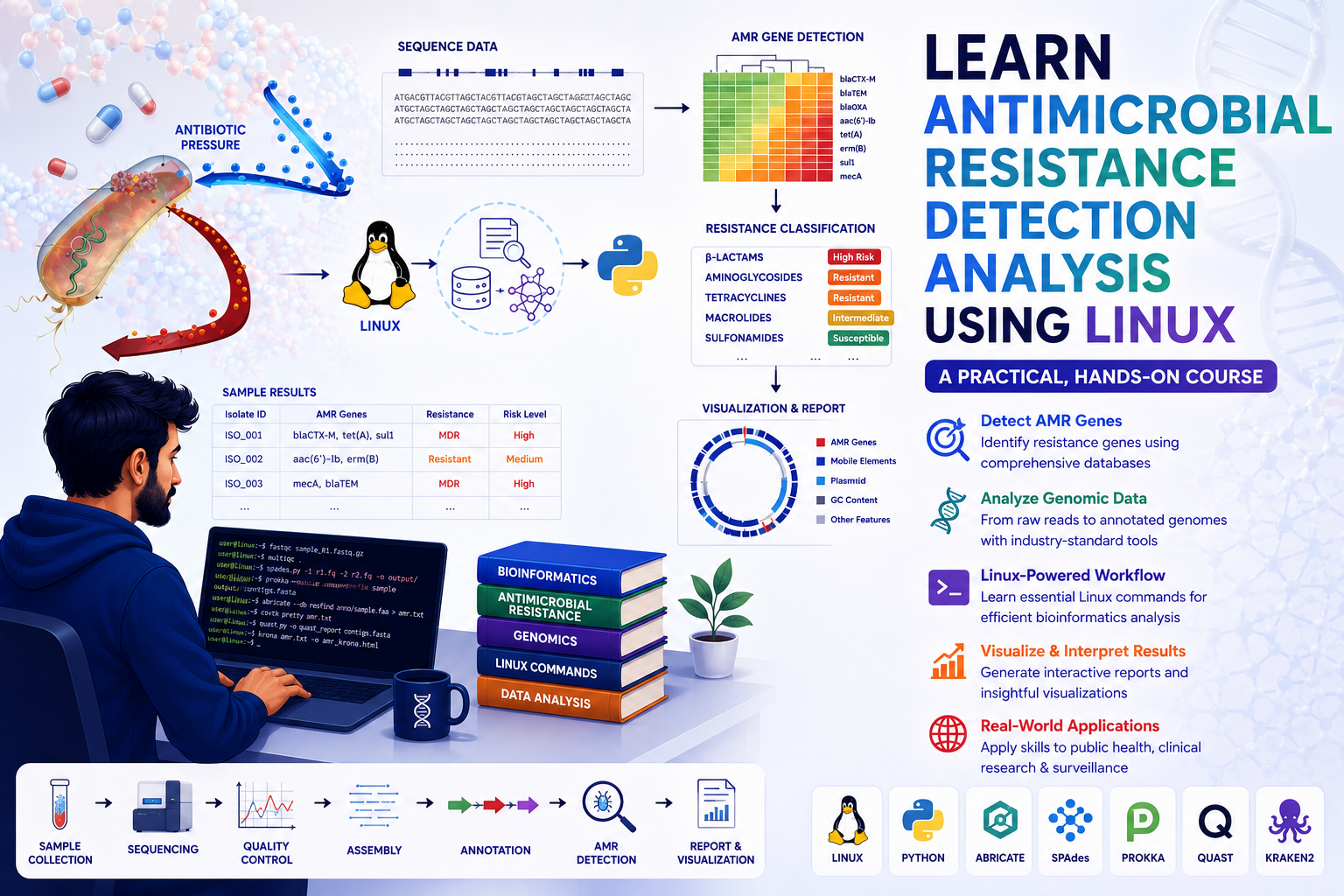
AMR Analysis Course is a comprehensive, hands-on training program designed to teach you how to detect and analyze antimicrobial resistance (AMR) genes using next-generation sequencing (NGS) data, Linux, and modern bioinformatics tools. Whether you’re a student, researcher, microbiologist, or bioinformatician, this course will help you master the complete workflow for identifying antimicrobial resistance genes in bacterial genomes.
Antimicrobial resistance is one of the world’s most significant public health challenges. With the rapid emergence of drug-resistant pathogens, healthcare organizations, researchers, and biotechnology laboratories increasingly rely on AMR analysis to monitor resistance mechanisms, support surveillance programs, and improve treatment strategies. This AMR Analysis Course provides practical training using real sequencing datasets and industry-standard bioinformatics software.
From raw sequencing reads to antimicrobial resistance gene identification and result interpretation, you’ll learn the complete AMR analysis workflow through step-by-step demonstrations and hands-on projects.
What You’ll Learn
By the end of this AMR Analysis Course, you will be able to:
- Understand the principles of antimicrobial resistance and AMR genomics.
- Learn common mechanisms of bacterial antimicrobial resistance.
- Work with bacterial whole-genome sequencing (WGS) datasets.
- Perform quality assessment and preprocessing of sequencing reads.
- Assemble microbial genomes using Linux.
- Detect antimicrobial resistance genes using specialized AMR databases.
- Interpret AMR analysis results and resistance profiles.
- Generate reports for research and surveillance studies.
- Build reproducible AMR analysis pipelines using Linux.
- Apply AMR analysis in clinical, environmental, and public health research.
Course Structure
The course is divided into practical modules covering:
- Introduction to Antimicrobial Resistance
- Linux for AMR Analysis
- Quality Control of Sequencing Data
- Genome Assembly
- AMR Gene Detection
- Resistance Profile Interpretation
- AMR Databases and Bioinformatics Tools
- Hands-On Projects
- Final Assessment
Each module includes video lectures, practical demonstrations, assignments, downloadable datasets, and real-world bacterial genome analysis.
Hands-On Projects
Throughout this AMR Analysis Course, you’ll complete practical projects including:
- Sequencing data quality control
- Bacterial genome assembly
- Antimicrobial resistance gene detection
- Resistance profile analysis
- AMR database searching
- Result interpretation
- Building complete AMR analysis workflows
These projects simulate analyses performed in microbiology laboratories, research institutes, public health organizations, and biotechnology companies.
Software and Tools You’ll Use
Gain hands-on experience with industry-standard bioinformatics tools, including:
- Linux
- FastQC
- Fastp
- SPAdes
- BWA
- Samtools
- CARD (Comprehensive Antibiotic Resistance Database)
- ResFinder
- AMRFinderPlus
- ABRicate
Who Should Enroll?
This course is ideal for:
- Bioinformatics students
- Microbiology students
- Biotechnology students
- Master’s and PhD researchers
- Clinical microbiologists
- Public health researchers
- Computational biologists
- Life science professionals
- Anyone interested in antimicrobial resistance genomics and bacterial genome analysis
No prior AMR analysis experience is required. The course provides step-by-step instruction from the fundamentals to complete antimicrobial resistance detection workflows.
Why Choose This AMR Analysis Course?
- Learn complete antimicrobial resistance detection workflows.
- Analyze real bacterial sequencing datasets.
- Master Linux-based AMR analysis pipelines.
- Work with internationally recognized AMR databases and bioinformatics tools.
- Develop practical skills for microbiology, genomics, biotechnology, and public health research.
- Project-based learning with real-world bacterial genome analysis.
Enroll today and master AMR analysis while learning how to detect antimicrobial resistance genes, interpret resistance profiles, and build professional bioinformatics workflows for microbial genomics and infectious disease research.



Reviews
There are no reviews yet.