Master Metagenomics and Microbiome Data Analysis Using Linux
About Course
Are you ready to unlock the secrets of microbial communities that live inside us and all around us? Whether you’re a life sciences student, a research scientist, or simply curious about the invisible world of microbes, this course will equip you with the essential skills to perform real-world metagenomics and microbiome data analysis using industry-standard tools like QIIME2, Kraken2, Bracken, and Linux-based pipelines.
“Master Metagenomics and Microbiome Data Analysis Using Linux” is a comprehensive, hands-on course designed to take you from raw sequencing data to meaningful biological insights. With a practical approach and clear guidance, this course will help you navigate the complex but exciting world of microbial community profiling using both 16S rRNA gene sequencing and whole-genome shotgun metagenomics.
You will start by understanding the fundamentals of metagenomics, microbiomes, and how they are transforming fields like human health, agriculture, and environmental science. You’ll explore the difference between 16S rRNA sequencing and shotgun sequencing, and learn where and how to access public datasets for your own analysis.
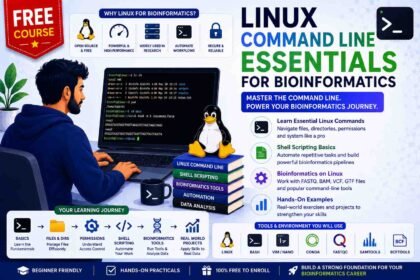
Next, you’ll set up your Linux-based bioinformatics environment, either through WSL (Windows Subsystem for Linux) or VirtualBox, and get comfortable using basic Linux commands that are crucial for data preprocessing, file management, and running bioinformatics tools.
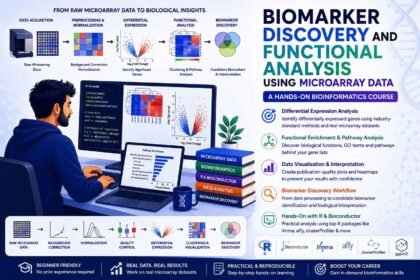
From there, we dive deep into QIIME2, one of the most widely used platforms for microbiome analysis. You’ll learn how to import your sequencing data, perform quality control, denoise reads using DADA2, and generate interactive visualizations. We’ll walk you through computing alpha and beta diversity, taxonomic classification, differential abundance testing, and how to create publication-quality plots that explain microbial community structure and variation.
But we don’t stop at 16S. This course also takes you into the powerful world of shotgun metagenomics using Kraken2, Bracken, and Krona for high-resolution taxonomic classification and microbial abundance estimation. You’ll learn how to download and configure metagenomic databases, classify reads, and visualize your results in interactive formats. These tools are crucial for researchers working in microbiome profiling, diagnostics, drug discovery, and microbial ecology.
Throughout the course, you’ll get access to:
Pre-formatted sample datasets
Scripts and command templates
Metadata files and manifest examples
Hands-on walkthroughs of every step
Visualization tools and interpretation strategies
This course is built for beginners and intermediate learners. You don’t need prior experience in bioinformatics or command-line tools—just a willingness to learn and explore.
By the end of the course, you’ll be able to confidently:
1. Set up a working bioinformatics environment
2. Analyze 16S and shotgun metagenomic datasets
3. Interpret taxonomic and functional profiles
4. Perform diversity and differential abundance analysis
5. Generate high-quality reports and plots
If you’re planning a research project, working in a lab, or aiming to publish microbiome data, this course gives you the technical skills and practical confidence you need.
Join now and become part of a growing community exploring the power of microbiome data in health, environment, and beyond!
Course Content
Course Introduction
Introduction of Course
04:44
Introduction to Metagenomics and Microbiome
Linux Essentials for Bioinformatics
Microbiome Data Analysis Using QIIME 2
Metagenomics Data Analysis Using Kraken2, Bracken and Krona
Final Project & Capstone
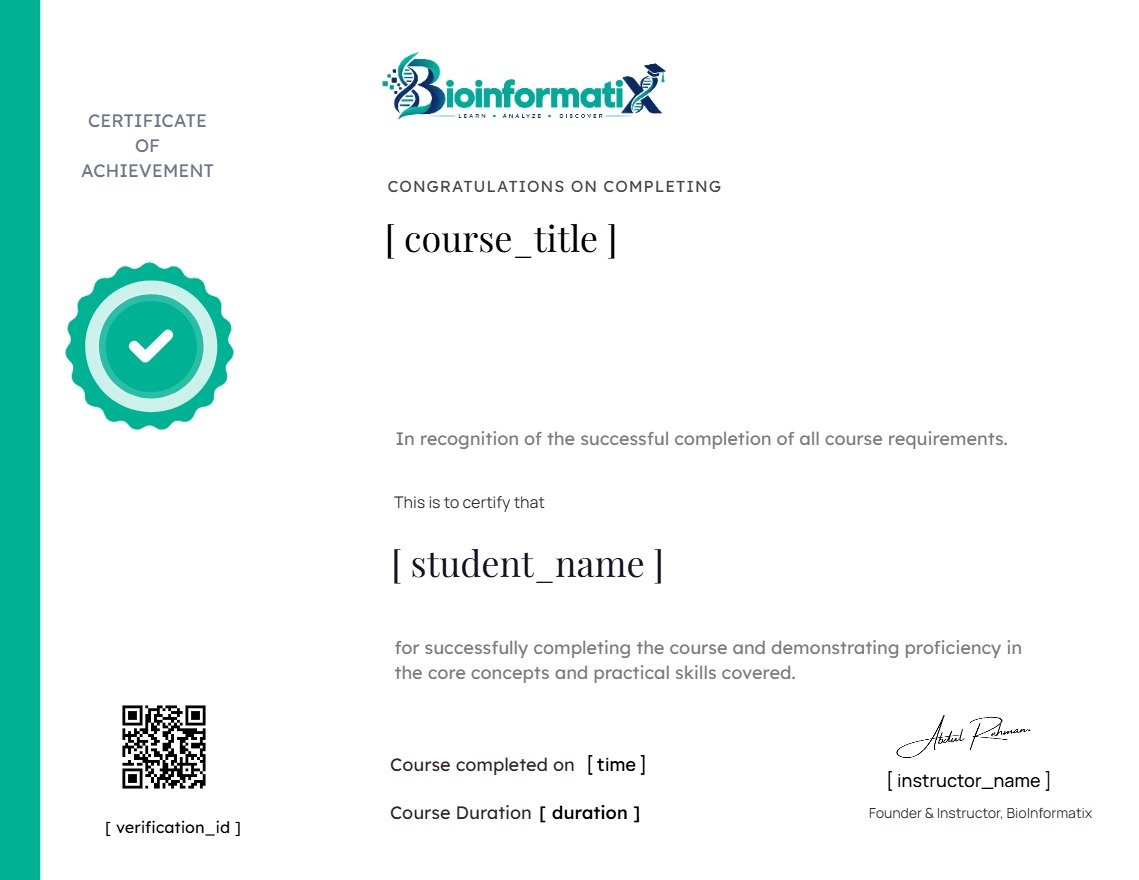
Get Certified in Bioinformatics
Showcase your achievement with a certificate recognized by students and researchers worldwide.
Student Ratings & Reviews

Your Instructor

Abdul Rehman Ikram
Bioinformatician | Data Analyst | Computational BiologistAbdul is a distinguished bioinformatician, data analyst, and computational biologist known for his exceptional contributions to the field of biomedical research. With a passion for integrating technology and biology, Abdul has carved a niche for himself, leveraging cutting-edge computational techniques to unravel complex biological data.
Driven by a curiosity to decode the complexities of life, Abdul believes in the power of interdisciplinary approaches. He is committed to mentoring the next generation of scientists, fostering a culture of innovation and continuous learning.