Learn Bioinformatics from Beginner to Master Through Real World Projects
About Course
Learn Bioinformatics – Beginner to Master Through Projects is a comprehensive and hands-on course designed for anyone looking to delve into the exciting field of bioinformatics. Whether you are a beginner, an intermediate learner, or someone exploring a career switch, this course equips you with the essential knowledge and practical skills to excel in the field. Through real-world projects and step-by-step guidance, you’ll explore the vast landscape of bioinformatics, from foundational concepts to advanced applications.
What Will You Learn?
This course offers a structured and immersive learning experience that covers a wide range of topics:
Foundations of Bioinformatics
Understand what bioinformatics is and its critical role in modern biology.
Explore various subfields like genomics, proteomics, transcriptomics, metabolomics, structural bioinformatics, pharmacogenomics, and computational biology.
Learn about the latest trends and required skills in computational biology.
Data Retrieval from Bioinformatics Databases
Gain proficiency in using key bioinformatics databases, including NCBI, PDB, Uniprot, and GEO.
Learn to retrieve, interpret, and analyze biological data effectively.
Bioinformatics Tools and Programming
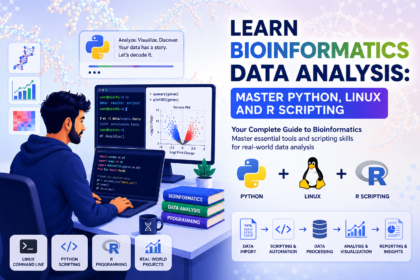
Explore essential tools and programming languages used in bioinformatics, such as Python, R, and Linux commands.
Understand how these tools are applied to solve real-world biological problems.
Sequence Analysis
Master sequence alignment techniques, including pairwise and multiple sequence alignments.
Conduct homology searches using BLAST and interpret the results.
Functional Genomics and Proteomics
Perform gene prediction, genome annotation, and functional enrichment analysis.
Analyze protein motifs, domains, and protein-protein interaction (PPI) networks.
Evolutionary Bioinformatics
Build and interpret phylogenetic trees to explore evolutionary relationships using tools like IQ-TREE and iTOL.
Command-Line Bioinformatics
Develop strong Linux skills to navigate file systems, install tools, and write bash scripts.
Automate bioinformatics workflows for efficient data analysis.
Transcriptomics and RNA-Seq Data Analysis
Analyze transcriptomics data, including microarray datasets.
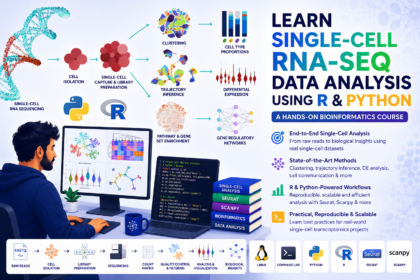
Perform RNA-Seq data retrieval, preprocessing, alignment, and quantification using Linux.
How Is This Course Structured?
The course is divided into 10 sections, each focusing on a specific area of bioinformatics. Each section includes:
Engaging Lectures: Clear and concise explanations of concepts with real-world examples.
Practical Demonstrations: Hands-on tutorials to help you apply what you learn.
Projects: End-of-section projects that reinforce your learning and provide practical experience.
By the end of this course, you’ll complete 10 real-world projects, such as:
Exploring bioinformatics subfields.
Retrieving and analyzing biological data from major databases.
Conducting sequence alignments and phylogenetic analysis.
Performing genome annotation, gene prediction, and functional enrichment.
Analyzing transcriptomics and RNA-Seq data.
Who Should Take This Course?
This course is designed for:
Beginners and intermediate learners in bioinformatics.
Students and researchers in biology, biotechnology, or related fields.
Professionals exploring a career switch into bioinformatics.
Programmers and data analysts interested in applying their skills to biological data.
Anyone passionate about learning bioinformatics through hands-on projects.
Why Choose This Course?
Practical Approach: Learn bioinformatics through 10 real-world projects and practical demonstrations.
Comprehensive Content: Gain expertise in various aspects of bioinformatics, including genomics, proteomics, transcriptomics, and more.
Beginner-Friendly: Minimal prerequisites and step-by-step guidance make this course accessible to everyone.
Career-Oriented: Acquire skills that are highly sought after in the bioinformatics industry.
What Do You Need to Start?
All you need is a computer, an interest in biology, and a desire to learn. No prior experience in bioinformatics or programming is required—we’ll guide you every step of the way.
Enroll now and start your journey toward becoming a bioinformatics expert. Unlock the power of biological data and solve real-world challenges with confidence!
Course Content
Introduction to Bioinformatics and Subfields
Introduction to Bioinformatics and Subfields
06:13Genomics
03:23Proteomics
02:31Transcriptomics
03:10Metabolomics
02:44Structural Bioinformatics
02:38Pharmacogenomics
03:01Computational Biology
02:42Other Subfields of Bioinformatics
06:25Trends in Computational Biology
02:58Skills Needed for Bioinformatics Field
03:49Project 1: Bioinformatics Fields
Bioinformatics Databases and Data Retrieval
Bioinformatics Tools and Programming Languages
Sequence Analysis
Functional Genomics
Proteomics
Evolutionary Bioinformatics
Command Line Bioinformatics
Transcriptomics
RNA-Seq Data Analysis
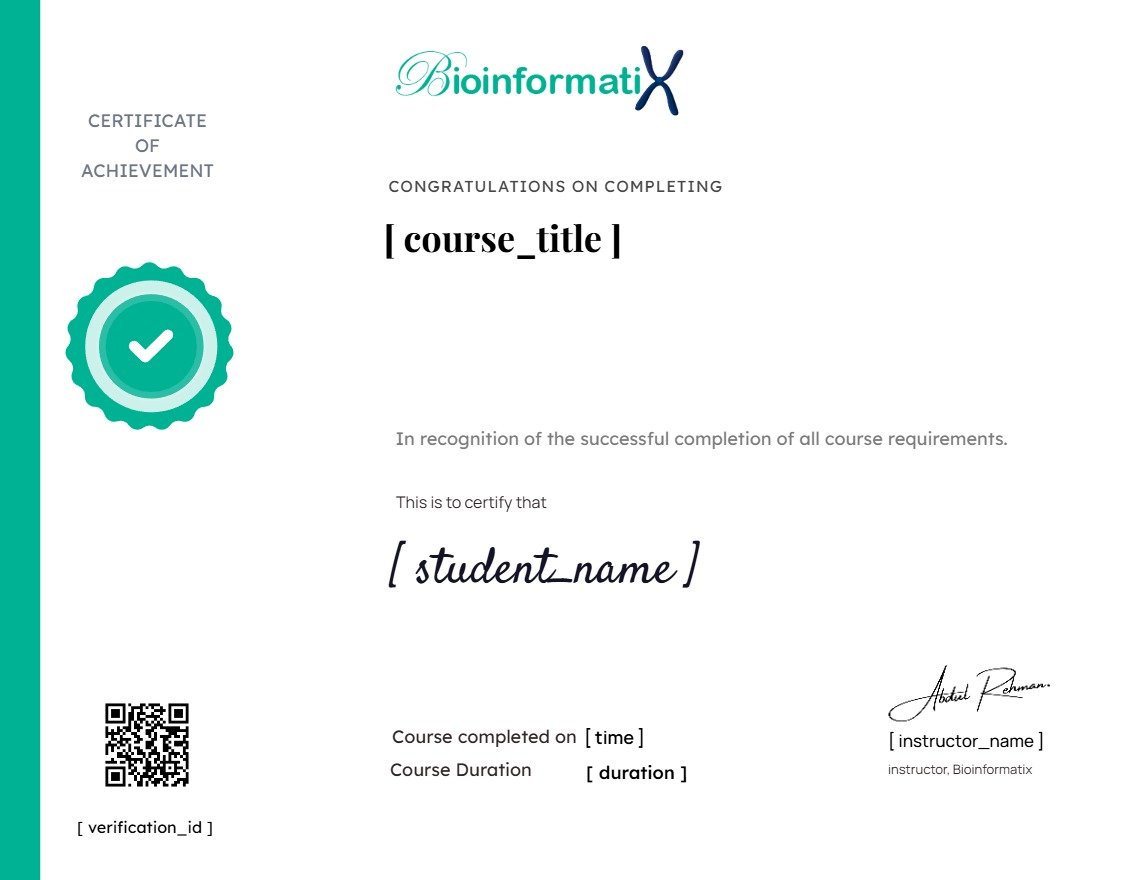
Get Certified in Bioinformatics
Showcase your achievement with a certificate recognized by students and researchers worldwide.
Student Ratings & Reviews

Your Instructor

Abdul Rehman Ikram
Bioinformatician | Data Analyst | Computational BiologistAbdul is a distinguished bioinformatician, data analyst, and computational biologist known for his exceptional contributions to the field of biomedical research. With a passion for integrating technology and biology, Abdul has carved a niche for himself, leveraging cutting-edge computational techniques to unravel complex biological data.
Driven by a curiosity to decode the complexities of life, Abdul believes in the power of interdisciplinary approaches. He is committed to mentoring the next generation of scientists, fostering a culture of innovation and continuous learning.