Learn Variant Calling NGS Data Analysis: A Hands-on Bioinformatics Course
About Course
Become a Variant Calling Pro Using Linux and R – No Prior Experience Needed!
Unlock the secrets of the genome with hands-on training in variant calling! This course gives you practical skills to analyze next-generation sequencing (NGS) data using industry-standard tools like FreeBayes, Samtools, and R, all within a Linux environment. Whether you’re a student, researcher, or clinician, this course empowers you to process FASTQ data, perform variant calling, visualize VCFs, and extract biological insights using open-source pipelines.
What You’ll Learn:
Linux for Bioinformatics: Learn essential commands and file systems for data handling and tool usage.
NGS Variant Calling Basics: Understand confidence, quality metrics, and key concepts in variant analysis.
Pipeline Setup: Download datasets, prepare your analysis environment, and index genomes.
Data Preprocessing: Run FastQC, trim reads, align with BWA, and prepare BAM files.
Variant Calling with FreeBayes: Perform SNP and indel calling and filter low-quality variants.
Visualization and Interpretation: View variants in IGV and interpret biological impact.
R for Genomic Analysis: Set up R and use it to explore and visualize variant data.
Assignments and Quizzes: Test your knowledge with assessments after each section.
Who This Course Is For:
Biology & Medical Students: Learn NGS data analysis without needing advanced programming.
Researchers & Clinicians: Build reproducible pipelines for cancer genomics, rare diseases, and more.
Bioinformatics Enthusiasts: Transition into genomics with a complete beginner-to-advanced course.
Professionals in Biotech & Pharma: Strengthen your role in precision medicine and diagnostics.
Course Features:
Hands-on projects and real datasets
Assignments and quizzes after each section
Downloadable scripts and guides
Lifetime access and certificate of completion
No coding experience needed – just your interest in genomics and bioinformatics!
Course Content
Course Introduction
Introduction of Course
04:21
Basic Linux For Bioinformatics
Introduction to Variant Calling
Preparing the Environment
Data Preprocessing and Alignment
Variant Calling and Filtering Using Freebayes
R and R Studio
Variant Visualization and Interpretation
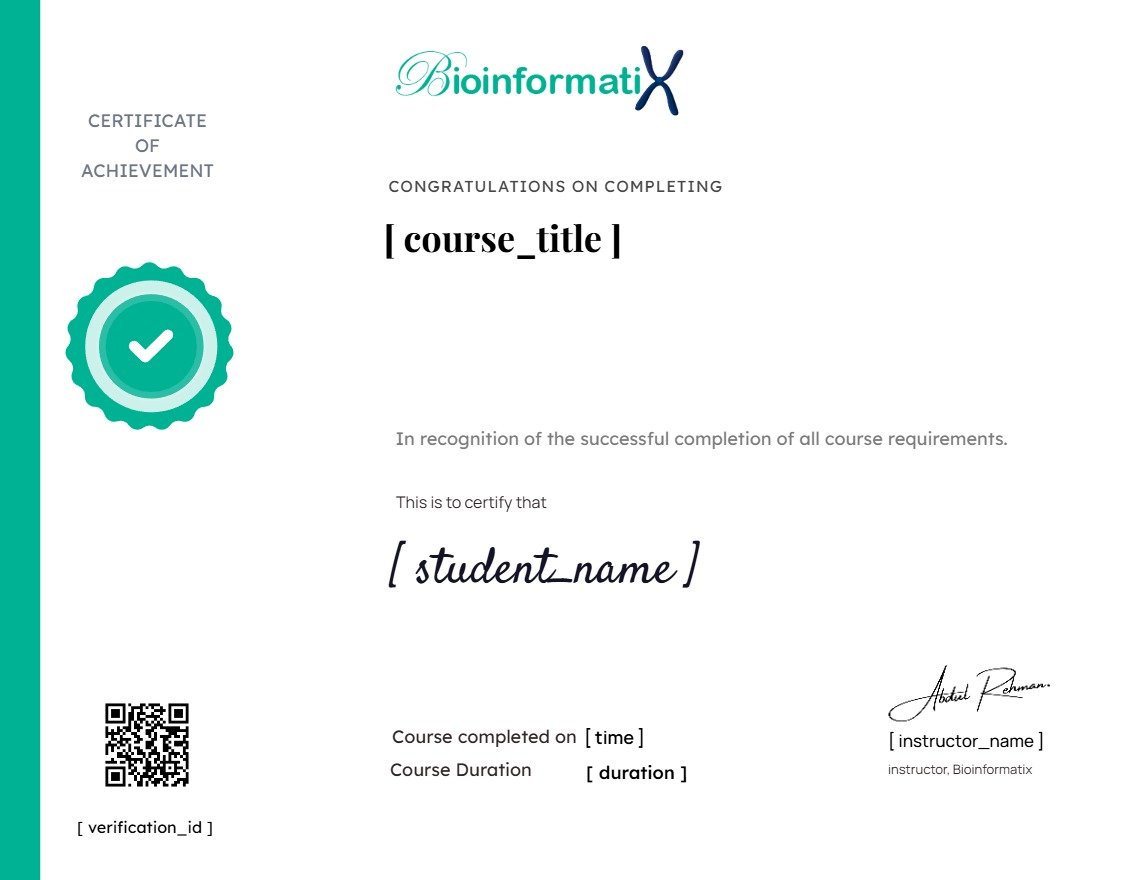
Get Certified in Bioinformatics
Showcase your achievement with a certificate recognized by students and researchers worldwide.
Student Ratings & Reviews

Your Instructor

Abdul Rehman Ikram
Bioinformatician | Data Analyst | Computational BiologistAbdul is a distinguished bioinformatician, data analyst, and computational biologist known for his exceptional contributions to the field of biomedical research. With a passion for integrating technology and biology, Abdul has carved a niche for himself, leveraging cutting-edge computational techniques to unravel complex biological data.
Driven by a curiosity to decode the complexities of life, Abdul believes in the power of interdisciplinary approaches. He is committed to mentoring the next generation of scientists, fostering a culture of innovation and continuous learning.