Description
Machine Learning Bioinformatics Course: Master AI for Biological Data Analysis
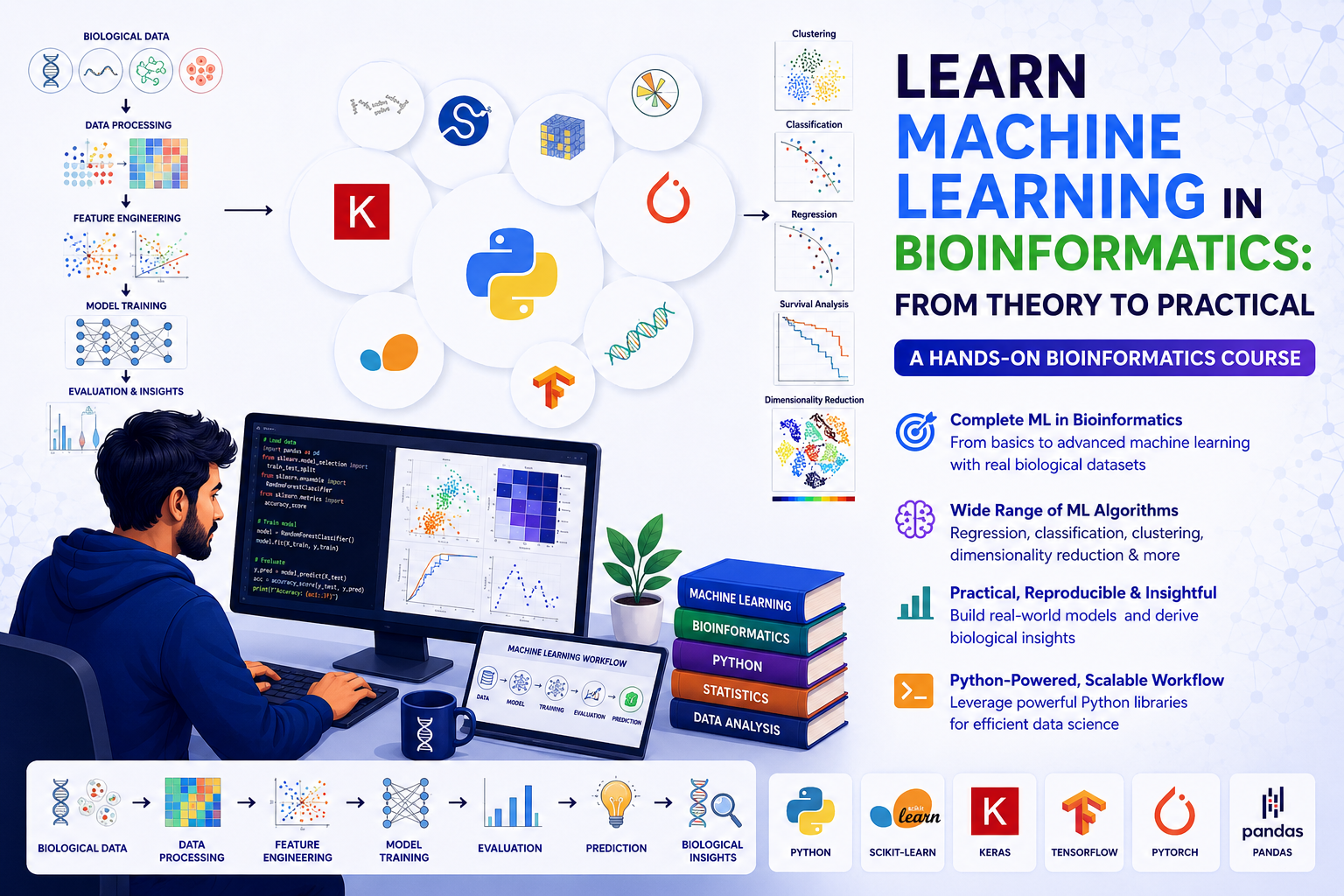
Machine Learning Bioinformatics Course is a comprehensive, hands-on training program designed to teach you how artificial intelligence and machine learning are transforming bioinformatics, genomics, healthcare, and life sciences. Whether you’re a student, researcher, bioinformatician, or data scientist, this course will help you build practical machine learning skills using real biological datasets and modern computational techniques.
Machine learning has become an essential part of bioinformatics, enabling researchers to predict protein functions, classify biological samples, identify disease biomarkers, analyze gene expression, discover drug targets, and interpret complex genomic data. This Machine Learning Bioinformatics Course provides step-by-step guidance from fundamental machine learning concepts to practical implementation using Python and popular machine learning libraries.
Through hands-on projects, you’ll learn how to prepare biological datasets, build predictive models, evaluate performance, and apply machine learning algorithms to real-world bioinformatics problems.
What You’ll Learn
By the end of this Machine Learning Bioinformatics Course, you will be able to:
- Understand the fundamentals of machine learning and artificial intelligence.
- Learn supervised and unsupervised learning techniques.
- Prepare and preprocess biological datasets for machine learning.
- Build classification and regression models using Python.
- Perform clustering analysis for biological data.
- Apply machine learning to genomics, transcriptomics, and proteomics datasets.
- Evaluate model performance using standard metrics.
- Reduce data dimensionality for high-throughput biological data.
- Interpret machine learning results for biological research.
- Develop practical AI workflows for bioinformatics applications.
Course Structure
The course is organized into practical modules covering:
- Introduction to Machine Learning and AI
- Python for Machine Learning
- Data Preparation and Feature Engineering
- Supervised Learning Algorithms
- Unsupervised Learning Algorithms
- Model Evaluation and Validation
- Machine Learning Applications in Bioinformatics
- Hands-On Projects
- Final Assessment
Each module includes video lectures, coding demonstrations, practical exercises, assignments, and real-world case studies.
Hands-On Projects
Throughout this Machine Learning Bioinformatics Course, you’ll complete practical projects such as:
- Predictive modeling using biological datasets
- Gene expression classification
- Protein function prediction
- Biological data clustering
- Feature selection for genomics
- Disease prediction models
- Machine learning workflow development
- Model performance evaluation
These projects provide practical experience with AI techniques used in modern bioinformatics research and biotechnology.
Software and Tools You’ll Use
Gain hands-on experience with widely used machine learning and bioinformatics tools, including:
- Python
- Jupyter Notebook
- NumPy
- Pandas
- Scikit-learn
- Matplotlib
- TensorFlow (Introduction)
- BioPython
- Google Colab
Who Should Enroll?
This course is ideal for:
- Bioinformatics students
- Biotechnology students
- Computational biology researchers
- Data scientists entering life sciences
- Master’s and PhD students
- Healthcare researchers
- AI enthusiasts interested in biology
- Anyone who wants to apply machine learning to biological data
Basic Python knowledge is helpful but not required, as programming concepts are explained throughout the course.
Why Choose This Machine Learning Bioinformatics Course?
- Learn machine learning through real bioinformatics applications.
- Build AI models using biological datasets.
- Master supervised and unsupervised learning techniques.
- Gain hands-on experience with Python and Scikit-learn.
- Develop practical skills for genomics, precision medicine, biotechnology, and computational biology.
- Project-based learning with real-world biological case studies.
Enroll today and master machine learning for bioinformatics while developing practical AI skills for genomics, transcriptomics, proteomics, precision medicine, and life science research.
Reviews
There are no reviews yet.