
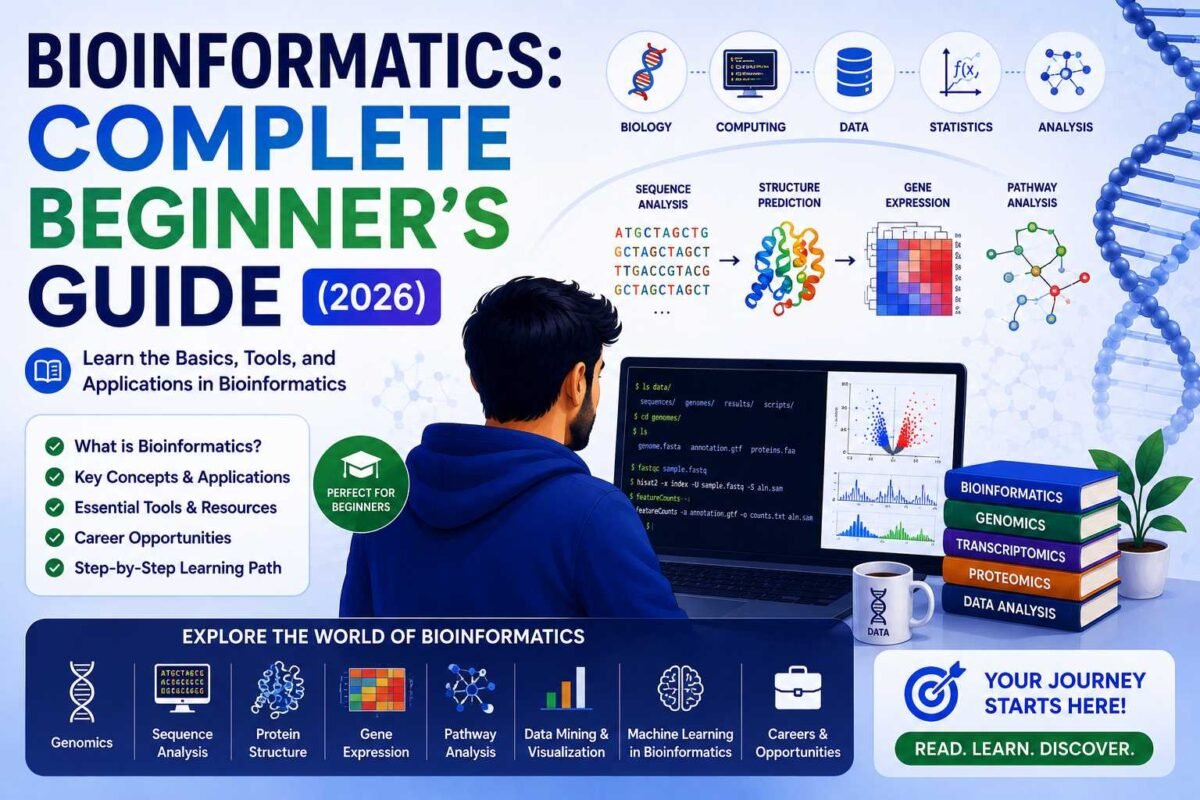
The field of bioinformatics has become one of the fastest-growing disciplines in modern science. With advances in genomics, artificial intelligence, precision medicine, and next-generation sequencing (NGS), the demand for professionals who can analyze biological data continues to increase worldwide.
If you’re wondering how to start learning bioinformatics in 2026, you’re not alone. Whether you’re a biology student, computer science graduate, biotechnology researcher, or someone looking to transition into computational biology, this guide will provide a clear roadmap to help you get started.
What Is Bioinformatics?
Bioinformatics is an interdisciplinary field that combines biology, computer science, mathematics, and statistics to analyze and interpret biological data. It enables researchers to study DNA, RNA, proteins, and entire genomes using computational tools.
Today, bioinformatics plays a critical role in:
- Disease diagnosis
- Drug discovery
- Cancer research
- Agriculture and crop improvement
- Personalized medicine
- Evolutionary biology
- Microbiome research
If you’re completely new to the field, you may also want to read our comprehensive guide on What Is Bioinformatics?, where we explain the fundamentals in detail.
Why Learn Bioinformatics?
The explosion of biological data has created a growing need for professionals who can analyze and interpret complex datasets.
Learning bioinformatics can open doors to careers in:
- Biotechnology companies
- Pharmaceutical industries
- Hospitals and diagnostic laboratories
- Universities and research institutes
- Government organizations
- Agricultural research centers
Because bioinformatics combines multiple disciplines, professionals in this field often enjoy diverse career opportunities and continuous learning.
Step 1: Build a Strong Foundation in Biology
You don’t need to be an expert biologist, but understanding the basics is essential.
Focus on learning:
- Cell Biology
- Molecular Biology
- Genetics
- DNA and RNA Structure
- Protein Synthesis
- Evolution
These concepts will help you understand the biological significance of the data you’ll analyze later.
Step 2: Learn Linux
Linux is one of the most important operating systems in bioinformatics because most bioinformatics software is designed to run in Linux environments.
Essential Linux skills include:
- File management
- Directory navigation
- Shell commands
- Permissions
- Bash scripting
- Installing software
If you’re using Windows, you can install Windows Subsystem for Linux (WSL) to practice Linux without changing your operating system.
Step 3: Learn Python Programming
Python is considered the most beginner-friendly programming language for bioinformatics.
Some important Python topics include:
- Variables
- Data types
- Loops
- Functions
- Lists and dictionaries
- File handling
- Object-oriented programming
Eventually, you’ll use Python to:
- Process FASTA and FASTQ files
- Automate repetitive tasks
- Analyze sequencing data
- Visualize biological datasets
Step 4: Learn Statistics
Bioinformatics relies heavily on statistics.
Key topics include:
- Probability
- Hypothesis testing
- p-values
- Correlation
- Regression
- Data visualization
These concepts become especially important when analyzing RNA-Seq and microarray datasets.
Step 5: Understand Biological Databases
Modern bioinformatics revolves around publicly available databases.
Some of the most commonly used databases include:
- NCBI
- GenBank
- UniProt
- Ensembl
- Protein Data Bank (PDB)
- GEO (Gene Expression Omnibus)
Learning how to retrieve and interpret biological data from these databases is a fundamental skill.
Step 6: Learn Core Bioinformatics Tools
After building your foundation, start working with commonly used software.
Examples include:
- BLAST
- Clustal Omega
- MUSCLE
- MAFFT
- MEGA
- Galaxy
- IGV
- Cytoscape
These tools are widely used for sequence analysis, phylogenetics, genome analysis, and network visualization.
Step 7: Learn Next-Generation Sequencing (NGS)
NGS has revolutionized biological research.
Topics you should learn include:
- FASTQ files
- Quality control
- Read trimming
- Sequence alignment
- Variant calling
- RNA-Seq analysis
- Differential gene expression
- Functional enrichment analysis
These skills are highly valued in both academia and industry.
Step 8: Work on Real-World Projects
One of the best ways to learn bioinformatics is by solving real biological problems.
Project ideas include:
- DNA sequence analysis
- Genome annotation
- RNA-Seq differential expression analysis
- Protein structure prediction
- Phylogenetic tree construction
- Biomarker discovery
- Functional enrichment analysis
Building a portfolio of projects will strengthen your resume and improve your job prospects.
Step 9: Learn Version Control
As your projects become more advanced, you’ll want to organize and share your code.
Git and GitHub allow you to:
- Track code changes
- Collaborate with others
- Build a professional portfolio
- Showcase your bioinformatics projects
Many employers value candidates with an active GitHub profile.
Step 10: Keep Learning Emerging Technologies
Bioinformatics is evolving rapidly.
Stay updated with topics such as:
- Artificial Intelligence
- Machine Learning
- AlphaFold
- Single-cell RNA sequencing
- Multi-omics
- Spatial transcriptomics
- Precision medicine
Keeping up with new technologies will help you remain competitive in the field.
Common Mistakes Beginners Make
Many beginners struggle because they:
- Try to learn everything at once.
- Skip biology fundamentals.
- Avoid programming.
- Focus only on theory without practical projects.
- Don’t practice Linux.
- Ignore statistics.
Instead, learn step by step and spend time practicing with real datasets.
Recommended Learning Path
A simple roadmap could look like this:
- Learn basic biology.
- Learn Linux.
- Learn Python.
- Study statistics.
- Explore biological databases.
- Learn sequence analysis tools.
- Practice NGS workflows.
- Complete real-world projects.
- Build a GitHub portfolio.
- Continue learning advanced topics like AI and multi-omics.
Following this roadmap will give you a strong foundation and prepare you for more advanced bioinformatics work.
Learn Bioinformatics Through Hands-On Projects
Reading blogs is an excellent way to understand concepts, but practical experience is what truly builds confidence.
If you’re looking for a structured learning path, our Learn Bioinformatics: Beginner to Master Through Real-World Projects course provides step-by-step training with practical exercises, real datasets, and industry-relevant projects. You can explore the course here Learn Bioinformatics: Beginner to Master Through Real-World Projects
Whether you’re a student, researcher, or professional, the course is designed to help you develop practical bioinformatics skills that can be applied in academic research and industry.
Final Thoughts
Bioinformatics is one of the most exciting and impactful fields in modern science. By combining biology, programming, and data analysis, it enables researchers to solve complex biological problems and drive discoveries in medicine, agriculture, and biotechnology.
The journey may seem challenging at first, but by following a structured roadmap and practicing consistently, you can build valuable skills and open the door to a rewarding career.
Remember, every expert bioinformatician started as a beginner. Start with the basics, work on real-world projects, and continue learning as the field evolves. Your bioinformatics journey starts today.