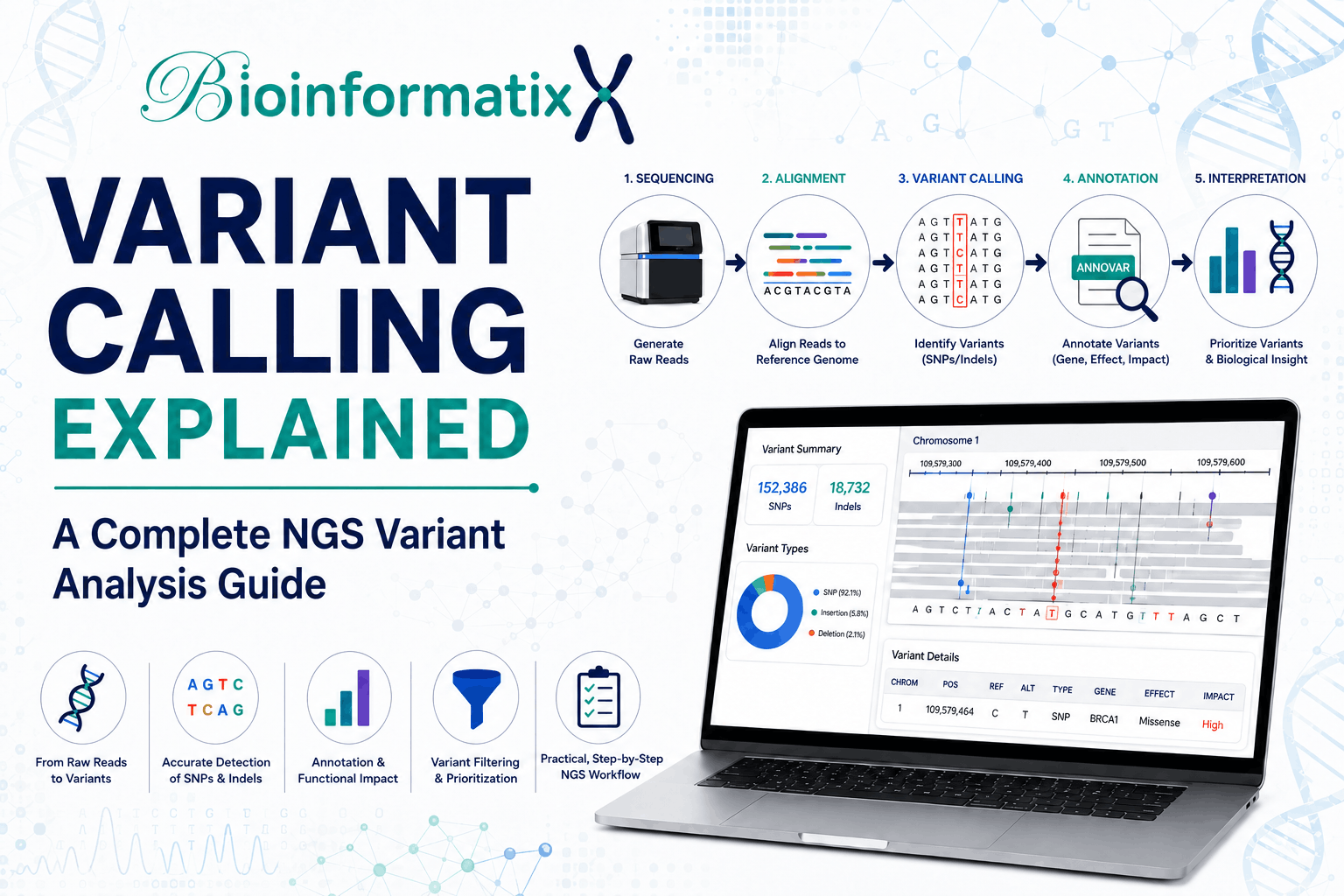
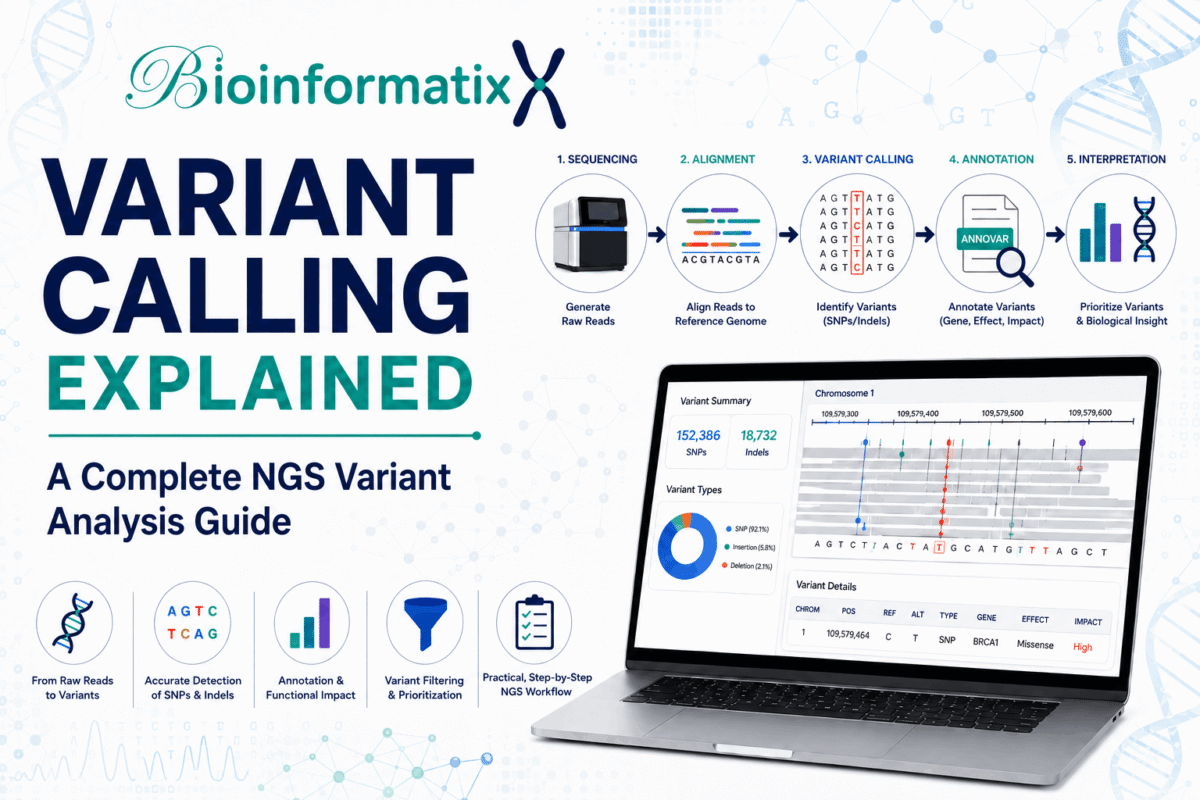
Variant calling is one of the most important applications of next-generation sequencing (NGS). It allows researchers to identify positions where the DNA sequence of an individual, tumor, microorganism, plant, or other biological sample differs from a reference genome.
Starting with millions of sequencing reads, a variant-calling workflow can identify single nucleotide variants, insertions, deletions, and—with specialized methods—larger genomic alterations. The resulting variants can then be filtered, annotated, prioritized, and interpreted for applications ranging from rare-disease research and cancer genomics to population genetics and microbial genomomics.
For aspiring NGS data analysts, variant calling is a particularly valuable skill because it combines many fundamental bioinformatics concepts:
- FASTQ quality control
- Reference genomes
- Read alignment
- SAM and BAM processing
- Sequencing depth
- Variant detection
- VCF and BCF files
- Variant filtering
- Functional annotation
- Biological interpretation
In this complete beginner’s guide, you will learn what variant calling is, how a typical NGS variant-calling pipeline works, the difference between germline and somatic variants, how tools such as GATK and BCFtools are used, and how to progress from raw FASTQ reads to an annotated VCF.
If you are completely new to sequencing, first read our What Is Next-Generation Sequencing (NGS)? Complete Beginner’s Guide.
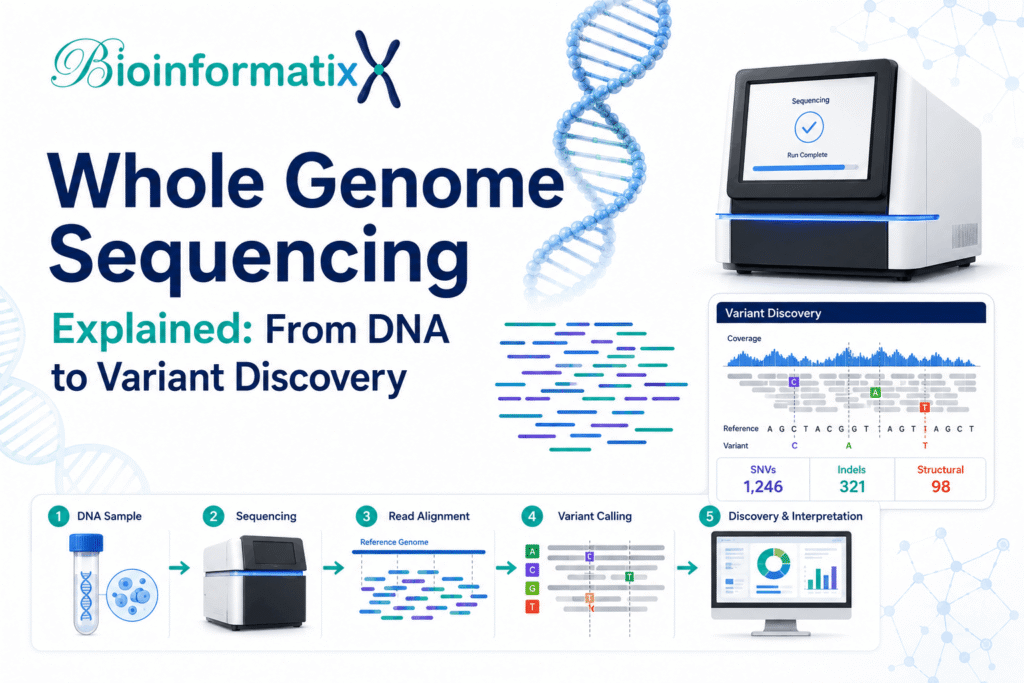
For the broader genomic workflow surrounding variant discovery, also read Whole Genome Sequencing Explained: From DNA to Variant Discovery.
What Is Variant Calling?
Variant calling is the computational process of identifying differences between sequencing data from a sample and a reference sequence.
Imagine that the reference genome contains:
Reference: A C G T C A G T
but sequencing evidence from your sample consistently supports:
Sample: A C G T T A G T
At one genomic position, the reference contains:
C
while the sample contains:
T
A variant caller evaluates the sequencing evidence and determines whether this difference is sufficiently supported to report as a candidate genetic variant.
The process is more complicated than simply comparing letters because real sequencing datasets contain:
- Sequencing errors
- Mapping errors
- Duplicate reads
- Repetitive genomic regions
- Uneven coverage
- Heterozygous genotypes
- Multiple alleles
- Technology-specific biases
Modern variant callers therefore use statistical or probabilistic models to distinguish likely biological variation from technical noise.
The GATK Best Practices workflows provide established workflows for several categories of genomic variant discovery, including germline and somatic analyses.
Why Is Variant Calling Important?
Genomes from different individuals are not identical.
Variant calling allows researchers to identify these differences and investigate whether they are associated with:
- Disease
- Drug response
- Phenotypic variation
- Evolution
- Population structure
- Cancer
- Microbial adaptation
- Antimicrobial resistance
- Agricultural traits
Applications include:
Rare Disease Research
Researchers can identify candidate variants that may contribute to inherited disorders.
Cancer Genomics
Tumor sequencing can reveal acquired somatic mutations.
Population Genomics
Variants across many individuals can be used to investigate population diversity and evolutionary history.
Pharmacogenomics
Genetic variants may influence how individuals metabolize or respond to drugs.
Microbial Genomics
Variant calling can help compare bacterial or viral isolates.
Plant and Agricultural Genomics
Researchers can identify polymorphisms associated with traits such as disease resistance, yield, or environmental adaptation.
Variant Calling Explained: The Core Concept
The simplest conceptual workflow is:
Sequencing Reads
↓
Reference Genome
↓
Read Alignment
↓
Evidence of Differences
↓
Variant Calling
↓
Candidate Variants
↓
Filtering
↓
Annotation
↓
Biological Interpretation
In practice, the workflow normally involves several intermediate file formats and quality-control stages.
A more realistic NGS pipeline is:
FASTQ
↓
Quality Control
↓
Read Alignment
↓
SAM/BAM
↓
BAM Processing
↓
Variant Calling
↓
VCF/BCF
↓
Variant Filtering
↓
Variant Annotation
↓
Variant Prioritization
↓
Biological Interpretation
GATK describes preprocessing as the phase that transforms raw sequencing data into analysis-ready alignment files before variant discovery.
What Types of Variants Can Be Detected?
Variant calling is not limited to one type of genomic change.
Different tools and analytical strategies detect different classes of variants.
Single Nucleotide Variants
A single nucleotide variant, or SNV, occurs when one nucleotide differs from the reference.
For example:
Reference: A
Sample:    G
The genomic sequence has changed from A to G at one position.
SNVs are among the most commonly analyzed variants in NGS datasets.
SNP vs SNV
The terms SNP and SNV are sometimes used interchangeably, but they are not exactly identical.
SNV describes a single-nucleotide difference.
SNP, or single nucleotide polymorphism, generally refers to a single-nucleotide variant recognized as polymorphic within a population.
For practical variant-calling workflows, you will often see both terms.
Insertions
An insertion occurs when additional nucleotides are present relative to the reference.
For example:
Reference: A C T G
Sample:    A C A A T G
Here, additional bases have been inserted.
Deletions
A deletion occurs when nucleotides present in the reference are absent from the sample.
Example:
Reference: A C A A T G
Sample:    A C T G
Indels
Small insertions and deletions are collectively referred to as:
indels
Variant callers such as GATK HaplotypeCaller are designed to identify SNPs and small indels through local haplotype reconstruction around candidate regions.
Structural Variants
Structural variants usually involve larger genomic rearrangements.
Examples include:
- Large deletions
- Large insertions
- Duplications
- Inversions
- Translocations
- Complex rearrangements
Structural variant detection often requires different algorithms from standard short-variant calling.
GATK, for example, provides separate workflows for structural variation discovery in addition to its short-variant workflows.
Copy Number Variants
Copy number variants, or CNVs, occur when genomic regions are present in different numbers of copies.
For example:
Typical diploid state:
2 copies

Deletion:
1 copy

Duplication:
3 or more copies
CNVs can be particularly important in:
- Cancer
- Developmental disorders
- Rare disease
- Population genetics
Germline vs Somatic Variant Calling
One of the most important distinctions in variant calling is whether you are studying germline or somatic variation.
These analyses answer different questions and often use different computational workflows.
Germline Variant Calling
Germline variants are part of an individual’s inherited or constitutional genome and can potentially be transmitted between generations.
The National Cancer Institute describes germline genetic material as the genetic information associated with reproductive-cell lineage and inheritance. (NCI germline definition)
Germline variant calling is commonly used in:
- Rare genetic disease
- Mendelian genetics
- Population genomics
- Family studies
- Pharmacogenomics
A simplified germline workflow is:
Patient FASTQ
↓
Alignment
↓
BAM
↓
Germline Variant Calling
↓
VCF
↓
Filtering
↓
Annotation
↓
Candidate Variant Prioritization
Somatic Variant Calling
Somatic variants arise in cells during an individual’s lifetime.
They are especially important in cancer genomics.
A typical cancer study may compare:
Tumor Sample
vs
Matched Normal Sample
The objective is to identify candidate mutations present in the tumor but absent from the normal constitutional genome.
Somatic analysis can be challenging because tumors may contain:
- Normal-cell contamination
- Multiple tumor subclones
- Variable tumor purity
- Copy-number alterations
- Low-frequency mutations
Therefore, germline and somatic variant-calling workflows should not be treated as interchangeable.
Variant Calling Workflow: From FASTQ to VCF
Let’s examine a typical short-read reference-based variant-calling workflow step by step.
Step 1: Obtain the Sequencing Data
Variant calling typically begins with FASTQ files.
For paired-end sequencing:
Sample01_R1.fastq.gz
Sample01_R2.fastq.gz
FASTQ stores:
- Read identifier
- Nucleotide sequence
- Separator
- Per-base quality scores
Public sequencing data can be obtained from repositories such as the NCBI Sequence Read Archive.
Our GEO Database Tutorial & SRA Database Guide explains how to identify studies, retrieve SRR accessions, and download public sequencing data.
BioInformatix also includes practical public-data retrieval inside the Learn Variant Calling NGS Data Analysis course.
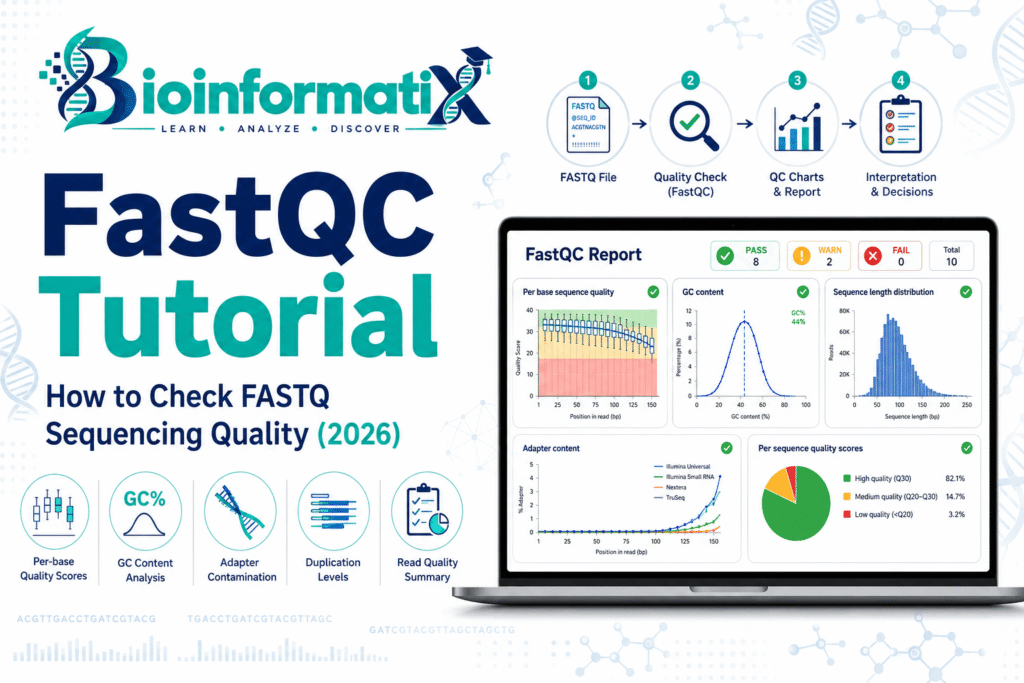
Step 2: Perform FASTQ Quality Control
Raw sequencing data should be evaluated before alignment.
Common quality metrics include:
- Per-base sequence quality
- GC content
- Adapter contamination
- Sequence duplication
- Read length
- Overrepresented sequences
- Low-quality bases
Common tools include:
- FastQC
- MultiQC
- fastp
Quality control helps determine whether preprocessing is required.
A simplified workflow is:
Raw FASTQ
↓
FastQC
↓
Evaluate Read Quality
↓
Trim or Filter if Necessary
↓
Recheck Quality
Skipping quality control can make downstream troubleshooting much harder.
Step 3: Read Trimming and Filtering
Depending on sequencing quality, preprocessing may remove:
- Adapter sequences
- Low-quality bases
- Very short reads
- Technical contaminants
Common tools include:
- fastp
- Cutadapt
- Trimmomatic
Do not trim reads blindly.
Aggressive preprocessing can remove useful sequence information and potentially reduce alignment performance.
Use your QC results to guide the decision.
Step 4: Choose the Correct Reference Genome
Reference-based variant calling requires a reference genome.
For human data, commonly encountered assemblies include:
- GRCh37
- GRCh38
The reference FASTA might look like:
GRCh38.fa
The reference assembly must remain consistent throughout the analysis.
Do not directly combine:
GRCh38 BAM
with:
GRCh37 variant resources
because genomic coordinates differ between assemblies.
Your:
- FASTA
- BAM
- VCF
- BED
- Annotation files
- Population resources
must be compatible with the selected reference assembly.
Read our Ensembl Genome Browser Guide for a detailed explanation of genome assemblies, transcripts, and genomic coordinates.
Step 5: Align Sequencing Reads
Sequencing reads must normally be mapped to the reference genome before conventional reference-based variant calling.
For short-read DNA sequencing, BWA is commonly used.
Conceptually:
FASTQ
Reference FASTA
↓
Read Alignment
↓
SAM/BAM
The aligner determines the most likely genomic origin of each sequencing read.
Why Alignment Quality Matters for Variant Calling
Imagine a read contains a nucleotide that differs from the reference.
That difference could represent:
- A true biological variant
- A sequencing error
- A read mapped to the wrong genomic location
Variant calling therefore depends heavily on reliable alignment.
Important alignment characteristics include:
- Mapping quality
- Correct read pairing
- Coverage
- Duplicate rate
- Insert size
Poor alignment can create false variants or hide real ones.
Step 6: Convert and Process SAM/BAM Files
Read alignment produces SAM or BAM files.
SAM
SAM is a text-based alignment format.
BAM
BAM is the compressed binary representation of SAM.
A common processing workflow is:
SAM
↓
BAM
↓
Sorted BAM
↓
Indexed BAM
SAMtools is widely used for alignment-file manipulation.
Common operations include:
- Viewing alignments
- Converting SAM/BAM
- Sorting
- Indexing
- Filtering
- Calculating alignment statistics
Step 7: Prepare Analysis-Ready BAM Files
Variant-calling pipelines may require additional preprocessing depending on the chosen workflow.
These steps can include:
- Coordinate sorting
- Read-group assignment
- Duplicate marking
- Base-quality processing
- Alignment-quality assessment
GATK specifically describes preprocessing as transforming raw sequence data into analysis-ready BAM files before variant discovery.
The exact preprocessing steps should match:
- Sequencing technology
- Library protocol
- Variant caller
- Variant type
- Experimental design
Step 8: Run the Variant Caller
Once an appropriate alignment is available, the variant caller evaluates sequencing evidence across the genome.
Several variant callers are available.
Common examples include:
- GATK HaplotypeCaller
- BCFtools
- FreeBayes
- DeepVariant
Different tools use different algorithms, so outputs will not always be identical.
Variant Calling with GATK
The Genome Analysis Toolkit (GATK) provides widely used workflows for genomic variant discovery.
For germline SNP and indel discovery, a central tool is:
HaplotypeCaller
Rather than evaluating every genomic base independently using only a simple pileup, HaplotypeCaller identifies candidate regions and performs local haplotype reconstruction before assigning genotype likelihoods. GATK maintains Best Practices workflows for germline short-variant discovery in whole-genome and exome data.
A simplified workflow is:
Analysis-ready BAM
↓
HaplotypeCaller
↓
Variant output
For multi-sample cohorts, GATK workflows can use intermediate genomic VCF outputs before joint genotyping.
What Is a gVCF?
A gVCF, or genomic VCF, contains information about both variant and non-variant genomic positions in a representation designed to support later cohort-level genotyping.
Conceptually:
Sample 1 → sample1.g.vcf.gz
Sample 2 → sample2.g.vcf.gz
Sample 3 → sample3.g.vcf.gz
These samples can then be combined or jointly genotyped according to the chosen GATK workflow.
This approach is particularly useful for cohort analysis because new samples can be processed consistently before cohort-level variant genotyping.
Variant Calling with BCFtools
BCFtools provides another widely used variant-calling workflow.
The official BCFtools documentation describes a basic pipeline combining:
bcftools mpileup
with:
bcftools call
to generate variant calls from aligned reads.
Conceptually:
BAM
↓
bcftools mpileup
↓
bcftools call
↓
VCF/BCF
BCFtools also provides tools for:
- Filtering
- Normalization
- Annotation
- Querying
- Merging
- Comparing
- Manipulating VCF and BCF files
The official BCFtools documentation describes BCFtools as a collection of utilities for variant calling and manipulation of VCF and BCF data.
GATK vs BCFtools
There is no universal rule that one tool is always appropriate for every project.
| Feature | GATK | BCFtools |
|---|---|---|
| Germline variant calling | Yes | Yes |
| SNPs | Yes | Yes |
| Small indels | Yes | Yes |
| Cohort workflows | Strong support | Supported |
| VCF manipulation | Available | Extensive |
| Command-line use | Yes | Yes |
| Large workflow ecosystem | Extensive | Extensive HTS ecosystem |
The appropriate tool depends on:
- Organism
- Dataset size
- Variant type
- Established laboratory pipeline
- Computational environment
- Validation strategy
A good bioinformatician understands the analytical principles rather than treating one software package as universally correct.
Step 9: Understand the VCF File
Variant-calling results are commonly written to VCF, or Variant Call Format.
A simplified record might look like:
#CHROM  POS      ID       REF  ALT  QUAL  FILTER
1       123456   rs123    A    G    99    PASS
VCF can contain substantially more information.
Important columns include:
CHROM
Chromosome or reference sequence.
POS
Genomic position.
ID
Existing database identifier, when known.
REF
Reference allele.
ALT
Alternative allele.
QUAL
Variant confidence-related quality value.
FILTER
Whether the variant satisfies selected filtering criteria.
INFO
Additional annotations describing the variant.
FORMAT
Defines genotype-level information.
Sample Columns
Contain sample-specific genotypes and supporting metrics.
What Is BCF?
BCF is the binary representation of VCF.
BCFtools operates on both VCF and BCF and can transparently process these formats in many commands.
BCF can be advantageous for computational efficiency, particularly for large variant datasets.
Understanding Genotypes
Variant callers do more than identify alternative alleles.
They can also assign genotypes.
For a diploid sample:
0/0
commonly represents homozygous reference.
0/1
commonly represents heterozygous.
1/1
commonly represents homozygous alternative.
For multiallelic sites, additional allele indices can appear.
Important Variant Quality Metrics
A VCF may contain many metrics that help evaluate variant confidence.
Some commonly encountered concepts include:
- Read depth
- Genotype quality
- Variant quality
- Mapping quality
- Allele depth
- Allele balance
- Strand-related bias
The exact fields depend on the caller.
Read Depth
Read depth indicates how much sequencing evidence covers a site.
For example:
DP = 30
could indicate approximately 30 reads contributing coverage information at that locus, depending on how the field is defined by the tool.
Very low depth may reduce confidence.
Extremely high depth can sometimes occur in repetitive or duplicated regions and should also be interpreted carefully.
Allele Depth
Allele depth can indicate how many reads support each allele.
For example:
Reference-supporting reads = 16
Alternative-supporting reads = 14
This could be compatible with a heterozygous genotype in an appropriate diploid germline context.
But expected allele balance depends strongly on the biological scenario.
A tumor variant, for example, may appear at a much lower fraction.
Mapping Quality
Mapping quality reflects confidence that reads are aligned to the correct genomic location.
Low-quality alignments can produce unreliable variant evidence.
Step 10: Variant Filtering
A raw variant call set can contain false positives.
Variant filtering attempts to retain reliable candidates while excluding low-confidence calls.
Filtering may consider:
- Variant quality
- Mapping quality
- Read depth
- Allele balance
- Strand-related metrics
- Caller-specific statistics
The BCFtools documentation explicitly notes that variant filtering is not trivial and provides quality-based filtering examples while emphasizing the need for appropriate interpretation.
Hard Filtering vs Model-Based Filtering
Two broad strategies may be used.
Hard Filtering
Explicit thresholds are applied.
Conceptually:
Keep variants if:
QUAL ≥ threshold
DP within desired range
Other metrics acceptable
Model-Based Filtering
A statistical or machine-learning model estimates variant quality using multiple annotations.
The appropriate method depends on the workflow and available training resources.
Do Not Copy Variant Filters Blindly
A filtering threshold appropriate for:
30× human WGS
may not be appropriate for:
10× plant sequencing
or:
deep tumor sequencing
or:
microbial sequencing
Filtering decisions depend on the sequencing and biological context.
Step 11: Variant Normalization
Variants can sometimes be represented in multiple equivalent ways, especially indels.
Normalization helps produce consistent representations.
BCFtools provides norm functionality for operations including indel normalization relative to a reference sequence.
Consistent representation becomes important when:
- Comparing call sets
- Annotating variants
- Matching external databases
- Merging samples
Step 12: Variant Annotation
Variant calling tells you:
Where does the sample differ from the reference?
Variant annotation asks:
What biological features are affected by those differences?
For example:
Variant:
chr17 position X A>G
may become:
Gene:
Gene A

Transcript:
Transcript 1

Consequence:
missense_variant

Protein:
p.Arg123Gly
One widely used tool is the Ensembl Variant Effect Predictor (VEP).
Ensembl VEP predicts the consequences of SNPs, insertions, deletions, CNVs, and structural variants on genes, transcripts, protein sequences, and regulatory regions.
Common Variant Consequences
Variant annotation may classify variants as:
- Missense
- Synonymous
- Stop gained
- Stop lost
- Frameshift
- Splice donor
- Splice acceptor
- Splice region
- Intronic
- 5′ UTR
- 3′ UTR
- Upstream
- Downstream
- Intergenic
Different transcripts can produce different consequences for the same genomic variant.
Why Transcript Selection Matters
Imagine a genomic variant overlapping two transcripts.
In:
Transcript A
it may be:
missense_variant
while in:
Transcript B
it may be:
intron_variant
Variant annotation therefore requires careful attention to:
- Gene
- Transcript
- Transcript version
- Genome assembly
- Coding sequence
- Biological relevance
Our Ensembl Genome Browser Guide explains Ensembl transcripts, MANE Select, canonical transcripts, and variant consequences in detail.
Variant Calling vs Variant Annotation vs Variant Interpretation
Beginners often mix these concepts.
They are distinct stages.
Variant Calling
Identifies candidate differences from the reference genome.
Output: VCF/BCF
Variant Filtering
Determines which calls satisfy selected quality criteria.
Output: filtered VCF
Variant Annotation
Adds biological information.
Output: annotated VCF or annotation table
Variant Interpretation
Evaluates potential biological or clinical significance.
Output: prioritized biological conclusions
A variant caller does not automatically determine whether a genetic variant causes disease.
Step 13: Variant Prioritization
Whole-genome sequencing can identify millions of variants.
Most will not explain the specific phenotype being investigated.
Variant prioritization gradually reduces the candidate list.
For rare disease research, a conceptual pipeline might be:
Millions of Variants
↓
Quality Filters
↓
Population Frequency
↓
Variant Consequence
↓
Inheritance Model
↓
Disease-Gene Evidence
↓
Phenotype Compatibility
↓
Candidate Variants
The specific workflow depends on the biological objective.
Population Frequency
Population frequency is extremely useful for distinguishing common polymorphisms from rare variants.
A variant observed frequently in healthy populations may be less likely to explain a very rare highly penetrant Mendelian disease, although the interpretation depends on the specific disease model.
Population databases should therefore be used within biological context rather than as simple yes/no filters.
Inheritance Models
Family-based studies may consider patterns such as:
- Autosomal dominant
- Autosomal recessive
- X-linked
- De novo
- Compound heterozygous
For example:
Autosomal Recessive
Researchers may look for:
Affected child:
two relevant alleles

Parents:
each carries one allele
Pedigree information can dramatically reduce candidate variants.
Variant Calling in Whole Genome Sequencing
WGS provides genome-wide sequencing data.
Variant calling can therefore examine:
- Coding regions
- Introns
- Regulatory regions
- Intergenic regions
This broad scope is one of the major advantages of WGS.
However, it also means:
- Larger BAM files
- Larger VCF files
- More candidate variants
- Greater storage requirements
- More extensive annotation
Read our Whole Genome Sequencing Explained guide for the complete WGS workflow.
Variant Calling in Whole Exome Sequencing
Whole-exome sequencing primarily targets protein-coding exons.
The computational workflow remains similar:
FASTQ
↓
QC
↓
Alignment
↓
BAM
↓
Variant Calling
↓
VCF
but analysis must account for the targeted capture regions.
Because WES does not uniformly sequence the entire genome, variant evaluation commonly focuses on the exome target and adequately covered surrounding regions.
Variant Calling in Cancer Genomics
Tumor variant calling presents additional challenges.
Important concepts include:
- Matched-normal comparison
- Tumor purity
- Variant allele fraction
- Subclonal variants
- Copy-number changes
- Tumor heterogeneity
A variant present in only a fraction of tumor cells may have a relatively low alternative allele fraction.
Therefore, filtering assumptions designed for germline variants cannot simply be transferred to somatic workflows.
Variant Calling in Microbial Genomics
Variant calling is also useful for comparing microbial genomes.
Applications include:
- Outbreak analysis
- Evolution
- Strain comparison
- Drug-resistance investigation
- Phylogenetic analysis
A simplified microbial workflow can be:
Bacterial FASTQ
↓
Reference Alignment
↓
Variant Calling
↓
SNP Filtering
↓
Comparative Analysis
↓
Phylogeny
For reference-free microbial projects, genome assembly may be more appropriate.
Common File Formats in Variant Calling
A variant analyst should understand several key formats.
| Format | Purpose |
|---|---|
| FASTQ | Raw sequencing reads |
| FASTA | Reference genome |
| SAM | Text alignment |
| BAM | Binary alignment |
| CRAM | Compressed reference-based alignment |
| VCF | Variant calls |
| BCF | Binary variant calls |
| BED | Genomic regions |
| GTF/GFF | Genome annotations |
Future articles in this cluster should explore these formats in detail in:
FASTQ, SAM, BAM and VCF Files Explained
Essential Variant Calling Tools
A practical NGS analyst may encounter:
Quality Control
- FastQC
- MultiQC
- fastp
Alignment
- BWA
BAM Processing
- SAMtools
Variant Calling
- GATK
- BCFtools
- FreeBayes
- DeepVariant
Variant Annotation
- Ensembl VEP
- SnpEff
Visualization
- IGV
VCF Processing
- BCFtools
- GATK tools
You do not need to learn every caller at once.
Understanding one complete end-to-end workflow is much more valuable for a beginner.
Why Linux Is Essential for Variant Calling
Most genomic variant-analysis pipelines run in Linux environments.
Linux skills help you:
- Manage FASTQ files
- Download public datasets
- Build reference indexes
- Run BWA
- Manipulate BAM files
- Execute GATK
- Process VCF files
- Run BCFtools
- Automate workflows
- Work with servers and HPC systems
If you are new to the command line, start with the free:
Linux Command Line Essentials for Bioinformatics
The course introduces Linux fundamentals and prepares learners for more advanced command-line bioinformatics pipelines.
You can also read our Linux for Bioinformatics Complete Beginner’s Guide.
Python for Variant Analysis
Python can complement command-line genomic tools.
It can be used for:
- VCF parsing
- Variant filtering
- Metadata management
- Pipeline automation
- Gene-list integration
- Custom reporting
- Data visualization
If you want stronger programming foundations, read:
Python for Bioinformatics: A Complete Beginner’s Guide
or take:
Learn Bioinformatics Data Analysis: Master Python, Linux and R Scripting
The course provides practical training in Python, Linux, and R for biological data processing and analysis.
Public NGS Data for Variant Calling Practice
You do not need your own sequencing experiment to learn variant calling.
Public datasets are available through resources such as:
- NCBI SRA
- BioProject
- ENA
A practical training project could involve:
- Find a public WGS dataset.
- Review its metadata.
- Identify SRR accessions.
- Download FASTQ files.
- Perform quality control.
- Align reads.
- Sort and index BAM.
- Assess alignment quality.
- Call variants.
- Filter variants.
- Annotate the VCF.
- Investigate biologically relevant candidates.
Read our GEO Database Tutorial & SRA Database Guide to learn public sequencing-data retrieval.
Common Variant Calling Mistakes
Using the Wrong Reference Genome
All genomic coordinates depend on the reference assembly.
Confirm:
- Species
- Genome assembly
- Reference version
before starting.
Mixing Genome Assemblies
A GRCh37 coordinate and GRCh38 coordinate are not automatically interchangeable.
Keep your:
- BAM
- VCF
- BED
- Annotation
- Population resources
on compatible assemblies.
Skipping FASTQ Quality Control
Poor sequence quality can affect read alignment and downstream calls.
Inspect the raw data first.
Calling Variants from Poor Alignments
Bad mapping can produce false-positive variants.
Evaluate:
- Mapping rate
- Mapping quality
- Coverage
- Duplicate rate
before variant calling.
Ignoring Read Groups
Some downstream genomics tools use read-group metadata to distinguish:
- Samples
- Libraries
- Sequencing runs
Incorrect metadata can complicate multi-sample analysis.
Ignoring Sequencing Depth
Variants with insufficient read support may be unreliable.
However, simply applying one universal depth threshold is also inappropriate.
Treating Every VCF Record as True
Variant callers generate candidate variants.
Quality control, filtering, and validation remain necessary.
Using Filters from Another Study
Do not copy filters designed for:
human WGS
into:
bacterial sequencing
without evaluating whether they are appropriate.
Confusing Variant Calling with Clinical Interpretation
Detecting a variant is not equivalent to determining disease causality.
Clinical variant classification requires additional evidence and applicable professional frameworks.
Ignoring Transcript Version
Protein consequences depend on the selected transcript.
Always document the transcript used when reporting coding effects.
Ignoring Multiallelic Variants
Some genomic positions can contain more than one alternative allele.
Your workflow must correctly preserve and interpret multiallelic records.
Forgetting Variant Normalization
Equivalent indel representations can complicate comparisons between datasets.
Normalize variant representations when required by your pipeline.
Is Variant Calling Difficult to Learn?
At first, variant calling can appear complicated because it combines several technical concepts:
- NGS
- Linux
- Genome assemblies
- Alignment
- BAM processing
- Genetics
- Statistics
- VCF
- Annotation
The easiest approach is to learn the workflow sequentially.
Start with:
FASTQ
↓
Quality Control
↓
Alignment
↓
BAM
↓
Variant Calling
↓
VCF
↓
Filtering
↓
Annotation
Do not start by trying to memorize every GATK option.
First understand what each stage accomplishes.
Learn Variant Calling with BioInformatix
If your main goal is to gain hands-on experience with genomic variant analysis, the most directly relevant individual course is:
Learn Variant Calling NGS Data Analysis: A Hands-on Bioinformatics Course
The course is designed specifically around practical NGS variant analysis. It includes public sequencing-data retrieval and hands-on genomic workflows rather than treating variant calling only as a theoretical concept.
It is particularly suitable for learners interested in:
- NGS variant analysis
- FASTQ data
- Read alignment
- SAM/BAM processing
- SNP and indel discovery
- VCF files
- Genomic bioinformatics
Should You Learn Variant Calling Alone?
Variant calling is extremely useful, but NGS analysts rarely work with only one type of sequencing data.
Modern projects may require knowledge of:
- Genomics
- RNA-Seq
- Transcriptomics
- Single-cell sequencing
- Regulatory genomics
For this reason, learners seeking broader NGS expertise should consider developing several complementary workflows.
Become an NGS Data Analyst with BioInformatix
For learners who want to move beyond one variant-calling pipeline and develop broader sequencing-analysis expertise, the main learning pathway is:
NGS & Transcriptomics Analyst Bundle: Master RNA-Seq, Variant Calling & Single-Cell Genomics
The bundle is designed around practical high-value NGS workflows and currently combines training across genomic variant analysis, transcriptomics, and single-cell sequencing. BioInformatix positions this pathway specifically for developing broader NGS data-analysis capabilities.
Rather than learning only:
Variant Calling
you can build complementary expertise across areas such as:
- RNA-Seq analysis
- Variant calling
- Single-cell RNA-Seq
- Regulatory genomics
- Real research datasets
This broader skill set is particularly valuable for aspiring NGS Data Analysts.
Recommended Variant Calling Learning Roadmap
Stage 1 — Understand NGS
Read:
What Is Next-Generation Sequencing? Complete Beginner’s Guide
Stage 2 — Learn Whole Genome Sequencing Fundamentals
Read:
Whole Genome Sequencing Explained: From DNA to Variant Discovery
Stage 3 — Learn Linux
Complete the free:
Linux Command Line Essentials for Bioinformatics
Stage 4 — Learn Public NGS Data Retrieval
Read:
GEO Database Tutorial & SRA Database Guide
Stage 5 — Understand Genome Assemblies
Read:
Stage 6 — Learn FASTQ Quality Control
Practice:
- FastQC
- MultiQC
- fastp
Stage 7 — Learn Read Alignment
Study:
- BWA
- Reference indexing
- Mapping quality
Stage 8 — Learn BAM Processing
Practice:
- SAMtools
- Sorting
- Indexing
- Alignment statistics
Stage 9 — Learn Variant Calling
Complete:
Learn Variant Calling NGS Data Analysis
Practice callers such as:
- GATK
- BCFtools
Stage 10 — Learn VCF Processing
Understand:
- VCF fields
- Genotypes
- Filtering
- Normalization
- BCFtools queries
BCFtools provides extensive functionality for querying and manipulating VCF/BCF records.
Stage 11 — Learn Variant Annotation
Practice using:
and learn how transcript selection affects predicted consequences.
Stage 12 — Build Broader NGS Expertise
Continue through the:
NGS & Transcriptomics Analyst Bundle
Frequently Asked Questions
What is variant calling?
Variant calling is the computational process of identifying candidate genomic differences between sequencing data from a sample and a reference genome.
Is variant calling part of NGS analysis?
Yes. Variant calling is one of the major downstream applications of DNA-based next-generation sequencing.
What is the starting file for variant calling?
Most workflows begin with raw sequencing data in FASTQ format.
What is the basic variant-calling workflow?
A simplified workflow is:
FASTQ → QC → Alignment → BAM → Variant Calling → VCF → Filtering → Annotation
What is a variant caller?
A variant caller is software that evaluates sequencing evidence and identifies candidate genomic variants.
Which tools are used for variant calling?
Common tools include:
- GATK
- BCFtools
- FreeBayes
- DeepVariant
What is GATK HaplotypeCaller?
HaplotypeCaller is GATK’s germline short-variant caller for SNPs and indels. It performs local haplotype reconstruction in regions showing evidence of variation.
What is BCFtools?
BCFtools is a collection of command-line utilities for variant calling and manipulation of VCF and BCF files.
What is a VCF file?
VCF stands for Variant Call Format. It stores genetic variant records and associated information such as coordinates, alleles, quality, and genotypes.
What is BCF?
BCF is a binary representation of VCF designed for efficient computational processing.
What is a gVCF?
A gVCF is an intermediate genomic variant format commonly used in germline cohort workflows to retain information needed for later joint genotyping.
What is the difference between SNP and indel calling?
SNP calling identifies single-base substitutions, while indel calling identifies small insertions and deletions.
What is germline variant calling?
Germline variant calling identifies candidate variants belonging to an individual’s inherited or constitutional genome.
What is somatic variant calling?
Somatic variant calling identifies acquired variants, particularly mutations found in tumors or other somatically altered tissues.
What is variant filtering?
Variant filtering applies quality criteria or statistical models to distinguish higher-confidence calls from likely technical artifacts.
What is variant annotation?
Variant annotation connects variants with biological information such as genes, transcripts, protein changes, and predicted consequences.
What is Ensembl VEP?
The Ensembl Variant Effect Predictor annotates variants and predicts their effects on transcripts, proteins, and regulatory features.
Is a missense variant automatically pathogenic?
No. A missense consequence only describes how a variant changes a protein-coding sequence. Biological or clinical significance requires additional evidence.
Do I need Linux to learn variant calling?
Linux is highly recommended because most major NGS variant-analysis tools are command-line applications.
Can beginners learn variant calling?
Yes. Learn the workflow stage by stage rather than trying to master every tool simultaneously.
Final Thoughts
Variant calling is one of the core skills of modern genomic bioinformatics.
At its simplest, the workflow can be remembered as:
FASTQ → Quality Control → Alignment → BAM → Variant Calling → VCF → Filtering → Annotation → Interpretation
But successful variant analysis requires more than running a caller.
You must understand:
- Which reference genome was used
- Whether reads were aligned correctly
- Whether coverage is adequate
- What each VCF field means
- How filtering affects results
- Which transcript is being annotated
- Whether the analysis is germline or somatic
- How technical evidence differs from biological interpretation
If your immediate goal is to master this pipeline practically, start with the Learn Variant Calling NGS Data Analysis: A Hands-on Bioinformatics Course.
If your goal is broader professional NGS expertise, use the NGS & Transcriptomics Analyst Bundle as the main learning pathway. It allows you to combine genomic variant analysis with other major sequencing workflows rather than learning variant calling in isolation.