
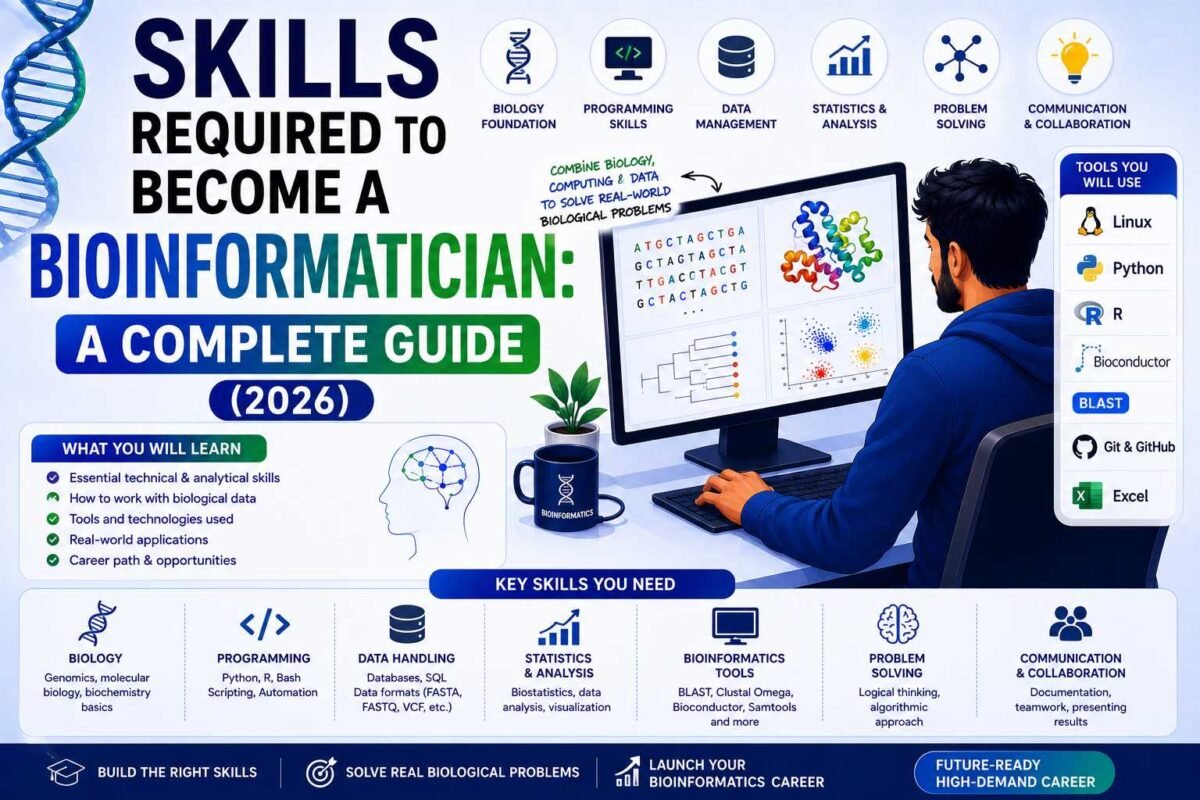
Bioinformatics skills are becoming increasingly important as biology enters the era of big data, artificial intelligence, and precision medicine. From genomics and next-generation sequencing (NGS) to drug discovery and computational biology, modern bioinformaticians rely on a combination of biological knowledge, programming, statistics, and data analysis to solve complex scientific problems. Whether you’re a student, researcher, or professional planning a career in bioinformatics, understanding the essential bioinformatics skills will help you build a strong foundation and prepare for success in this rapidly growing field.
Whether you’re a biology student, computer science graduate, researcher, or someone planning a career transition, understanding the essential skills needed for bioinformatics is the first step toward building a successful career.
In this guide, we’ll explore the technical and soft skills every aspiring bioinformatician should develop, along with practical tips to help you start your learning journey.
What Does a Bioinformatician Do?
A bioinformatician analyzes biological data using computational tools and statistical methods. Their work helps researchers understand DNA, RNA, proteins, genomes, and biological systems.
Typical responsibilities include:
- Analyzing DNA and RNA sequencing data
- Developing computational pipelines
- Managing biological databases
- Identifying disease-related genes
- Performing statistical analyses
- Visualizing biological data
- Supporting drug discovery and precision medicine
Because the field is highly interdisciplinary, bioinformaticians need a diverse set of technical and analytical skills.
1. Strong Foundation in Biology
Before working with biological data, you must understand the science behind it.
Important topics include:
- Cell Biology
- Molecular Biology
- Genetics
- DNA and RNA Structure
- Protein Synthesis
- Evolution
- Genomics
Understanding these concepts allows you to interpret computational results correctly and communicate effectively with researchers.
Learn More about bioinformatics from our crash courses bundles for beginners: Bioinformatics Foundations Bundle: From Beginner to Bioinformatics Professional – bioinformatix.co
2. Programming Skills
Programming is one of the most valuable skills in bioinformatics.
The most commonly used languages include:
Python
Python is widely used for:
- Data processing
- Sequence analysis
- Automation
- Machine learning
- Data visualization
R
R is essential for:
- Statistical analysis
- RNA-Seq analysis
- Differential gene expression
- Data visualization
- Bioconductor packages
Bash Scripting
Bash allows you to automate workflows and work efficiently in Linux environments.
Learn more about the programming languages for bioinformatics: Learn Bioinformatics Data Analysis: Master Python, Linux and R Scripting – bioinformatix.co
3. Linux Command Line
Most bioinformatics software is designed to run on Linux.
Essential Linux skills include:
- File management
- Directory navigation
- File permissions
- Shell scripting
- Package installation
- Working with large datasets
If you’re new to Linux, our Linux Command Line Essentials for Bioinformatics course provides a practical introduction that prepares you for real bioinformatics workflows.
Learn more about the Linux programming language for bioinformatics: Learn Bioinformatics Data Analysis: Master Python, Linux and R Scripting – bioinformatix.co
4. Statistics and Data Analysis
Bioinformatics relies heavily on statistics.
Important topics include:
- Probability
- Hypothesis testing
- p-values
- Correlation
- Regression
- Experimental design
- Data visualization
These concepts help researchers determine whether biological findings are statistically significant.
5. Biological Databases
Modern bioinformatics depends on accessing and interpreting biological databases.
Every bioinformatician should know how to work with resources such as:
- NCBI
- GenBank
- UniProt
- Ensembl
- GEO
- Protein Data Bank (PDB)
Knowing how to search, retrieve, and interpret biological information is a fundamental skill.
Our Introduction to Biological Databases for Bioinformatics course is an excellent starting point for beginners.
6. Sequence Analysis
Sequence analysis forms the foundation of many bioinformatics projects.
Essential techniques include:
- BLAST searches
- Multiple sequence alignment
- Phylogenetic analysis
- Gene annotation
- Motif discovery
These methods help researchers identify similarities, evolutionary relationships, and functional regions within biological sequences.
Learn more about the bioinformatics concepts for beginners from our course: Learn Bioinformatics from Beginner to Master Through Real World Projects – bioinformatix.co
7. Next-Generation Sequencing (NGS)
NGS technologies generate enormous amounts of biological data.
A bioinformatician should understand workflows such as:
- Quality control
- Read trimming
- Sequence alignment
- Variant calling
- RNA-Seq analysis
- Differential gene expression
- Functional enrichment analysis
NGS skills are among the most sought-after in both academia and industry.
Learn How to do the NGS data analysis from our course: Hands-On RNA-Seq Analysis Crash Course: From FASTQ to Differential Expression – bioinformatix.co
8. Data Visualization
Communicating results is just as important as performing analyses.
Common visualization techniques include:
- Heatmaps
- Volcano plots
- PCA plots
- UMAP visualizations
- Network diagrams
- Boxplots
- Bar charts
Clear visualizations help researchers understand complex datasets and present findings effectively.
9. Problem-Solving Skills
Bioinformatics projects rarely follow a perfect workflow.
You’ll often encounter:
- Software installation issues
- Data quality problems
- Pipeline errors
- Missing annotations
- Unexpected results
Strong analytical thinking and troubleshooting skills are essential for overcoming these challenges.
10. Machine Learning and Artificial Intelligence
Artificial intelligence is transforming bioinformatics.
Modern applications include:
- Disease prediction
- Drug discovery
- Protein structure prediction
- Biomarker identification
- Precision medicine
Although beginners don’t need advanced AI knowledge immediately, learning machine learning can significantly expand your career opportunities.
Learn More about machine learning for bioinformatics from our course: Learn Machine Learning in Bioinformatics: From Theory to Practical – bioinformatix.co
Essential Soft Skills
Technical knowledge alone isn’t enough.
Successful bioinformaticians also develop:
- Communication skills
- Critical thinking
- Scientific writing
- Time management
- Team collaboration
- Continuous learning
Because bioinformatics combines multiple disciplines, professionals frequently collaborate with biologists, clinicians, statisticians, and software engineers.
Recommended Learning Roadmap
If you’re starting from scratch, consider following this sequence:
- Learn biology fundamentals.
- Learn Linux.
- Learn Python.
- Study statistics.
- Explore biological databases.
- Practice sequence analysis.
- Learn NGS workflows.
- Build real-world projects.
- Learn Git and GitHub.
- Explore AI and machine learning.
Building skills gradually is much more effective than trying to master everything at once.
Build These Skills with BioInformatix
If you’re serious about becoming a bioinformatician, practical experience is just as important as theory.
At BioInformatix, we’ve developed beginner-friendly courses that help you build these essential skills step by step:
- Roadmap to Bioinformatics: A Beginner’s Guide to Careers, Skills & Learning Path – Understand the field and create a structured learning plan.
- Introduction to Biological Databases for Bioinformatics – Learn how to work with the world’s most important biological databases.
- Linux Command Line Essentials for Bioinformatics – Master the Linux commands used in modern bioinformatics workflows.
- Learn Bioinformatics: Beginner to Master Through Real-World Projects – Gain hands-on experience by working with practical bioinformatics projects from start to finish.
Together, these courses provide a comprehensive foundation for anyone starting a career in bioinformatics.
Final Thoughts
Becoming a successful bioinformatician requires a combination of biological knowledge, programming expertise, statistical thinking, and practical experience. While the learning journey may seem challenging at first, developing these skills step by step will prepare you for exciting opportunities in research, healthcare, biotechnology, and pharmaceutical industries.
The field of bioinformatics continues to grow as biological data becomes more abundant and computational methods become more powerful. By investing in the right skills today, you’ll be well-positioned for one of the most dynamic and impactful careers in modern science.