
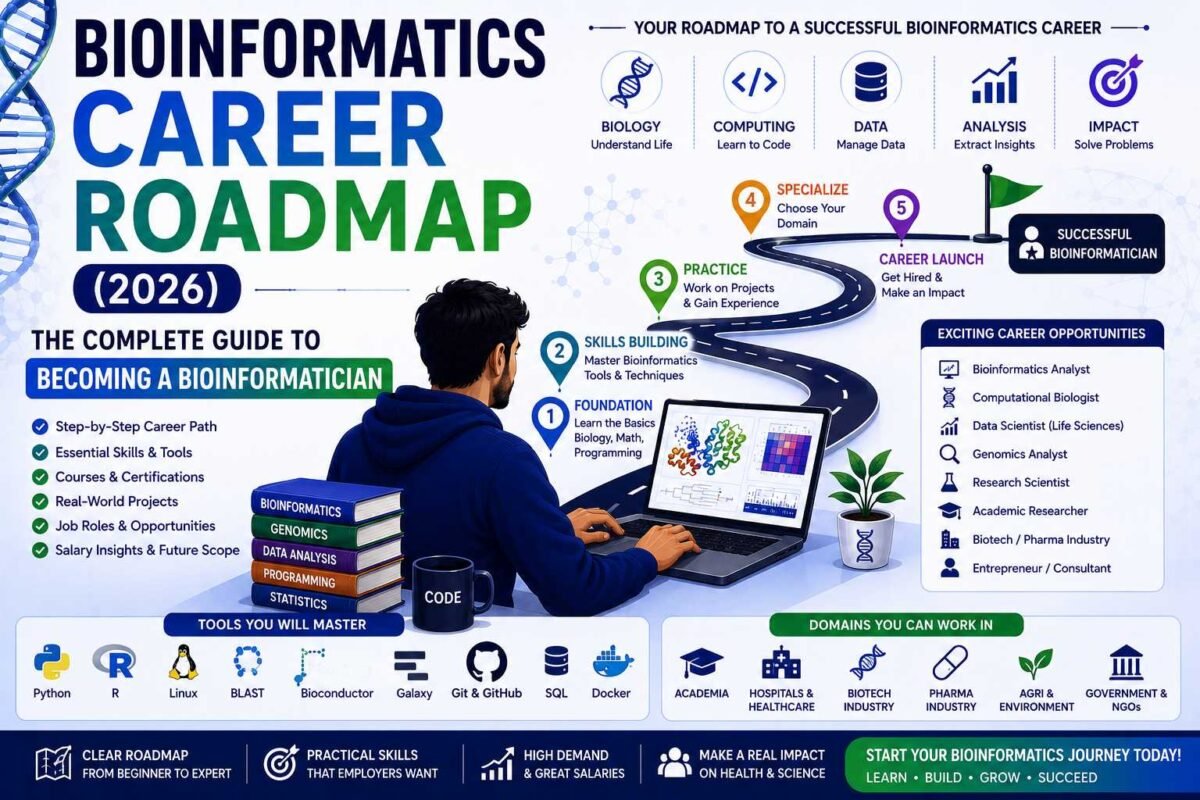
Bioinformatics career roadmap is one of the most searched topics by students who want to build a successful career in computational biology. With rapid advancements in genomics, artificial intelligence, next-generation sequencing (NGS), and precision medicine, bioinformatics has become one of the fastest-growing fields in life sciences.
Whether you’re a biology student, computer science graduate, biotechnology professional, or researcher, this roadmap will help you understand the skills, tools, and learning path needed to become a successful bioinformatician in 2026 and beyond.
Why Choose a Career in Bioinformatics?
Bioinformatics combines biology, computer science, mathematics, and statistics to analyze biological data and solve complex scientific problems.
Professionals in bioinformatics contribute to groundbreaking research in:
- Precision medicine
- Cancer genomics
- Drug discovery
- Agricultural biotechnology
- Evolutionary biology
- Microbiome research
- Artificial intelligence in healthcare
As biological data continues to grow exponentially, organizations worldwide are actively hiring skilled bioinformaticians.
Who Can Become a Bioinformatician?
One of the biggest misconceptions is that only biology students can learn bioinformatics.
In reality, successful bioinformaticians come from diverse backgrounds, including:
- Biology
- Biotechnology
- Genetics
- Computer Science
- Software Engineering
- Data Science
- Statistics
- Mathematics
- Biomedical Engineering
Regardless of your educational background, you can build a successful career by following a structured learning path.
Step 1: Build Your Biology Foundation
If you’re from a computer science background, begin by learning the basics of biology.
Focus on understanding:
- Cell Biology
- Molecular Biology
- Genetics
- DNA and RNA
- Proteins
- Evolution
- Genomics
A solid biological foundation helps you understand the significance of computational analyses.
Recommended Course
Start with:
🎓 Roadmap to Bioinformatics: A Beginner’s Guide to Careers, Skills & Learning Path
This beginner-friendly course helps you understand the bioinformatics field, career opportunities, required skills, and the correct learning sequence before starting advanced topics.
Step 2: Learn Linux
Linux is the operating system used in most bioinformatics laboratories and research institutions.
Essential Linux skills include:
- File and directory management
- Command-line navigation
- File permissions
- Shell scripting
- Installing software packages
Learning Linux early will make working with bioinformatics pipelines much easier.
Recommended Course
Start building your command-line skills with:
🎓 Linux Command Line Essentials for Bioinformatics
https://bioinformatix.co/courses/linux-command-line-essentials-for-bioinformatics/
This free course teaches practical Linux skills required for working with biological datasets, analysis tools, and computational workflows.
Step 3: Learn Python Programming
Python has become the most widely used programming language in bioinformatics.
You’ll use Python to:
- Process biological data
- Automate repetitive tasks
- Build analysis pipelines
- Visualize datasets
- Develop bioinformatics applications
Key topics include:
- Variables
- Loops
- Functions
- File handling
- Pandas
- NumPy
- Biopython
Recommended Course
For a complete practical learning experience, continue with:
🎓 Learn Bioinformatics Data Analysis: Master Python, Linux and R Scripting
This course combines Python, Linux, and R skills specifically for bioinformatics data analysis and real-world computational workflows.
Step 4: Understand Biological Databases
Every bioinformatician should know how biological information is stored and accessed.
Important databases include:
- NCBI
- GenBank
- UniProt
- Ensembl
- GEO
- Protein Data Bank (PDB)
These resources provide genomic, transcriptomic, and protein data for research and analysis.
Recommended Course
Learn how to work with biological databases through:
🎓 Introduction to Biological Databases for Bioinformatics
https://bioinformatix.co/courses/introduction-to-biological-databases-for-bioinformatics/
This free course teaches you how to search, retrieve, and interpret biological information from essential databases used by researchers worldwide.
Step 5: Learn Sequence Analysis
Sequence analysis forms the backbone of many bioinformatics projects.
Important topics include:
- BLAST
- Multiple Sequence Alignment
- Phylogenetics
- Gene Annotation
- Motif Discovery
These techniques help researchers compare biological sequences and understand evolutionary relationships.
Recommended Course
To strengthen your sequence analysis foundation, explore:
🎓 Learn Bioinformatics: Beginner to Master Through Real-World Projects
This hands-on course covers essential bioinformatics concepts through practical projects and real biological datasets.
Step 6: Learn Statistics
Bioinformatics is impossible without statistics.
Focus on:
- Probability
- Hypothesis testing
- p-values
- Correlation
- Regression
- Data visualization
Statistical analysis enables researchers to identify meaningful biological patterns and validate experimental results.
Recommended Course
Develop your statistical and computational analysis skills with:
🎓 Learn Bioinformatics Data Analysis: Master Python, Linux and R Scripting
This course includes practical scripting approaches used for analyzing biological datasets.
Step 7: Master Next-Generation Sequencing (NGS)
NGS is one of the most valuable skills in today’s bioinformatics job market.
Learn workflows such as:
- FASTQ quality control
- Read trimming
- Sequence alignment
- Variant calling
- RNA-Seq analysis
- Differential gene expression
- Functional enrichment
These techniques are used extensively in research laboratories and biotechnology companies.
Recommended Courses
Gain practical NGS analysis experience with:
🎓 Hands-on RNA-Seq Analysis: From FASTQ to DEGs
https://bioinformatix.co/courses/hands-on-rna-seq-analysis-crash-course-from-fastq-to-degs/
Learn complete RNA-Seq workflows, including quality control, alignment, differential expression analysis, and biological interpretation.
🎓 Learn Variant Calling: NGS Data Analysis
Master variant calling workflows used for identifying genetic variations from sequencing data.
Step 8: Build Real-World Projects
Employers value practical experience more than theoretical knowledge.
Some excellent beginner projects include:
- Genome annotation
- Sequence analysis
- RNA-Seq analysis
- Protein structure prediction
- Phylogenetic analysis
- Biomarker discovery
Create a portfolio showcasing your projects and document your work on GitHub.
Recommended Course
Build practical experience through:
🎓 Learn Bioinformatics: Beginner to Master Through Real-World Projects
This course guides learners through practical bioinformatics projects designed to develop job-ready skills.
Step 9: Learn Version Control
Git and GitHub are essential for managing code and collaborating with researchers.
Benefits include:
- Version tracking
- Collaboration
- Portfolio building
- Reproducible research
A well-maintained GitHub profile can strengthen your resume and demonstrate your technical skills.
Recommended Course
Learn practical computational workflows through:
🎓 Learn Bioinformatics Data Analysis: Master Python, Linux and R Scripting
This course helps you develop coding practices and analysis workflows useful for professional bioinformatics projects.
Step 10: Explore Advanced Topics
After mastering the fundamentals, expand your knowledge into emerging areas such as:
- Artificial Intelligence
- Machine Learning
- Deep Learning
- Single-cell RNA Sequencing
- Multi-omics
- Spatial Transcriptomics
- Drug Discovery
- Precision Medicine
These fields represent the future of bioinformatics and offer exciting career opportunities.
Recommended Advanced Courses
Continue your learning with:
🎓 Learn Machine Learning in Bioinformatics: From Theory to Practical
https://bioinformatix.co/courses/learn-machine-learning-in-bioinformatics-from-theory-to-practical/
🎓 Generative AI for Bioinformatics and Life Sciences
https://bioinformatix.co/courses/learn-generative-ai-for-bioinformatics-and-life-sciences/
🎓 Learn Single Cell RNA-Seq Data Analysis Using R and Python
https://bioinformatix.co/courses/learn-single-cell-rna-seq-data-analysis-using-r-and-python/
These courses help you explore modern computational approaches shaping the future of biological research.
Career Opportunities in Bioinformatics
Bioinformaticians work in a wide range of industries.
Popular job roles include:
- Bioinformatician
- Computational Biologist
- Genomics Analyst
- Clinical Bioinformatics Scientist
- Data Scientist
- Research Associate
- Biostatistician
- Computational Genomics Specialist
Common employers include:
- Universities
- Biotechnology companies
- Pharmaceutical companies
- Hospitals
- Government research institutes
- Agricultural organizations
Skills Employers Look For
Technical Skills:
- Biology
- Python
- R Programming
- Linux
- SQL
- Statistics
- NGS Analysis
- Machine Learning
Soft Skills:
- Problem-solving
- Scientific communication
- Critical thinking
- Teamwork
- Continuous learning
- Time management
Developing both technical and professional skills will make you a stronger candidate.
Recommended Learning Timeline
Months 1–2
- Biology fundamentals
- Linux basics
- Python programming
Recommended courses:
- Roadmap to Bioinformatics: A Beginner’s Guide to Careers, Skills & Learning Path
https://bioinformatix.co/courses/roadmap-to-bioinformatics-a-beginners-guide-to-careers-skills-learning-path/ - Linux Command Line Essentials for Bioinformatics
https://bioinformatix.co/courses/linux-command-line-essentials-for-bioinformatics/
Months 3–4
- Biological databases
- Sequence analysis
- Statistics
Recommended courses:
- Introduction to Biological Databases for Bioinformatics
https://bioinformatix.co/courses/introduction-to-biological-databases-for-bioinformatics/ - Learn Bioinformatics Data Analysis: Master Python, Linux and R Scripting
https://bioinformatix.co/courses/learn-bioinformatics-data-analysis-master-python-linux-and-r-scripting/
Months 5–6
- NGS workflows
- RNA-Seq
- Genome analysis
Recommended courses:
- Hands-on RNA-Seq Analysis: From FASTQ to DEGs
https://bioinformatix.co/courses/hands-on-rna-seq-analysis-crash-course-from-fastq-to-degs/ - Learn Variant Calling: NGS Data Analysis
https://bioinformatix.co/courses/learn-variant-calling-ngs-data-analysis-a-hands-on-bioinformatics-course/
Months 7–9
- Real-world projects
- GitHub portfolio
- Scientific writing
Recommended course:
- Learn Bioinformatics: Beginner to Master Through Real-World Projects
https://bioinformatix.co/courses/learn-bioinformatics-beginner-to-master-through-real-world-projects/
Months 10–12
- Machine learning
- AI in bioinformatics
- Job applications and internships
Recommended courses:
- Learn Machine Learning in Bioinformatics: From Theory to Practical
https://bioinformatix.co/courses/learn-machine-learning-in-bioinformatics-from-theory-to-practical/ - Generative AI for Bioinformatics and Life Sciences
https://bioinformatix.co/courses/learn-generative-ai-for-bioinformatics-and-life-sciences/
Remember that everyone’s learning pace is different. Consistency is more important than speed.
Start Your Bioinformatics Journey with BioInformatix
If you’re looking for a structured learning path, BioInformatix offers beginner-friendly courses designed to help you build practical skills step by step.
Start with these free courses:
- Roadmap to Bioinformatics: A Beginner’s Guide to Careers, Skills & Learning Path
https://bioinformatix.co/courses/roadmap-to-bioinformatics-a-beginners-guide-to-careers-skills-learning-path/ - Introduction to Biological Databases for Bioinformatics
https://bioinformatix.co/courses/introduction-to-biological-databases-for-bioinformatics/ - Linux Command Line Essentials for Bioinformatics
https://bioinformatix.co/courses/linux-command-line-essentials-for-bioinformatics/
Continue your journey with hands-on professional training:
- Learn Bioinformatics: Beginner to Master Through Real-World Projects
https://bioinformatix.co/courses/learn-bioinformatics-beginner-to-master-through-real-world-projects/ - Learn Bioinformatics Data Analysis: Master Python, Linux and R Scripting
https://bioinformatix.co/courses/learn-bioinformatics-data-analysis-master-python-linux-and-r-scripting/ - Hands-on RNA-Seq Analysis: From FASTQ to DEGs
https://bioinformatix.co/courses/hands-on-rna-seq-analysis-crash-course-from-fastq-to-degs/ - Learn Variant Calling: NGS Data Analysis
https://bioinformatix.co/courses/learn-variant-calling-ngs-data-analysis-a-hands-on-bioinformatics-course/ - Learn Machine Learning in Bioinformatics: From Theory to Practical
https://bioinformatix.co/courses/learn-machine-learning-in-bioinformatics-from-theory-to-practical/
Final Thoughts
A successful bioinformatics career isn’t built overnight—it develops through consistent learning, practical experience, and continuous improvement. By following this roadmap, mastering the essential skills, and working on real-world projects, you’ll be well-prepared for opportunities in research, biotechnology, healthcare, and pharmaceutical industries.
The demand for skilled bioinformaticians continues to grow, making this an excellent time to begin your journey. Start with the fundamentals, practice regularly, and keep exploring new technologies as the field evolves.