
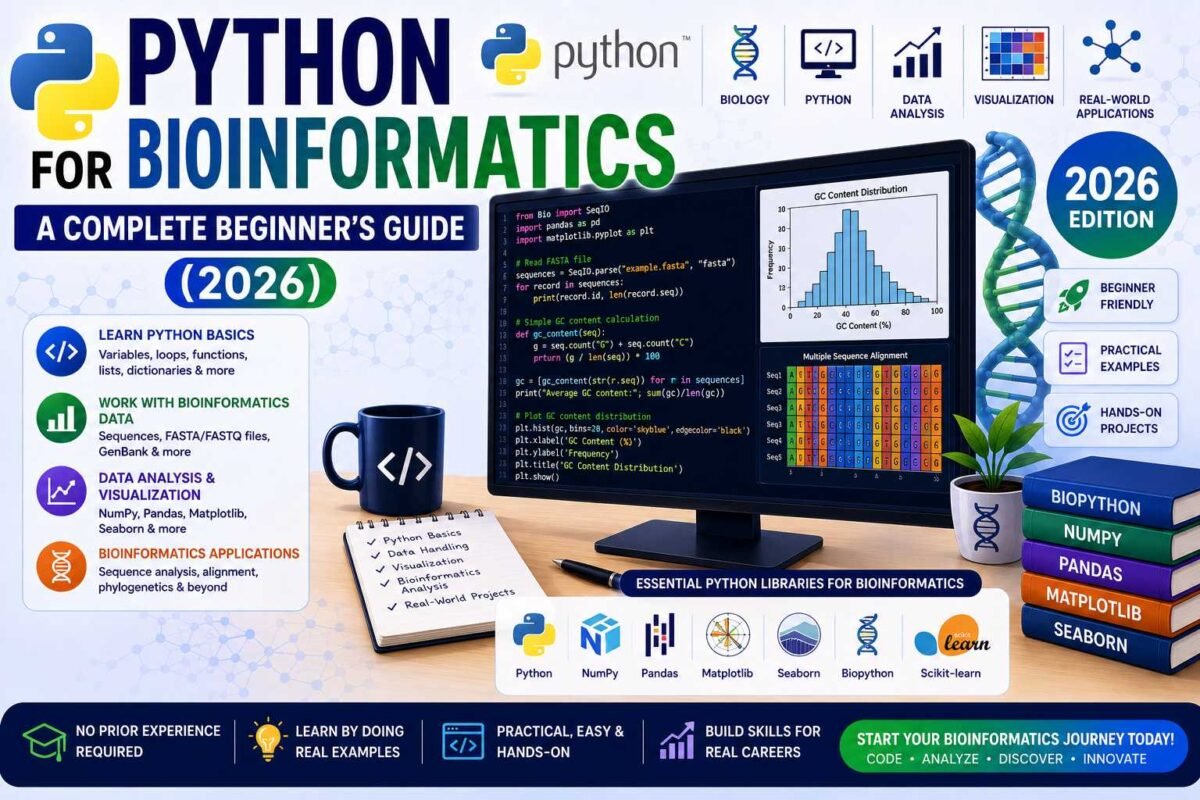
Python for Bioinformatics has become one of the most essential skills for modern bioinformaticians. Whether you’re analyzing DNA sequences, processing RNA-Seq data, automating repetitive tasks, or building machine learning models for biological research, Python is one of the most widely used programming languages in the field.
Its simple syntax, extensive scientific libraries, and active community make Python an excellent choice for students, researchers, and professionals entering bioinformatics.
In this guide, you’ll learn why Python is important, what skills you should develop, the most useful Python libraries, career opportunities, and how to start learning Python for bioinformatics.
Why Learn Python for Bioinformatics?
Modern biological research generates enormous amounts of data that cannot be analyzed manually.
Python allows researchers to:
- Automate repetitive analyses
- Process large biological datasets
- Analyze DNA and protein sequences
- Build bioinformatics pipelines
- Visualize genomic data
- Perform statistical analyses
- Apply machine learning to biological problems
Because of its flexibility and simplicity, Python has become the standard programming language in many research laboratories and biotechnology companies.
Is Python Necessary for Bioinformatics?
While some bioinformatics tools have graphical interfaces, most advanced analyses require programming.
Python is commonly used in:
- Genomics
- Transcriptomics
- Proteomics
- Metagenomics
- Structural Bioinformatics
- Drug Discovery
- Machine Learning
- Artificial Intelligence
If you’re planning a career in bioinformatics, learning Python is highly recommended.
What Can You Build with Python?
Python can be used for numerous bioinformatics applications.
Examples include:
- DNA sequence analysis
- FASTA and FASTQ processing
- Genome annotation
- Variant calling pipelines
- RNA-Seq analysis
- Protein sequence analysis
- Data visualization
- Workflow automation
- Web applications
- Machine learning models
Python’s versatility makes it useful for both beginners and experienced researchers.
Essential Python Skills for Bioinformatics
Start by learning the basics:
Variables
Store biological information and analysis results.
Data Types
Understand strings, integers, floats, and Boolean values.
Lists and Dictionaries
Manage DNA sequences, gene names, and experimental data efficiently.
Loops
Automate repetitive analyses across thousands of genes or sequences.
Functions
Write reusable code for common bioinformatics tasks.
File Handling
Read and write FASTA, FASTQ, CSV, and TSV files.
Object-Oriented Programming
Useful when developing larger bioinformatics applications.
Most Important Python Libraries
Several Python libraries are essential for bioinformatics.
Biopython
One of the most popular libraries for:
- Sequence analysis
- FASTA processing
- BLAST parsing
- GenBank files
- Phylogenetics
Pandas
Used for:
- Data cleaning
- Data manipulation
- Working with biological datasets
NumPy
Provides efficient numerical computing.
Matplotlib
Creates publication-quality figures and plots.
Plotly
Useful for interactive dashboards and scientific visualizations.
Scikit-learn
Widely used for machine learning applications in bioinformatics.
Python Projects for Beginners
The best way to learn Python is through practical projects.
Good beginner projects include:
- DNA sequence calculator
- GC content calculator
- FASTA parser
- Sequence translator
- Motif finder
- Protein property calculator
- Gene expression visualization
- Variant filtering script
These projects build confidence while developing real-world programming skills.
Python and Linux Go Together
Most bioinformatics workflows are performed on Linux servers.
Learning Linux alongside Python allows you to:
- Execute pipelines
- Manage files
- Automate analyses
- Install bioinformatics software
- Process sequencing data efficiently
If you’re new to Linux, start with our free course:
Linux Command Line Essentials for Bioinformatics
https://bioinformatix.co/courses/linux-command-line-essentials-for-bioinformatics/
Learning Roadmap
We recommend following this order:
Step 1
Understand bioinformatics fundamentals.
Start with our free course:
Roadmap to Bioinformatics: A Beginner’s Guide to Careers, Skills & Learning Path
Step 2
Learn Linux.
Complete:
Linux Command Line Essentials for Bioinformatics
https://bioinformatix.co/courses/linux-command-line-essentials-for-bioinformatics/
Step 3
Understand biological databases.
Complete:
Introduction to Biological Databases for Bioinformatics
https://bioinformatix.co/courses/introduction-to-biological-databases-for-bioinformatics/
Step 4
Master Python, Linux, and R together.
Our complete course:
Learn Bioinformatics Data Analysis: Master Python, Linux and R Scripting
This course teaches practical programming skills used in real bioinformatics analyses.
Step 5
Apply your knowledge to real research projects.
Continue with our flagship training:
Learn Bioinformatics: Beginner to Master Through Real-World Projects
You’ll work with real biological datasets while building practical bioinformatics workflows.
Career Opportunities
Python programming skills open opportunities in:
- Biotechnology
- Pharmaceutical companies
- Academic research
- Healthcare
- Genomics
- Drug discovery
- Artificial Intelligence
- Data Science
Many employers specifically list Python as a required skill for bioinformatics positions.
Common Mistakes Beginners Make
Avoid these common mistakes:
- Trying to memorize syntax instead of practicing
- Skipping Linux
- Ignoring biology fundamentals
- Avoiding projects
- Learning libraries before Python basics
- Not documenting code
Consistent practice is far more important than speed.
Why Learn Python with BioInformatix?
At BioInformatix, our courses are designed to help learners move beyond theory and gain practical experience.
We recommend starting with our free beginner courses before progressing to advanced training:
Free Courses
- Roadmap to Bioinformatics: A Beginner’s Guide to Careers, Skills & Learning Path
- Introduction to Biological Databases for Bioinformatics
- Linux Command Line Essentials for Bioinformatics
Premium Courses
- Learn Bioinformatics Data Analysis: Master Python, Linux and R Scripting
- Learn Bioinformatics: Beginner to Master Through Real-World Projects
- Generative AI for Bioinformatics Software Development: Build Tools and Applications
These courses provide hands-on experience with the tools and programming techniques used by bioinformatics professionals.
Final Thoughts
Learning Python for Bioinformatics is one of the best investments you can make if you’re planning a career in computational biology. Python’s simplicity, flexibility, and powerful ecosystem make it the ideal programming language for analyzing biological data, automating workflows, and developing bioinformatics applications.
Start with the fundamentals, practice through real-world projects, and continue building your skills with increasingly advanced topics. Combined with biology, Linux, and statistics, Python will become one of the strongest tools in your bioinformatics toolkit.