
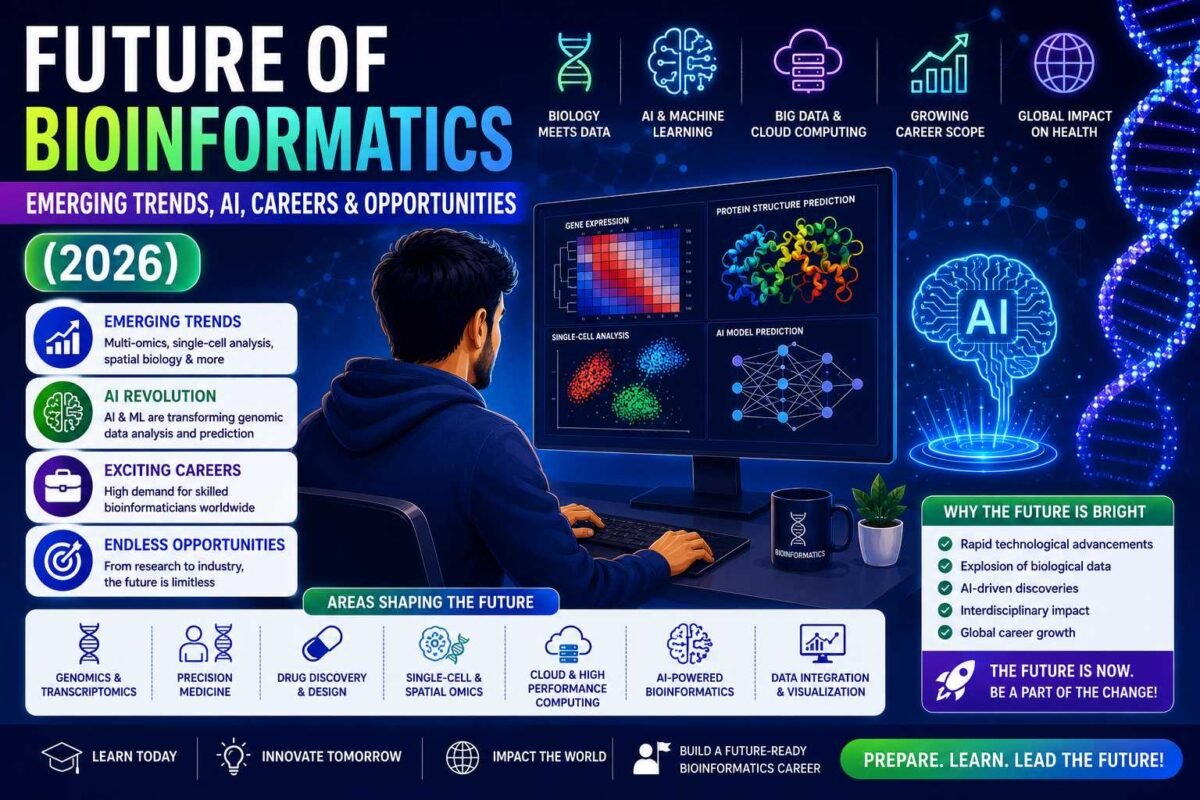
Future of bioinformatics has never looked more promising. As technologies such as artificial intelligence (AI), next-generation sequencing (NGS), single-cell genomics, multi-omics, and precision medicine continue to evolve, bioinformatics is becoming one of the most influential fields in modern science. Researchers, healthcare professionals, and biotechnology companies increasingly rely on bioinformatics to transform massive biological datasets into meaningful discoveries.
Whether you’re a student exploring career options or a researcher looking to stay ahead of emerging technologies, understanding the future of bioinformatics can help you prepare for one of the fastest-growing scientific disciplines.
Why Is Bioinformatics Growing So Rapidly?
The amount of biological data generated worldwide is increasing exponentially.
Modern sequencing technologies can produce terabytes of genomic data in a single experiment. Hospitals, pharmaceutical companies, and research laboratories require skilled professionals who can organize, analyze, and interpret this information.
Several factors are driving this growth:
- Advances in DNA sequencing technologies
- Falling sequencing costs
- Growth of personalized medicine
- Artificial intelligence integration
- Increased investment in biotechnology
- Expansion of healthcare research
- Drug discovery and vaccine development
As a result, bioinformatics is no longer limited to academic research—it has become a critical component of healthcare and biotechnology industries.
Artificial Intelligence Is Transforming Bioinformatics
Artificial intelligence is one of the biggest forces shaping the future of bioinformatics.
Machine learning algorithms can analyze complex biological datasets much faster than traditional methods, helping researchers identify patterns that would otherwise remain hidden.
AI applications in bioinformatics include:
- Protein structure prediction
- Drug discovery
- Disease diagnosis
- Biomarker discovery
- Genome annotation
- Variant classification
- Medical image analysis
- Predictive healthcare
If you’re interested in developing AI-powered bioinformatics solutions, consider our advanced course:
Generative AI for Bioinformatics and Life Sciences
https://bioinformatix.co/courses/learn-generative-ai-for-bioinformatics-and-life-sciences/
For learners who want practical machine learning experience, we also recommend:
Learn Machine Learning in Bioinformatics: From Theory to Practical
https://bioinformatix.co/courses/learn-machine-learning-in-bioinformatics-from-theory-to-practical/
Precision Medicine Will Continue to Expand
Traditional medicine often follows a “one-size-fits-all” approach.
Precision medicine changes this by using a patient’s genetic information to personalize diagnosis and treatment.
Bioinformatics enables researchers and clinicians to:
- Analyze patient genomes
- Identify disease-causing mutations
- Predict treatment responses
- Discover personalized therapies
As healthcare systems increasingly adopt genomic medicine, the demand for bioinformatics professionals will continue to grow.
Single-Cell Sequencing Is Revolutionizing Biology
Single-cell RNA sequencing (scRNA-Seq) allows researchers to study gene expression at the level of individual cells instead of averaging signals across millions of cells.
This technology has transformed research in:
- Cancer biology
- Immunology
- Neuroscience
- Developmental biology
- Stem cell research
As single-cell datasets become larger and more complex, bioinformatics will play an even greater role in processing and interpreting these data.
If you’d like to develop practical expertise in this area, explore our course:
Learn Single Cell RNA-Seq Data Analysis Using R and Python
https://bioinformatix.co/courses/learn-single-cell-rna-seq-data-analysis-using-r-and-python/
Multi-Omics Is the Next Frontier
Modern biology is moving beyond studying a single type of biological data.
Researchers increasingly combine multiple datasets to better understand biological systems.
Examples include:
- Genomics
- Transcriptomics
- Proteomics
- Metabolomics
- Epigenomics
- Microbiomics
Integrating these datasets known as multi-omics provides a more complete understanding of health and disease.
Future bioinformaticians will need strong computational and statistical skills to integrate and analyze these complex datasets.
Drug Discovery Is Becoming More Computational
Developing new medicines has traditionally been a slow and expensive process.
Bioinformatics is helping pharmaceutical companies:
- Identify therapeutic targets
- Analyze disease pathways
- Predict protein structures
- Screen drug candidates
- Discover biomarkers
- Reduce research costs
Combined with AI, computational drug discovery is expected to significantly accelerate the development of future therapies.
Genomics Will Continue to Drive Innovation
Whole-genome sequencing is becoming increasingly affordable and accessible.
Researchers now routinely analyze genomes to:
- Diagnose rare diseases
- Study cancer mutations
- Improve crops
- Understand evolution
- Monitor infectious diseases
Professionals with expertise in genome analysis will remain in high demand.
Our course Learn Genome-Wide Identification and Characterization of Plant Gene Families Using Bioinformatics provides practical experience in comparative genomics and gene family analysis.
RNA Sequencing Will Remain a Core Skill
RNA sequencing has become one of the most widely used technologies in molecular biology.
Applications include:
- Gene expression analysis
- Biomarker discovery
- Disease research
- Cancer genomics
- Functional genomics
Researchers who understand RNA-Seq workflows will continue to have excellent career opportunities.
Develop practical RNA-Seq skills with:
Hands-on RNA-Seq Analysis: Crash Course from FASTQ to DEGs
https://bioinformatix.co/courses/hands-on-rna-seq-analysis-crash-course-from-fastq-to-degs/
Bioinformatics Will Become More Automated
Automation is transforming bioinformatics workflows.
Modern researchers increasingly use:
- Workflow management systems
- Cloud computing
- High-performance computing
- Automated pipelines
- AI-assisted data analysis
Professionals who can automate analyses using Python, Linux, and workflow management tools will have a significant advantage.
Our course Learn Bioinformatics Data Analysis: Master Python, Linux and R Scripting teaches practical computational skills used in modern bioinformatics.
Career Opportunities Will Continue to Increase
The future of bioinformatics offers opportunities across many industries.
Common employers include:
- Pharmaceutical companies
- Biotechnology companies
- Hospitals
- Universities
- Government research organizations
- Agricultural companies
- AI healthcare startups
Job roles include:
- Bioinformatician
- Computational Biologist
- Genomics Scientist
- Clinical Bioinformatics Scientist
- Data Scientist
- AI Research Scientist
- Precision Medicine Specialist
As biological datasets continue to grow, organizations will require professionals who can transform data into actionable insights.
How to Prepare for the Future of Bioinformatics
If you’re planning a career in bioinformatics, begin building these skills today:
- Biology and genetics
- Linux
- Python programming
- Statistics
- Biological databases
- Sequence analysis
- Next-Generation Sequencing
- Machine learning
- Artificial intelligence
- Scientific communication
Starting with a structured learning path will make the journey much easier.
We recommend beginning with these free courses:
Roadmap to Bioinformatics: A Beginner’s Guide to Careers, Skills & Learning Path
Introduction to Biological Databases for Bioinformatics
https://bioinformatix.co/courses/introduction-to-biological-databases-for-bioinformatics/
Linux Command Line Essentials for Bioinformatics
https://bioinformatix.co/courses/linux-command-line-essentials-for-bioinformatics/
Once you’ve mastered the fundamentals, continue with our flagship practical course:
Learn Bioinformatics: Beginner to Master Through Real-World Projects
This course helps learners apply bioinformatics concepts to real biological datasets and industry-relevant workflows.
Final Thoughts
The future of bioinformatics is exceptionally bright. Advances in artificial intelligence, single-cell sequencing, multi-omics, precision medicine, and computational drug discovery are creating exciting opportunities for researchers and professionals worldwide.
Whether your goal is to work in academia, biotechnology, healthcare, agriculture, or pharmaceutical research, developing strong bioinformatics skills today will prepare you for tomorrow’s scientific challenges. By combining biological knowledge with computational expertise and continuous learning, you can build a rewarding career in one of the most innovative fields of modern science.