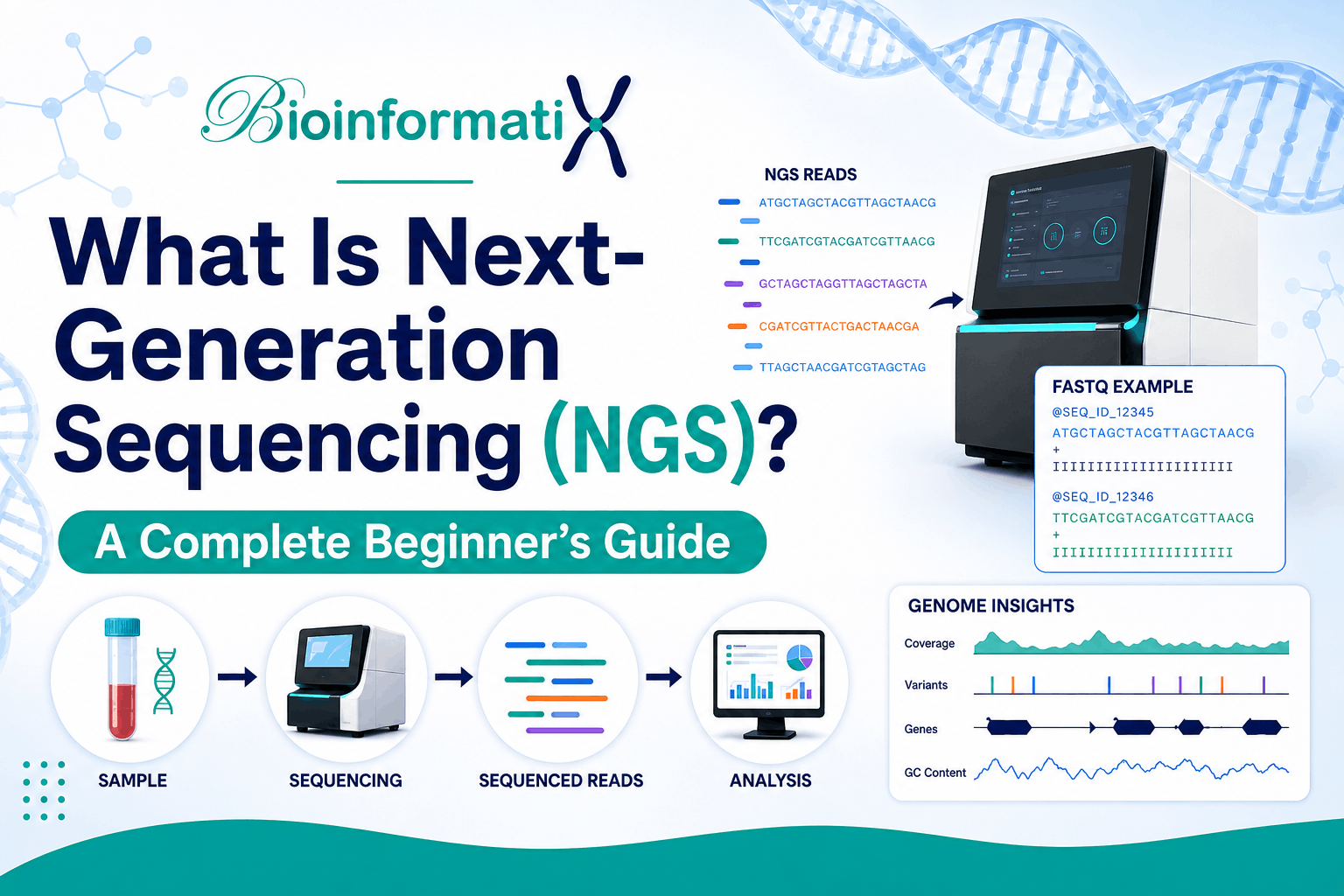
Next-Generation Sequencing (NGS) has transformed modern biology by allowing researchers to sequence millions of DNA or RNA fragments simultaneously. It is now widely used in genomics, transcriptomics, cancer research, infectious disease studies, precision medicine, microbiome research, single-cell biology and many other areas of life science.
Instead of examining one DNA fragment at a time, Next-Generation Sequencing technologies generate massive amounts of sequence data that can be analyzed computationally to answer biological questions.
For aspiring bioinformaticians, understanding Next-Generation Sequencing is especially important because NGS data analysis is one of the most practical and widely applied areas of modern bioinformatics.
In this complete beginner’s guide, you will learn:
- What Next-Generation Sequencing is
- How NGS works
- NGS vs Sanger sequencing
- Major types of NGS experiments
- RNA-Seq and transcriptomics
- Whole-genome and whole-exome sequencing
- Variant calling
- Single-cell RNA sequencing
- ChIP-Seq and ATAC-Seq
- Metagenomics
- Common NGS file formats
- Important NGS bioinformatics tools
- The complete NGS data-analysis workflow
- How to start learning NGS bioinformatics
If you are completely new to computational biology, begin with our What Is Bioinformatics? Complete Beginner’s Guide.
What Is Next-Generation Sequencing?
Next-Generation Sequencing (NGS) refers to high-throughput sequencing technologies capable of sequencing very large numbers of DNA or RNA molecules in parallel.
Traditional sequencing methods typically analyze relatively small amounts of sequence at a time. NGS technologies dramatically increased sequencing throughput, making it possible to analyze complete genomes, transcriptomes, microbial communities and millions of individual cells.
NGS can be used to investigate:
- DNA sequence
- RNA expression
- Genetic variants
- Genome structure
- Gene regulation
- Epigenetics
- Microbial communities
- Cancer genomes
- Rare genetic diseases
- Population genetics
- Single-cell biology
Modern NGS projects generate large datasets that require bioinformatics for processing, quality control, alignment, quantification, statistical analysis and biological interpretation.
This is one of the main reasons bioinformatics and sequencing have become so closely connected.
Why Is Next-Generation Sequencing Important?
NGS allows scientists to investigate biological systems at a scale that was previously difficult or impossible.
Researchers can use sequencing to ask questions such as:
- Which genes are expressed in cancer cells?
- Which genetic variants are present in a patient?
- Which mutations distinguish a tumor from normal tissue?
- Which microorganisms are present in an environmental sample?
- Which genes are active in individual cell populations?
- Which genomic regions interact with regulatory proteins?
- How does gene expression change after treatment?
- Which genetic differences exist between populations?
Next-Generation Sequencing is now used across many research fields, including:
- Human genetics
- Medical genomics
- Oncology
- Plant genomics
- Microbiology
- Infectious disease research
- Agricultural biotechnology
- Evolutionary biology
- Drug discovery
- Precision medicine
The National Human Genome Research Institute provides additional background on DNA sequencing and its applications.
Next-Generation Sequencing vs Sanger Sequencing
Sanger sequencing played a foundational role in molecular genetics and remains useful for specific applications.
However, NGS and Sanger sequencing differ substantially in scale.
| Feature | Sanger Sequencing | Next-Generation Sequencing |
|---|---|---|
| Sequencing scale | Small | Massive |
| Number of sequences processed simultaneously | Limited | Millions or more |
| Typical applications | Individual genes, validation | Genomes, transcriptomes, large panels |
| Data volume | Low | High |
| Bioinformatics requirements | Relatively limited | Extensive |
| Large-scale discovery | Limited | Highly suitable |
Sanger sequencing remains useful for:
- Sequencing individual PCR products
- Confirming specific variants
- Small-scale gene analysis
- Validation experiments
NGS is more appropriate for large-scale applications such as:
- Whole-genome sequencing
- Whole-exome sequencing
- RNA-Seq
- Metagenomics
- Single-cell sequencing
- ChIP-Seq
- ATAC-Seq
The technologies are therefore complementary rather than mutually exclusive.
How Does Next-Generation Sequencing Work?
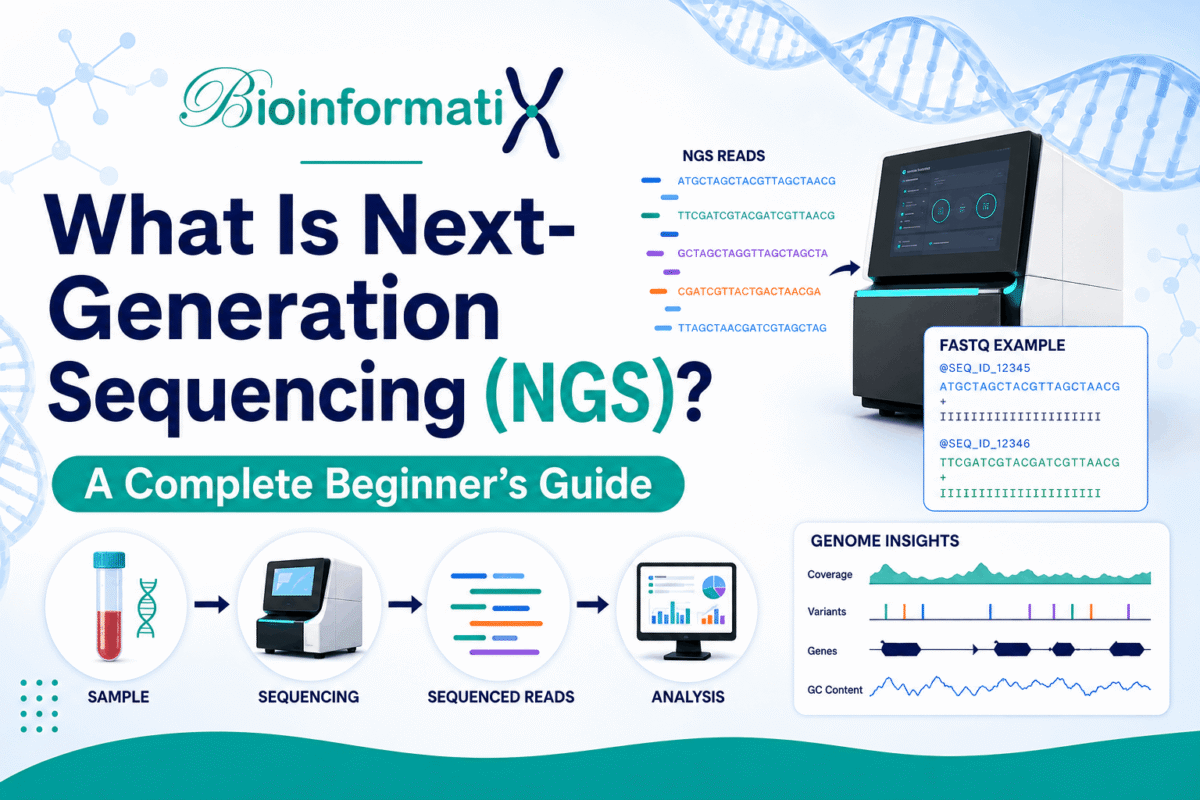
The exact laboratory workflow varies depending on the sequencing platform and experimental design, but a simplified NGS workflow can be represented as:
Biological Sample
↓
DNA or RNA Extraction
↓
Library Preparation
↓
Sequencing
↓
Raw Sequencing Reads
↓
Bioinformatics Analysis
↓
Biological Interpretation
Bioinformaticians primarily work with the data generated after sequencing.
A typical computational workflow starts with raw sequencing files and progresses through several analytical stages.
Step 1: Biological Sample Collection
The experiment begins with biological material.
Examples include:
- Blood
- Tumor tissue
- Plant tissue
- Bacterial cultures
- Environmental samples
- Cell cultures
- Single cells
- Clinical specimens
The biological question determines which material should be collected.
Step 2: DNA or RNA Extraction
DNA-based experiments may investigate:
- Genomes
- Genetic variants
- Epigenomic regions
- Microbial communities
RNA-based experiments investigate transcription and gene expression.
RNA is typically converted into complementary DNA during library preparation before sequencing.
Step 3: Library Preparation
During library preparation, nucleic acids are converted into a form compatible with the sequencing platform.
Library preparation may involve:
- Fragmentation
- Adapter addition
- Amplification
- Indexing or barcoding
- Size selection
- Target enrichment
Library design strongly influences the type of information obtained from the experiment.
Step 4: Sequencing
The prepared library is loaded onto a sequencing platform.
Major sequencing technology families include platforms from:
Different technologies vary in read length, throughput, chemistry, accuracy characteristics and applications.
Sequencing technologies are often broadly divided into:
- Short-read sequencing
- Long-read sequencing
Short-Read Sequencing
Short-read platforms generate relatively short sequence fragments at high throughput.
They are commonly used for:
- RNA-Seq
- Whole-genome sequencing
- Whole-exome sequencing
- Variant calling
- ChIP-Seq
- ATAC-Seq
- Metagenomics
- Targeted sequencing
Short-read sequencing remains highly useful for many standard genomics workflows.
Long-Read Sequencing
Long-read technologies generate much longer sequence reads.
Long reads are particularly useful for:
- Genome assembly
- Structural variant detection
- Transcript isoform analysis
- Repetitive genomic regions
- Haplotyping
- Full-length transcript sequencing
Modern bioinformaticians increasingly work with both short-read and long-read datasets.
Types of Next-Generation Sequencing
One of the most important parts of understanding Next-Generation Sequencing is recognizing that NGS is not a single experiment.
Different sequencing strategies answer different biological questions.
RNA-Seq
RNA sequencing, or RNA-Seq, measures RNA molecules present in a biological sample.
Researchers use RNA-Seq to investigate gene expression and transcriptome biology.
RNA-Seq can help answer questions such as:
- Which genes are expressed?
- Which genes change between disease and control?
- How does treatment affect gene expression?
- Which biological pathways are altered?
- Are alternative transcripts present?
- Which genes could serve as biomarkers?
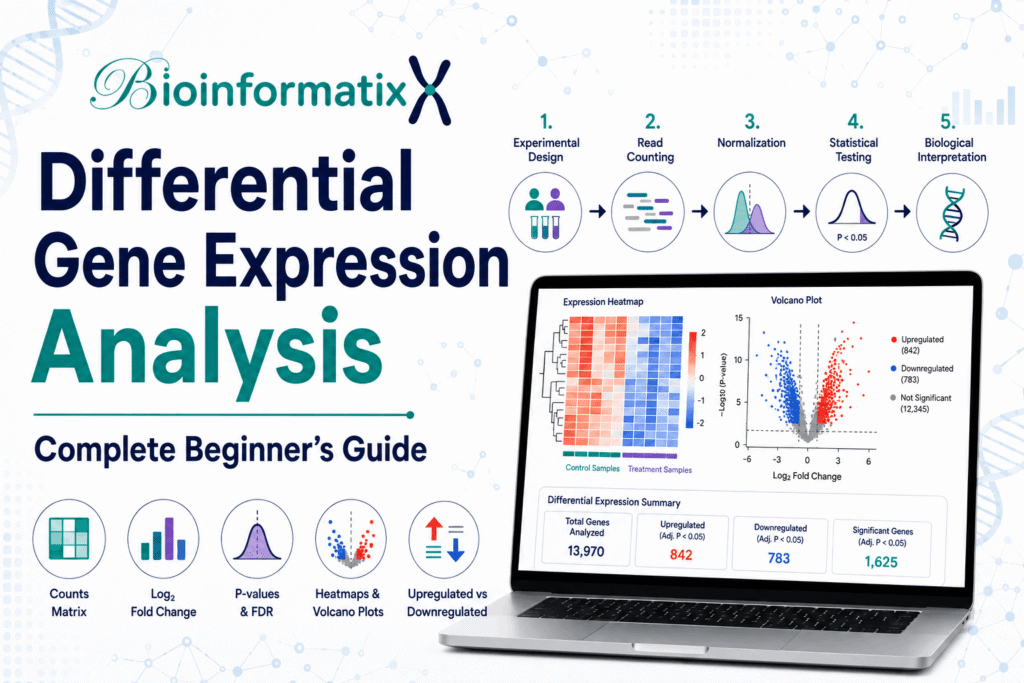
A typical RNA-Seq workflow is:
FASTQ
↓
Quality Control
↓
Read Trimming
↓
Alignment or Transcript Quantification
↓
Gene Counts
↓
Differential Expression
↓
Functional Interpretation
If you want to learn the complete practical workflow, explore:
Hands-On RNA-Seq Analysis: From FASTQ to Differential Expression
This is one of the core courses in the BioInformatix NGS learning pathway.
Whole-Genome Sequencing
Whole-genome sequencing (WGS) attempts to sequence most or all of an organism’s genome.
It is widely used for:
- Genetic disease studies
- Cancer genomics
- Microbial genomics
- Population genetics
- Variant discovery
- Evolutionary studies
- Agricultural genomics
A simplified WGS bioinformatics workflow is:
FASTQ
↓
Quality Control
↓
Alignment
↓
BAM
↓
Variant Calling
↓
VCF
↓
Variant Annotation
↓
Biological Interpretation
We will cover this workflow in a dedicated future article:
Whole Genome Sequencing Explained: From DNA to Variant Discovery
Whole-Exome Sequencing
Whole-exome sequencing (WES) focuses primarily on protein-coding regions of the genome.
Because exons represent a relatively small portion of the complete genome, WES can provide a cost-efficient strategy for investigating coding variants.
WES is frequently used in:
- Rare disease research
- Mendelian genetics
- Clinical genomics
- Cancer research
- Candidate variant discovery
The downstream analysis often involves variant calling and annotation.
For practical training, see:
Learn Variant Calling: NGS Data Analysis
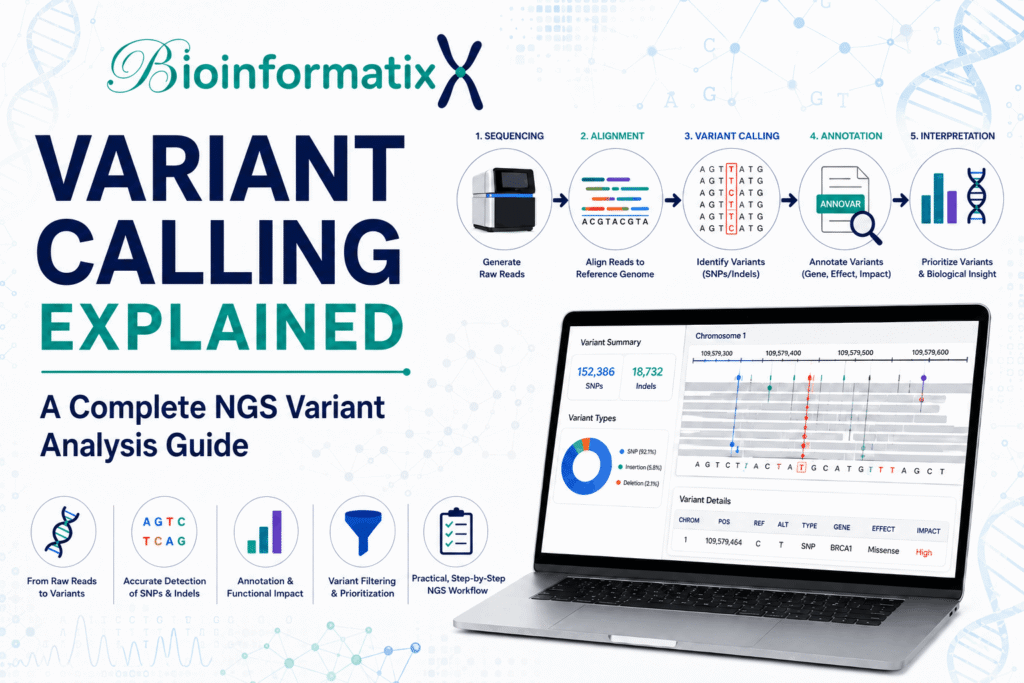
Variant Calling
Variant calling identifies differences between sequencing reads and a reference genome.
Common variant types include:
- Single nucleotide variants
- Insertions
- Deletions
More advanced workflows may also investigate:
- Copy-number variants
- Structural variants
- Repeat expansions
- Complex genomic rearrangements
A simplified workflow is:
FASTQ
↓
Quality Control
↓
Alignment to Reference Genome
↓
SAM/BAM
↓
BAM Processing
↓
Variant Calling
↓
VCF
↓
Annotation
↓
Prioritization
Variant calling is a major skill for researchers interested in human genetics, medical genomics, cancer genomics and population genetics.
Learn the workflow practically through:
Learn Variant Calling: NGS Data Analysis
Single-Cell RNA Sequencing
Traditional bulk RNA-Seq measures average gene expression across many cells.
Single-cell RNA sequencing (scRNA-Seq) allows researchers to study gene expression at the level of individual cells.
This makes it possible to identify:
- Cell populations
- Rare cell types
- Cellular heterogeneity
- Cell states
- Developmental trajectories
- Disease-associated cell populations
- Cell-type-specific gene expression
A typical single-cell workflow includes:
Raw sequencing data
↓
Read processing
↓
Gene-cell count matrix
↓
Quality control
↓
Normalization
↓
Dimensionality reduction
↓
Clustering
↓
Cell-type annotation
↓
Differential expression
↓
Biological interpretation
If you want practical experience with Seurat and Scanpy workflows, explore:
Learn Single Cell RNA-Seq Data Analysis Using R and Python
ChIP-Seq
Chromatin immunoprecipitation sequencing (ChIP-Seq) is used to identify genomic regions associated with particular DNA-binding proteins or histone modifications.
Applications include:
- Transcription factor binding
- Histone modification analysis
- Gene regulation
- Enhancer identification
- Epigenomics
A typical ChIP-Seq workflow includes:
FASTQ
↓
Quality Control
↓
Alignment
↓
Filtering
↓
Peak Calling
↓
Annotation
↓
Motif and functional analysis
ChIP-Seq is therefore another important application of NGS in regulatory genomics.
ATAC-Seq
ATAC-Seq is used to investigate chromatin accessibility.
Open chromatin regions often correspond to regulatory elements such as:
- Promoters
- Enhancers
- Transcription-factor-accessible regions
ATAC-Seq is widely used in:
- Epigenomics
- Gene regulation
- Developmental biology
- Cancer research
- Single-cell regulatory genomics
BioInformatix learners interested in regulatory genomics can progress into the ChIP-Seq & scATAC-Seq Data Analysis course after mastering the NGS fundamentals.
Metagenomic Sequencing
Metagenomics studies genetic material from entire microbial communities rather than isolating and sequencing one organism.
Applications include:
- Human microbiome research
- Environmental microbiology
- Soil microbiomes
- Marine microbiology
- Infectious disease studies
- Food microbiology
A metagenomics workflow may involve:
FASTQ
↓
Quality Control
↓
Host Read Removal
↓
Taxonomic Classification
↓
Abundance Estimation
↓
Functional Analysis
↓
Microbiome Interpretation
For learners interested in microbial NGS workflows, BioInformatix also offers training in metagenomics and microbiome analysis.
Common NGS File Formats
Understanding sequencing file formats is essential for NGS analysis.
FASTQ
FASTQ files contain raw sequencing reads and their quality scores.
A FASTQ record generally contains four lines:
@read_identifier
ACGTACGTACGT
+
FFFFFFFFFFFF
FASTQ is usually the starting point for an NGS analysis.
FASTA
FASTA stores sequence information without per-base sequencing quality scores.
It is commonly used for:
- Reference genomes
- Gene sequences
- Protein sequences
- Genome assemblies
- Custom sequence databases
SAM
SAM stands for Sequence Alignment/Map.
It stores information about how sequencing reads align to a reference genome.
SAM files are text based and can become very large.
BAM
BAM is the binary representation of SAM.
BAM files are more compact and efficient for computational processing.
They are widely used for:
- Read alignment
- Variant calling
- Genome visualization
- Coverage analysis
CRAM
CRAM is another compressed alignment format designed to reduce storage requirements.
VCF
VCF stands for Variant Call Format.
It stores genetic variants and associated information.
A VCF can contain:
- Chromosome
- Position
- Reference allele
- Alternative allele
- Quality
- Genotype
- Filtering information
- Annotation fields
VCF is central to variant-calling workflows.
GTF and GFF
GTF and GFF files describe genomic annotations such as:
- Genes
- Transcripts
- Exons
- Coding sequences
They are frequently used during RNA-Seq analysis and genome annotation.
Our Ensembl Genome Browser Guide explains how genomic annotations and transcripts are organized.
Next-Generation Sequencing Bioinformatics Workflow
Although every sequencing experiment is different, a general Next-Generation Sequencing analysis workflow often includes the following stages.
1. Obtain the Sequencing Data
You may receive sequencing data directly from a sequencing facility or download public data.
Major public resources include:
- NCBI Sequence Read Archive
- GEO
- European Nucleotide Archive
The official NCBI Sequence Read Archive contains public high-throughput sequencing datasets.
We have also prepared a complete guide:
GEO Database Tutorial & SRA Database Guide
It explains how GSE, GSM, SRP, SRX and SRR accessions relate to public sequencing datasets.
2. Perform Quality Control
Raw sequencing reads should be evaluated before downstream analysis.
Common quality metrics include:
- Per-base quality
- GC content
- Adapter contamination
- Sequence duplication
- Read length
- Overrepresented sequences
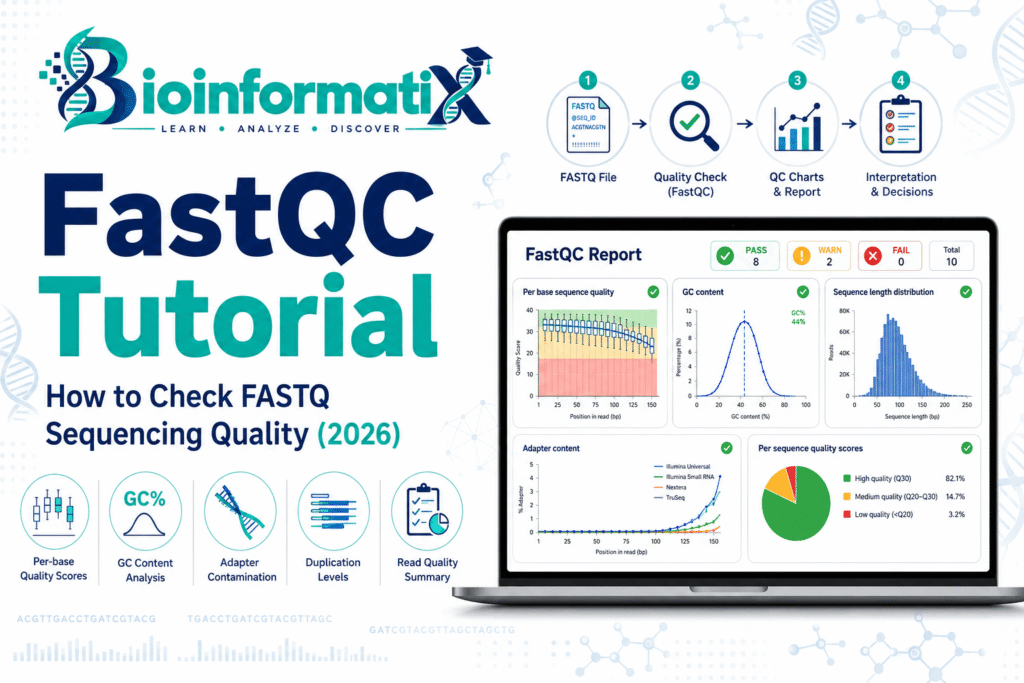
FastQC is one of the most widely used tools for inspecting sequencing quality.
A future article in this NGS cluster will cover:
FastQC Tutorial: How to Check FASTQ Sequencing Quality
3. Trim or Filter Reads When Necessary
Depending on the experiment, reads may require:
- Adapter removal
- Low-quality base trimming
- Short-read filtering
- Contaminant removal
Common tools include:
- fastp
- Cutadapt
- Trimmomatic
Not every dataset requires aggressive trimming. Quality-control results and the requirements of the downstream pipeline should guide preprocessing decisions.
4. Align Reads or Perform Mapping-Free Quantification
Many workflows align sequencing reads to a reference genome.
Common aligners include:
RNA-Seq
- STAR
- HISAT2
DNA Sequencing
- BWA
Some transcriptomics workflows use lightweight or alignment-free quantification approaches instead.
The correct method depends on the experiment.
5. Process Alignment Files
Aligned reads may require operations such as:
- Sorting
- Indexing
- Filtering
- Duplicate handling
- Read-group processing
Tools such as SAMtools are widely used for SAM and BAM manipulation.
6. Quantify Biological Features
For RNA-Seq, reads may be quantified at the gene or transcript level.
Common tools include:
- featureCounts
- HTSeq
- Salmon
- kallisto
The output may be a matrix such as:
| Gene | Sample 1 | Sample 2 | Sample 3 |
|---|---|---|---|
| Gene A | 100 | 115 | 97 |
| Gene B | 25 | 41 | 37 |
| Gene C | 500 | 430 | 510 |
These counts can then be used for statistical analysis.
7. Perform Statistical Analysis
The statistical method depends on the experiment.
Examples include:
- Differential gene expression
- Variant calling
- Peak enrichment
- Population comparison
- Microbial abundance testing
- Cell clustering
Popular R packages include:
- DESeq2
- edgeR
- limma
If you are new to R, read our R Programming for Bioinformatics Guide.
8. Biological Interpretation
Computational results must eventually be converted into biological conclusions.
This may involve:
- Gene Ontology analysis
- Pathway enrichment
- Protein interaction networks
- Variant interpretation
- Disease associations
- Biomarker discovery
- Cell-type annotation
Bioinformatics is therefore not simply about running software. Understanding the biological question remains essential.
Important NGS Bioinformatics Tools
A beginner working with NGS will frequently encounter tools such as:
Quality Control
- FastQC
- MultiQC
- fastp
Alignment
- STAR
- HISAT2
- BWA
- Bowtie2
Alignment Processing
- SAMtools
RNA-Seq Quantification
- featureCounts
- HTSeq
- Salmon
- kallisto
Differential Expression
- DESeq2
- edgeR
- limma
Variant Calling
- GATK
- BCFtools
- FreeBayes
Genome Visualization
- IGV
ChIP-Seq
- MACS2
Single-Cell Analysis
- Seurat
- Scanpy
You do not need to learn every tool at once.
The best approach is to understand one complete workflow first.
Why Linux Is Important for NGS Analysis
Most NGS software is designed for Linux or command-line environments.
Linux skills help you:
- Navigate sequencing directories
- Manage FASTQ files
- Run quality-control tools
- Install bioinformatics software
- Execute alignment pipelines
- Process BAM and VCF files
- Work on HPC systems
- Automate analysis
If you are new to Linux, start with the free:
Linux Command Line Essentials for Bioinformatics
You can also read our Linux for Bioinformatics Complete Beginner’s Guide.
Python and R for NGS Bioinformatics
NGS analysts frequently combine command-line tools with Python and R.
Python
Python is useful for:
- Processing metadata
- Parsing sequencing results
- Automating pipelines
- Manipulating files
- Machine learning
- Single-cell analysis with Scanpy
Read our Python for Bioinformatics Guide.
R
R is particularly useful for:
- Statistical analysis
- Differential gene expression
- Visualization
- Transcriptomics
- Single-cell analysis
- Functional genomics
Read our R Programming for Bioinformatics Guide.
For structured training in all three technologies, explore:
Learn Bioinformatics Data Analysis: Master Python, Linux and R Scripting
Public NGS Datasets for Practice
One of the best ways to learn NGS bioinformatics is to practice on real public datasets.
Important resources include:
- NCBI SRA
- GEO
- BioProject
- BioSample
- European Nucleotide Archive
For example, you might:
- Find an RNA-Seq study in GEO.
- Review the sample metadata.
- Identify the associated SRA accessions.
- Download FASTQ files.
- Perform quality control.
- Align the reads.
- Generate gene counts.
- Identify differentially expressed genes.
This allows you to build portfolio projects without producing sequencing data yourself.
Read our GEO Database Tutorial & SRA Database Guide before downloading public sequencing datasets.
Applications of NGS in Healthcare
NGS is increasingly important in biomedical research and healthcare.
Applications include:
- Rare genetic disease investigation
- Cancer genomics
- Pharmacogenomics
- Infectious disease surveillance
- Prenatal genetics
- Precision medicine
- Molecular diagnosis
Bioinformaticians help convert sequencing reads into interpretable genomic information.
Applications of NGS in Cancer Research
Cancer develops through genomic and epigenomic changes.
NGS can help researchers investigate:
- Somatic mutations
- Germline predisposition
- Copy-number changes
- Gene-expression profiles
- Tumor heterogeneity
- Regulatory changes
- Biomarker signatures
Different sequencing methods can provide complementary information about the same tumor.
Applications of NGS in Agriculture
NGS is also widely used in plant and agricultural research.
Applications include:
- Crop improvement
- Disease resistance
- Population genomics
- Gene-family analysis
- Transcriptomics
- Genome assembly
- Marker discovery
Researchers increasingly combine sequencing data with computational genomics to improve crops and understand plant biology.
Applications of NGS in Microbiology
Microbial sequencing can be used for:
- Pathogen identification
- Antimicrobial resistance analysis
- Outbreak investigation
- Genome assembly
- Comparative genomics
- Metagenomics
Whole-genome sequencing has become particularly valuable for studying bacterial evolution and resistance.
Common Mistakes Beginners Make in NGS Analysis
Starting Without Understanding the Experiment
Never begin by running software without understanding:
- Organism
- Experimental groups
- Sequencing strategy
- Library layout
- Reference genome
- Biological question
Ignoring FASTQ Quality
Poor sequencing quality can affect every downstream stage.
Always perform quality assessment.
Using the Wrong Reference Genome
Genome assemblies matter.
For human data, for example, GRCh37 and GRCh38 coordinates are not interchangeable.
Mixing Paired-End Reads
Paired-end samples typically contain two corresponding FASTQ files.
Keep read pairs correctly organized.
Losing Sample Metadata
Never separate sequencing data from its metadata.
Record:
- Sample ID
- Experimental condition
- Biological replicate
- Sequencing run
- Library strategy
- File names
Blindly Following Tutorials
A command copied from another experiment may not be appropriate for your dataset.
Understand what every major parameter does.
Ignoring Biological Replicates
Statistical analysis depends on appropriate experimental replication.
Technical sequencing depth cannot replace biological replicates.
Treating NGS Analysis as Only a Software Problem
The ultimate goal is biological interpretation.
A technically correct pipeline can still produce misleading conclusions if the experimental design is misunderstood.
Is NGS Data Analysis Difficult to Learn?
NGS analysis can initially seem complicated because it combines:
- Molecular biology
- Sequencing technology
- Linux
- Statistics
- Programming
- Biological databases
- Data interpretation
The key is to learn one workflow at a time.
For example:
First
Learn FASTQ and quality control.
Then
Learn alignment.
Then
Learn BAM processing.
Then
Learn either RNA-Seq quantification or variant calling.
Finally
Learn statistical analysis and interpretation.
A structured learning path is much more effective than attempting to learn dozens of tools independently.
Become an NGS Data Analyst with BioInformatix
If your goal is to develop broad, practical NGS skills rather than learning one isolated workflow, the recommended pathway is the:
NGS & Transcriptomics Analyst Bundle
The bundle is designed to help learners progress across major NGS and transcriptomics workflows rather than studying individual techniques in isolation.
The learning path brings together areas such as:
- RNA-Seq
- Variant calling
- Single-cell RNA sequencing
- Advanced transcriptomics
This makes it particularly suitable for students, researchers and aspiring bioinformaticians who want to build a broader NGS Data Analyst skill set.
Individual NGS Courses
You can also learn each workflow separately depending on your research interests.
RNA-Seq Analysis
Hands-On RNA-Seq Analysis: From FASTQ to Differential Expression
Recommended for learners interested in:
- Transcriptomics
- FASTQ processing
- Read alignment
- Gene quantification
- Differential expression
Variant Calling
Learn Variant Calling: NGS Data Analysis
Recommended for:
- Genomics
- Whole-genome sequencing
- Whole-exome sequencing
- BAM processing
- VCF generation
- Variant analysis
Single-Cell RNA-Seq
Learn Single Cell RNA-Seq Data Analysis Using R and Python
Recommended for:
- Single-cell transcriptomics
- Seurat
- Scanpy
- Clustering
- Cell-type annotation
- Differential expression
Programming for NGS
Learn Bioinformatics Data Analysis: Master Python, Linux and R Scripting
Recommended if you need stronger computational foundations before moving into advanced NGS workflows.
Recommended NGS Learning Roadmap
A beginner can follow this sequence:
Stage 1: Understand Bioinformatics
Read:
What Is Bioinformatics? Complete Beginner’s Guide
Stage 2: Learn Linux
Complete:
Linux Command Line Essentials for Bioinformatics
Stage 3: Understand Biological Databases
Complete:
Introduction to Biological Databases for Bioinformatics
Stage 4: Learn How Public NGS Data Are Organized
Read:
GEO Database Tutorial & SRA Database Guide
Stage 5: Learn an RNA-Seq Workflow
Complete:
Stage 6: Learn Genomic Variant Analysis
Complete:
Stage 7: Move into Single-Cell and Advanced Transcriptomics
Continue with specialized NGS courses as your research interests develop.
Stage 8: Build Broad NGS Expertise
Use the NGS & Transcriptomics Analyst Bundle to develop skills across multiple sequencing workflows.
Frequently Asked Questions
What does NGS stand for?
NGS stands for Next-Generation Sequencing.
What is Next-Generation Sequencing?
Next-Generation Sequencing refers to high-throughput technologies that sequence large numbers of DNA or RNA molecules in parallel.
Is RNA-Seq an NGS technique?
Yes. RNA-Seq uses high-throughput sequencing to study RNA abundance, transcript structure and gene expression.
Is whole-genome sequencing NGS?
Yes. Whole-genome sequencing is one of the major applications of NGS.
What is the first file used in NGS analysis?
Many NGS workflows begin with raw sequencing reads stored in FASTQ files.
What is BAM in NGS?
BAM is a compressed binary alignment format commonly used to store sequencing reads aligned to a reference genome.
What is VCF?
VCF, or Variant Call Format, is commonly used to store genetic variants identified from sequencing data.
Which programming language is best for NGS?
There is no single best language. Linux command-line skills are fundamental, while Python and R are widely used for automation, data processing, statistics and visualization.
Do I need Linux for NGS analysis?
Linux is highly recommended because many major NGS tools and pipelines are designed for Linux environments.
Can beginners learn NGS?
Yes. Beginners can learn NGS successfully by starting with sequencing fundamentals and progressing through one workflow at a time.
Where can I download NGS datasets?
Public NGS datasets are available through repositories such as NCBI SRA and GEO.
Which NGS workflow should I learn first?
RNA-Seq is a useful starting point because it introduces FASTQ files, quality control, alignment, quantification, statistics and biological interpretation.
Is variant calling part of NGS?
Yes. Variant calling is one of the major downstream applications of genomic NGS data.
Is single-cell RNA-Seq part of NGS?
Yes. Single-cell RNA sequencing combines high-throughput sequencing with cell-level barcoding and computational analysis to study individual cells.
Final Thoughts
Next-Generation Sequencing has become one of the foundations of modern genomics and bioinformatics.
NGS allows researchers to study complete genomes, transcriptomes, genetic variants, microbial communities, regulatory landscapes and individual cells at an unprecedented scale.
However, sequencing generates data rather than biological conclusions.
Bioinformatics transforms that raw sequencing data into useful information through:
FASTQ → Quality Control → Processing → Alignment or Quantification → Statistical Analysis → Biological Interpretation
If you want to build a career around sequencing data, do not focus only on individual software tools. Develop an understanding of the entire workflow, including experimental design, Linux, biological databases, file formats, statistics and biological interpretation.
For learners who want a structured path across multiple sequencing technologies, the NGS & Transcriptomics Analyst Bundle should be the primary learning pathway. You can then deepen individual skills through the Hands-On RNA-Seq Analysis, Variant Calling and Single Cell RNA-Seq courses.