Learn Single-Cell RNA-Seq Data Analysis Using R and Python languages
About Course
Welcome to our comprehensive course, “Learn Single-Cell RNA-Seq Data Analysis Using R, Python, GUI Tools, and Cloud Platforms,” designed to empower you with the essential skills and knowledge to explore one of the most advanced and high-resolution technologies in genomics: Single-Cell RNA Sequencing (scRNA-seq).
In the era of precision biology, where understanding individual cellular behavior is critical to unlocking insights in cancer biology, immunology, neuroscience, and regenerative medicine, scRNA-seq has emerged as a transformative tool. This course serves as your complete entry point into the field of single-cell transcriptomics, guiding you from foundational theory to hands-on data analysis using the most powerful open-source tools available.
Why Single-Cell RNA-Seq?
With the limitations of traditional bulk RNA sequencing—where gene expression is averaged across thousands or millions of cells—scRNA-seq allows you to analyze gene expression at single-cell resolution, revealing the hidden heterogeneity in tissues, uncovering rare cell types, and providing new dimensions to disease understanding and treatment strategies.
Bioinformatics for the Single Cell Era
At the heart of this course is the interdisciplinary power of bioinformatics—a fusion of biology, computer science, and data science. You’ll master the computational approaches and statistical frameworks that drive modern single-cell data analysis, learning how to interpret, visualize, and extract meaningful biological insights from complex datasets.
Comprehensive Learning Journey: From the basics of single-cell technology to full-scale analysis workflows, this course walks you through every step of scRNA-seq data analysis with clarity and practical insight.
Multi-Tool Mastery: You’ll gain hands-on experience with both R and Python-based analysis pipelines, using powerful libraries like Seurat and Scanpy, while also exploring graphical interfaces and cloud-based platforms like Galaxy for non-coders.
Real-World Data: Work with real scRNA-seq datasets from public repositories like NCBI GEO, giving you confidence in applying your skills to actual biological data.
Expert Instruction: Learn from experienced bioinformatics educators who break down complex concepts into manageable, actionable learning steps.
Section 1: Introduction to Single-Cell RNA-Seq
What is scRNA-seq and how it differs from bulk RNA-seq
Real-world applications in medicine and biology
A clear overview of the entire analysis pipeline
Section 2: Getting Started with R and RStudio
Introduction to R programming for biologists
Installing RStudio and understanding data structures
Importing data, managing packages, and creating visualizations using ggplot2 and Seurat
Section 3: Single-Cell RNA-Seq Analysis in R
Preprocessing scRNA-seq data with Seurat
Quality control, normalization, scaling, and PCA
Clustering, UMAP visualization, marker gene identification, and cell type annotation
Section 4: Single-Cell RNA-Seq Analysis in Python
Using Scanpy and scVI-tools
Replicating full pipelines in Python
Advanced annotation using models like scANVI
Section 5: GUI and Cloud-Based Pipelines
Running scRNA-seq analysis without coding
Using platforms like Galaxy, CodeOcean, or Cellxgene
Downloading and analyzing GEO datasets visually
Who This Course Is For:
Biology or medical students transitioning into bioinformatics
Bioinformatics beginners and researchers
Data scientists exploring single-cell applications
Wet lab scientists wanting to analyze their own scRNA-seq data
Anyone interested in high-resolution transcriptomics
What You Need:
No prior coding experience required — this course is beginner-friendly
All tools used are open-source and freely available
Basic familiarity with biology or interest in genomics is helpful
Join us in this immersive learning experience and gain the confidence to run full single-cell RNA-seq analysis pipelines, interpret your results, and contribute meaningfully to cutting-edge research. Whether you aim to build a research career or enhance your skill set as a life science professional, this course is your gateway to mastering single-cell bioinformatics using R, Python, GUI tools, and cloud platforms.
Course Content
Getting Started with Single Cell Technology (Theory)
What is Single-Cell RNA Sequencing (scRNA-seq)?
12:15From Bulk RNA-Seq to Single-Cell Transcriptomics
12:31Key Applications of scRNA-seq in Research and Medicine
18:43Overview of the Single-Cell RNA-Seq Analysis Pipeline
12:30
Getting Started with R and R-Studio
Single-Cell RNA-Seq Analysis in R
Single-Cell RNA-Seq Analysis in Python
GUI and Cloud-Based scRNA-Seq Tools
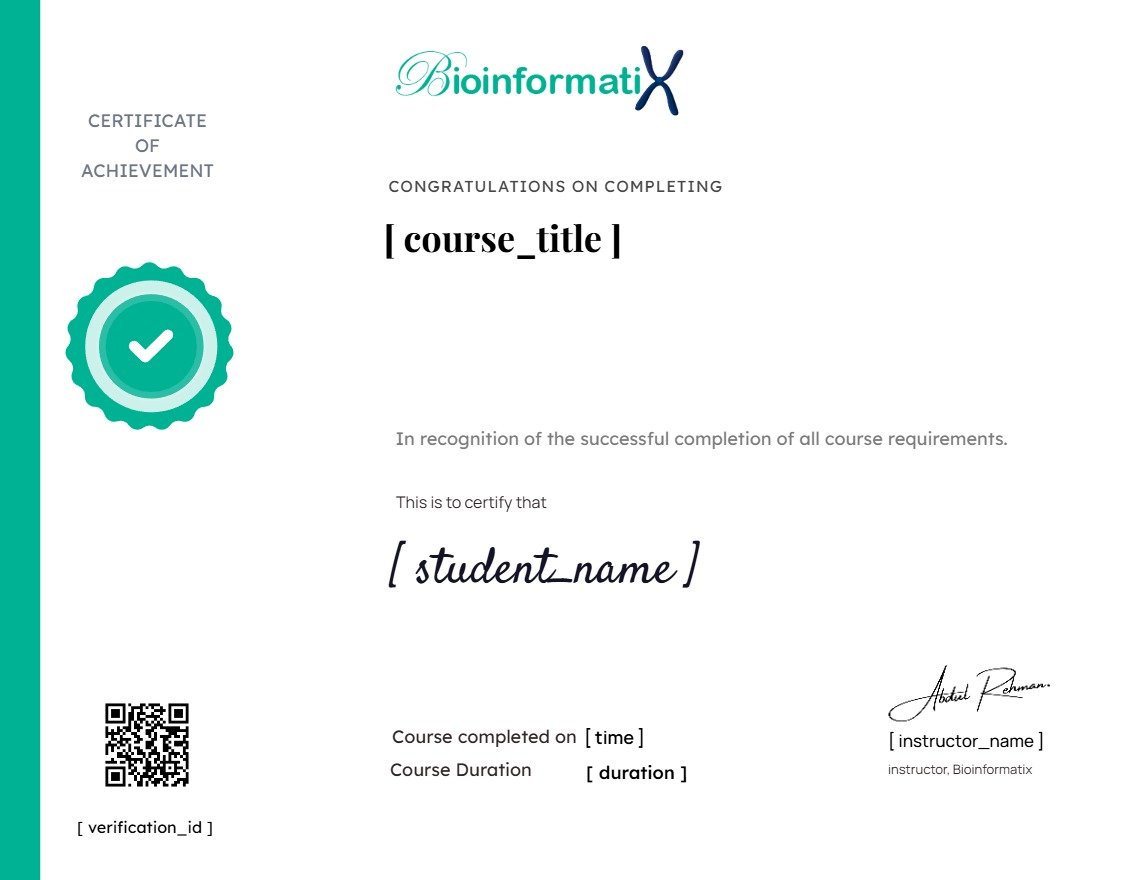
Get Certified in Bioinformatics
Showcase your achievement with a certificate recognized by students and researchers worldwide.
Student Ratings & Reviews

Your Instructor

Abdul Rehman Ikram
Bioinformatician | Data Analyst | Computational BiologistAbdul is a distinguished bioinformatician, data analyst, and computational biologist known for his exceptional contributions to the field of biomedical research. With a passion for integrating technology and biology, Abdul has carved a niche for himself, leveraging cutting-edge computational techniques to unravel complex biological data.
Driven by a curiosity to decode the complexities of life, Abdul believes in the power of interdisciplinary approaches. He is committed to mentoring the next generation of scientists, fostering a culture of innovation and continuous learning.