
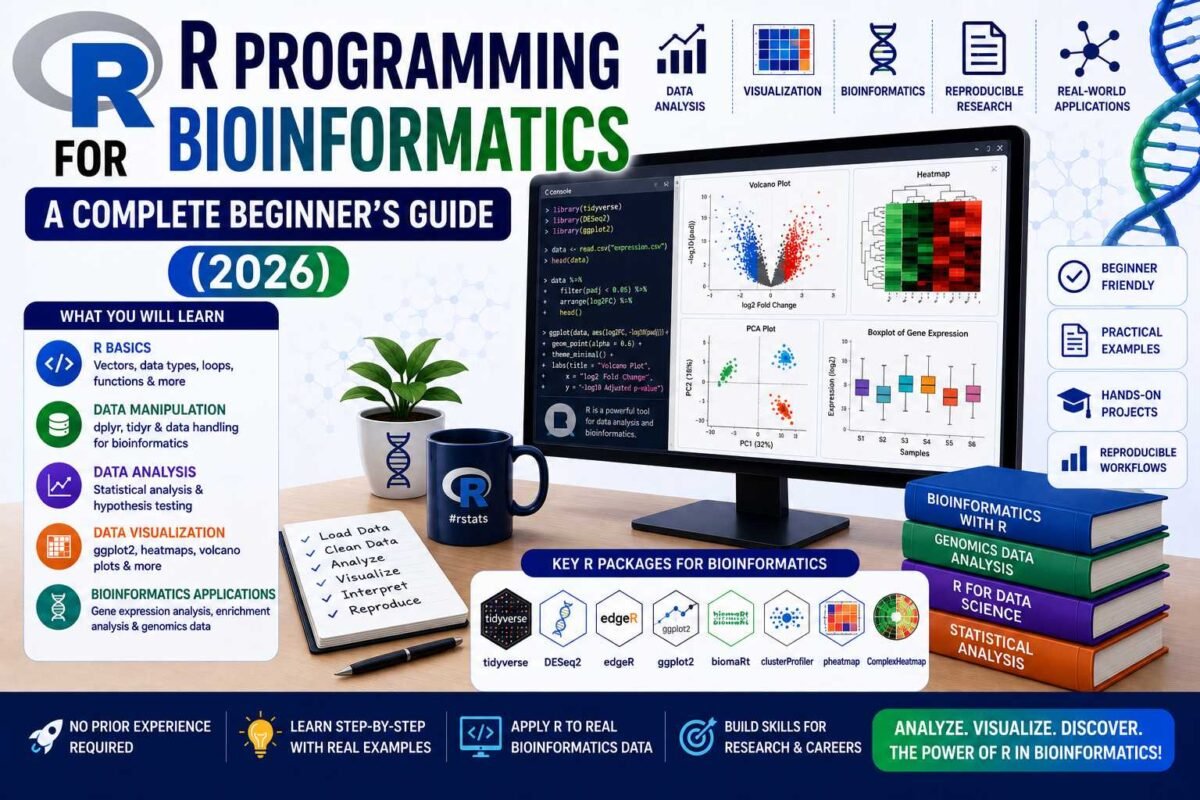
R Programming for Bioinformatics is one of the most valuable skills for researchers working with genomics, transcriptomics, RNA sequencing, proteomics, and biological data analysis. While Python is widely used for workflow automation and software development, R has become the standard language for statistical computing, data visualization, and high-throughput biological data analysis.
Whether you’re a student, researcher, or aspiring bioinformatician, learning R will help you analyze complex biological datasets, create publication-quality figures, and perform reproducible scientific research.
In this guide, you’ll learn why R is important in bioinformatics, the essential packages every beginner should know, career opportunities, and a step-by-step roadmap to mastering R.
What Is R Programming?
R is a programming language specifically designed for statistical computing and data visualization.
In bioinformatics, R is widely used to:
- Analyze RNA-Seq data
- Identify differentially expressed genes
- Perform statistical analysis
- Create publication-quality graphs
- Visualize genomic datasets
- Conduct functional enrichment analysis
- Analyze single-cell sequencing data
Thousands of researchers worldwide use R every day because of its powerful statistical capabilities and extensive collection of bioinformatics packages.
Why Learn R for Bioinformatics?
Modern biological research produces large and complex datasets that require advanced statistical analysis.
R makes it possible to:
- Analyze thousands of genes simultaneously
- Process transcriptomic datasets
- Build reproducible workflows
- Generate high-quality figures for publications
- Perform machine learning analyses
- Integrate multi-omics datasets
If you plan to work in genomics, transcriptomics, or biomedical research, R is an essential skill.
Python vs R for Bioinformatics
One of the most common questions beginners ask is whether they should learn Python or R first.
Python is best suited for:
- Workflow automation
- Software development
- Machine learning
- Pipeline development
- Data processing
R excels at:
- Statistical analysis
- RNA-Seq analysis
- Differential gene expression
- Data visualization
- Biological data interpretation
Instead of choosing one over the other, professional bioinformaticians often use both languages together.
If you’re new to Python, read our guide Python for Bioinformatics: A Complete Beginner’s Guide to understand how the two languages complement each other.
Essential R Skills Every Bioinformatician Should Learn
Start with the basics:
Variables and Data Types
Learn how to store biological data efficiently.
Vectors
The foundation of data analysis in R.
Matrices
Useful for gene expression datasets.
Data Frames
Essential for working with biological tables.
Lists
Store multiple biological objects together.
Functions
Create reusable code for common analyses.
Loops and Apply Functions
Automate repetitive analyses.
Most Important R Packages for Bioinformatics
Bioconductor
Bioconductor is the largest collection of bioinformatics packages for R.
It provides tools for:
- RNA-Seq
- Microarray analysis
- Variant analysis
- Genomics
- Epigenomics
DESeq2
One of the most popular packages for differential gene expression analysis.
Widely used for RNA-Seq experiments.
edgeR
Another powerful package for RNA-Seq differential expression analysis.
limma
Originally developed for microarray analysis but now widely used for RNA-Seq and proteomics.
ggplot2
The most popular package for creating publication-quality scientific figures.
dplyr
Simplifies data manipulation and cleaning.
tidyr
Makes organizing biological datasets easier.
Applications of R in Bioinformatics
Researchers use R in many areas, including:
- Transcriptomics
- RNA-Seq
- Single-cell RNA sequencing
- Proteomics
- Metabolomics
- Microarray analysis
- Functional enrichment
- Biomarker discovery
- Survival analysis
- Clinical research
Because of its flexibility, R has become a standard tool in both academia and industry.
Learn Linux Alongside R
Many bioinformatics analyses are performed on Linux servers.
Learning Linux alongside R allows you to:
- Run bioinformatics software
- Process sequencing files
- Automate workflows
- Manage large biological datasets
If you’re just getting started, our free Linux Command Line Essentials for Bioinformatics course is an excellent place to begin.
Course Link:
https://bioinformatix.co/courses/linux-command-line-essentials-for-bioinformatics/
Understanding Biological Databases
Before analyzing biological data, you need to know where it comes from.
Our free course Introduction to Biological Databases for Bioinformatics teaches you how to use resources such as NCBI, GenBank, UniProt, GEO, and Ensembl.
Course Link:
https://bioinformatix.co/courses/introduction-to-biological-databases-for-bioinformatics/
Master Python, Linux and R Together
Professional bioinformaticians rarely use a single programming language.
Our comprehensive course:
Learn Bioinformatics Data Analysis: Master Python, Linux and R Scripting
teaches all three technologies together while working with real biological datasets.
Course Link:
Learn RNA-Seq Analysis Using R
One of the most valuable applications of R is RNA sequencing analysis.
Our Hands-on RNA-Seq Analysis: Crash Course from FASTQ to DEGs course teaches you how to:
- Perform quality control
- Align sequencing reads
- Quantify gene expression
- Identify differentially expressed genes
- Interpret biological results
Course Link:
https://bioinformatix.co/courses/hands-on-rna-seq-analysis-crash-course-from-fastq-to-degs/
Analyze Single-Cell RNA Sequencing Data
Single-cell sequencing is one of the fastest-growing areas of bioinformatics.
Our course:
Learn Single Cell RNA-Seq Data Analysis Using R and Python
covers:
- Quality control
- Clustering
- Cell annotation
- Differential expression
- Cell trajectory analysis
- Visualization
Course Link:
https://bioinformatix.co/courses/learn-single-cell-rna-seq-data-analysis-using-r-and-python/
Career Opportunities
Learning R opens opportunities in:
- Biotechnology
- Pharmaceutical research
- Clinical genomics
- Precision medicine
- Academic research
- Healthcare
- Agricultural genomics
Common job titles include:
- Bioinformatician
- Computational Biologist
- Genomics Analyst
- Transcriptomics Scientist
- Data Scientist
- Research Associate
Best Learning Path
We recommend following this order:
Step 1
Complete our free course:
Roadmap to Bioinformatics: A Beginner’s Guide to Careers, Skills & Learning Path
Step 2
Learn Linux.
Complete:
Linux Command Line Essentials for Bioinformatics
Step 3
Understand Biological Databases.
Complete:
Introduction to Biological Databases for Bioinformatics
Step 4
Master programming.
Complete:
Learn Bioinformatics Data Analysis: Master Python, Linux and R Scripting
Step 5
Apply your knowledge through real projects.
Complete:
Learn Bioinformatics: Beginner to Master Through Real-World Projects
Final Thoughts
Learning R Programming for Bioinformatics is one of the best investments you can make if you plan to work with genomic and transcriptomic data. Combined with Python, Linux, and biological knowledge, R provides the statistical and visualization capabilities needed to analyze modern biological datasets.
Start with the fundamentals, practice consistently, and apply your knowledge through real-world projects. As sequencing technologies and biological datasets continue to grow, R will remain one of the most valuable programming languages in bioinformatics.