
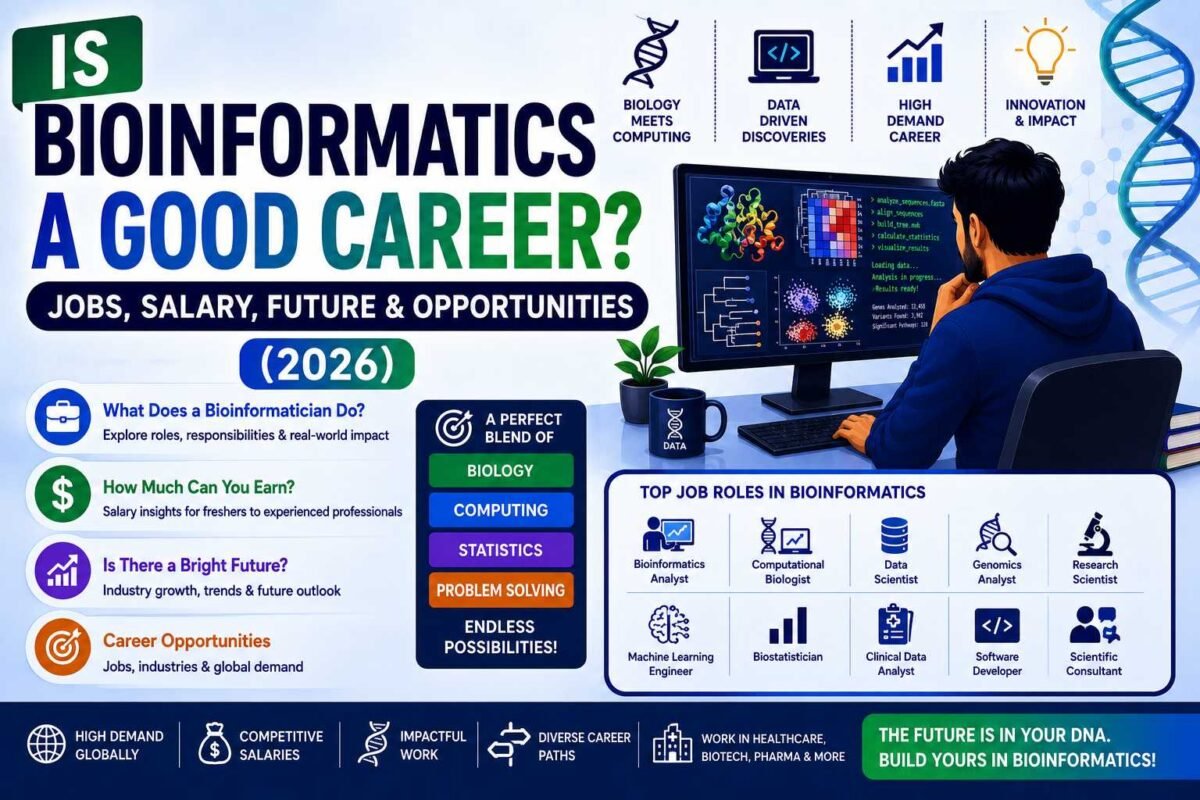
Is bioinformatics a good career? This is one of the most common questions asked by students considering careers in biology, biotechnology, computer science, or data science. The short answer is yes. Bioinformatics has become one of the fastest-growing fields in life sciences, offering exciting career opportunities in healthcare, pharmaceuticals, agriculture, genomics, and artificial intelligence.
As biological research becomes increasingly data-driven, the demand for professionals who can analyze genomic and biological data continues to rise. In this guide, we’ll explore the career prospects, salary expectations, required skills, future trends, and how you can start your journey in bioinformatics.
What Is Bioinformatics?
Bioinformatics is an interdisciplinary field that combines biology, computer science, mathematics, and statistics to analyze biological data. Bioinformaticians use computational tools to study DNA, RNA, proteins, and genomes, helping researchers make discoveries in medicine, biotechnology, and agriculture.
If you’re completely new to the field, we recommend reading our article “What Is Bioinformatics? A Complete Beginner’s Guide” before continuing.
Why Is Bioinformatics a Good Career?
There are many reasons why bioinformatics is considered one of the best career options in modern science.
High Demand Worldwide
The rapid growth of genomics, precision medicine, and biotechnology has created a significant demand for skilled bioinformaticians across the world.
Organizations are actively hiring professionals who can manage, analyze, and interpret biological data.
Diverse Career Opportunities
A degree or skill set in bioinformatics opens doors to multiple industries.
You can work in:
- Pharmaceutical companies
- Biotechnology companies
- Hospitals
- Research institutes
- Universities
- Agricultural research centers
- Government organizations
- AI and healthcare startups
Unlike many traditional biology careers, bioinformatics also provides opportunities in software development and data science.
Competitive Salaries
Bioinformatics professionals generally earn competitive salaries because they possess a combination of biological knowledge and computational expertise.
Salary depends on factors such as:
- Country
- Experience
- Education
- Technical skills
- Industry
Professionals with expertise in areas such as NGS, machine learning, cloud computing, and AI often command higher salaries than entry-level candidates.
What Jobs Can You Get in Bioinformatics?
One of the biggest advantages of bioinformatics is the variety of career paths available.
Popular job titles include:
- Bioinformatician
- Computational Biologist
- Genomics Data Analyst
- Clinical Bioinformatics Scientist
- Research Associate
- Biostatistician
- Data Scientist (Life Sciences)
- Computational Genomics Scientist
- Drug Discovery Scientist
- Biomedical Data Analyst
Many professionals also work as freelancers, consultants, or educators in the field of bioinformatics.
Skills Needed for a Successful Bioinformatics Career
To build a successful career, you should develop both biological and computational skills.
Core skills include:
- Molecular Biology
- Genetics
- Python Programming
- R Programming
- Linux
- Statistics
- Sequence Analysis
- Next-Generation Sequencing (NGS)
- Biological Databases
- Data Visualization
If you’re unsure where to begin, our free Roadmap to Bioinformatics: A Beginner’s Guide to Careers, Skills & Learning Path course provides a structured overview of the field and helps beginners create an effective learning plan.
How to Start a Career in Bioinformatics
Building a career in bioinformatics doesn’t happen overnight, but following a structured roadmap makes the process much easier.
We recommend learning in this order:
Step 1: Learn the Fundamentals
Understand:
- Biology
- Genetics
- Molecular Biology
Step 2: Learn Linux
Most bioinformatics software runs on Linux systems.
Our free course Linux Command Line Essentials for Bioinformatics teaches the command-line skills required for modern bioinformatics workflows.
👉 https://bioinformatix.co/courses/linux-command-line-essentials-for-bioinformatics/
Step 3: Learn Biological Databases
Every bioinformatician should know how to retrieve and interpret biological data.
Our free course Introduction to Biological Databases for Bioinformatics covers databases such as NCBI, GenBank, UniProt, and Ensembl.
👉 https://bioinformatix.co/courses/introduction-to-biological-databases-for-bioinformatics/
Step 4: Build Practical Skills
Theory alone isn’t enough.
Employers value candidates who have practical experience with real-world bioinformatics projects.
Our flagship course Learn Bioinformatics: Beginner to Master Through Real-World Projects teaches practical workflows using real datasets, making it ideal for students and researchers who want industry-ready skills.
Is Bioinformatics Difficult?
Bioinformatics can seem challenging because it combines several disciplines, including biology, programming, and statistics.
However, beginners who follow a structured learning path and practice regularly can learn bioinformatics successfully.
The key is to focus on one topic at a time instead of trying to master everything simultaneously.
How Artificial Intelligence Is Changing Bioinformatics
Artificial Intelligence is transforming biological research.
Modern bioinformaticians increasingly use AI for:
- Protein structure prediction
- Drug discovery
- Biomarker identification
- Disease prediction
- Genome annotation
- Medical image analysis
Professionals with AI skills are becoming highly sought after.
If you’re interested in this rapidly growing area, explore our advanced courses:
Generative AI for Bioinformatics and Life Sciences
https://bioinformatix.co/courses/learn-generative-ai-for-bioinformatics-and-life-sciences/
Learn Machine Learning in Bioinformatics: From Theory to Practical
https://bioinformatix.co/courses/learn-machine-learning-in-bioinformatics-from-theory-to-practical/
Future Scope of Bioinformatics
The future of bioinformatics looks extremely promising.
Emerging fields include:
- Precision Medicine
- Multi-omics
- Single-cell RNA Sequencing
- Artificial Intelligence
- Synthetic Biology
- Digital Healthcare
- Personalized Medicine
As sequencing technologies become more affordable, organizations will continue generating enormous amounts of biological data, increasing the demand for skilled bioinformaticians.
Who Should Choose Bioinformatics?
Bioinformatics is an excellent choice for:
- Biology students
- Biotechnology students
- Computer Science graduates
- Software Engineers
- Data Scientists
- Researchers
- Healthcare professionals
- Anyone interested in combining biology with technology
Even if you have little programming experience, you can gradually build the required skills through consistent learning and hands-on practice.
Why Learn with BioInformatix?
At BioInformatix, we believe bioinformatics education should combine theory with practical experience.
Our learning pathway is designed to help beginners and professionals progress step by step.
Start with our FREE courses:
- Roadmap to Bioinformatics: A Beginner’s Guide to Careers, Skills & Learning Path
https://bioinformatix.co/courses/roadmap-to-bioinformatics-a-beginners-guide-to-careers-skills-learning-path/ - Introduction to Biological Databases for Bioinformatics
https://bioinformatix.co/courses/introduction-to-biological-databases-for-bioinformatics/ - Linux Command Line Essentials for Bioinformatics
https://bioinformatix.co/courses/linux-command-line-essentials-for-bioinformatics/
Continue with our premium courses:
- Learn Bioinformatics: Beginner to Master Through Real-World Projects
https://bioinformatix.co/courses/learn-bioinformatics-beginner-to-master-through-real-world-projects/ - Learn Bioinformatics Data Analysis: Master Python, Linux and R Scripting
https://bioinformatix.co/courses/learn-bioinformatics-data-analysis-master-python-linux-and-r-scripting/ - Hands-on RNA-Seq Analysis: From FASTQ to DEGs
https://bioinformatix.co/courses/hands-on-rna-seq-analysis-crash-course-from-fastq-to-degs/ - Learn Machine Learning in Bioinformatics: From Theory to Practical
https://bioinformatix.co/courses/learn-machine-learning-in-bioinformatics-from-theory-to-practical/
These courses are designed to help you build practical skills that can be applied in academic research, biotechnology, healthcare, and industry.
Final Thoughts
So, is bioinformatics a good career? Absolutely. It offers excellent job opportunities, competitive salaries, continuous innovation, and the chance to contribute to meaningful scientific discoveries. Whether your goal is to work in research, healthcare, biotechnology, or artificial intelligence, bioinformatics provides a rewarding and future-proof career path.
The best way to succeed is to start with a strong foundation, build practical skills through real-world projects, and continue learning as new technologies emerge. With dedication and the right training, you can build a successful career in one of the most exciting fields of modern science.