Learn Generative AI for Bioinformatics and Life Sciences using hands-on projects
About Course
Artificial Intelligence is rapidly transforming bioinformatics but using AI correctly, safely, and effectively in biological research requires more than just asking questions.
This course is a complete, practical guide to using AI responsibly in bioinformatics and genomics, with a strong focus on RNA-seq, variant analysis, pipeline development, interpretation, and scientific reporting. You will learn where AI truly adds value, where it must not be trusted, and how to combine AI with Linux, Python, and standard bioinformatics tools to accelerate real research workflows.
Instead of replacing bioinformatics tools, this course teaches you how to use AI as a research assistant for experimental design, pipeline generation, debugging, biological interpretation, hypothesis development, and professional scientific writing while maintaining reproducibility, accuracy, and ethical integrity.
Through hands-on examples, real-world case studies, structured prompt libraries, and capstone projects, you will build AI-assisted workflows that reflect how modern bioinformatics research is actually conducted in academia and industry.
This is not a theory-only course.
You will work with:
Real RNA-seq and genomics scenarios
Step-by-step prompting examples
Pipeline generation and debugging exercises
Interpretation of real biological outputs
AI-assisted report writing
Case studies reflecting real research workflows
You will see how AI behaves with good prompts vs poor prompts, how hallucinations appear, how errors emerge, and how to systematically detect and correct them.
The goal is not automation for automation’s sake the goal is professional-grade bioinformatics practice.
Whether you are a student, researcher, or professional, this course equips you with future-ready skills to work faster, think more clearly, and communicate your bioinformatics results with confidence without sacrificing scientific rigor.
This course does not promise shortcuts. It promises clarity, structure, responsibility, and professional growth.
If you want to use AI the right way in bioinformatics with confidence, ethics, and scientific credibility, this course is built for you.
Course Content
Introduction to Generative AI in Life Sciences
What Is Generative AI
29:55Why Generative AI Is A Game-Changer For Bioinformatics
24:32Real-World Use Cases Of Generative AI In Life Sciences
29:58Assignment 1: Foundations of Generative AI in Bioinformatics
Understanding LLMs from a Bioinformatician’s Perspective
Prompt Engineering for Biological Questions
AI-Assisted Sequence Analysis
Generating NGS Pipelines Using LLMs
Automating Reports and Scientific Interpretation
AI for Research Design & Experimental Planning
Ethics, Bias, and Scientific Integrity
Building Your Own AI-Driven Bioinformatics Workflow
Capstone Projects
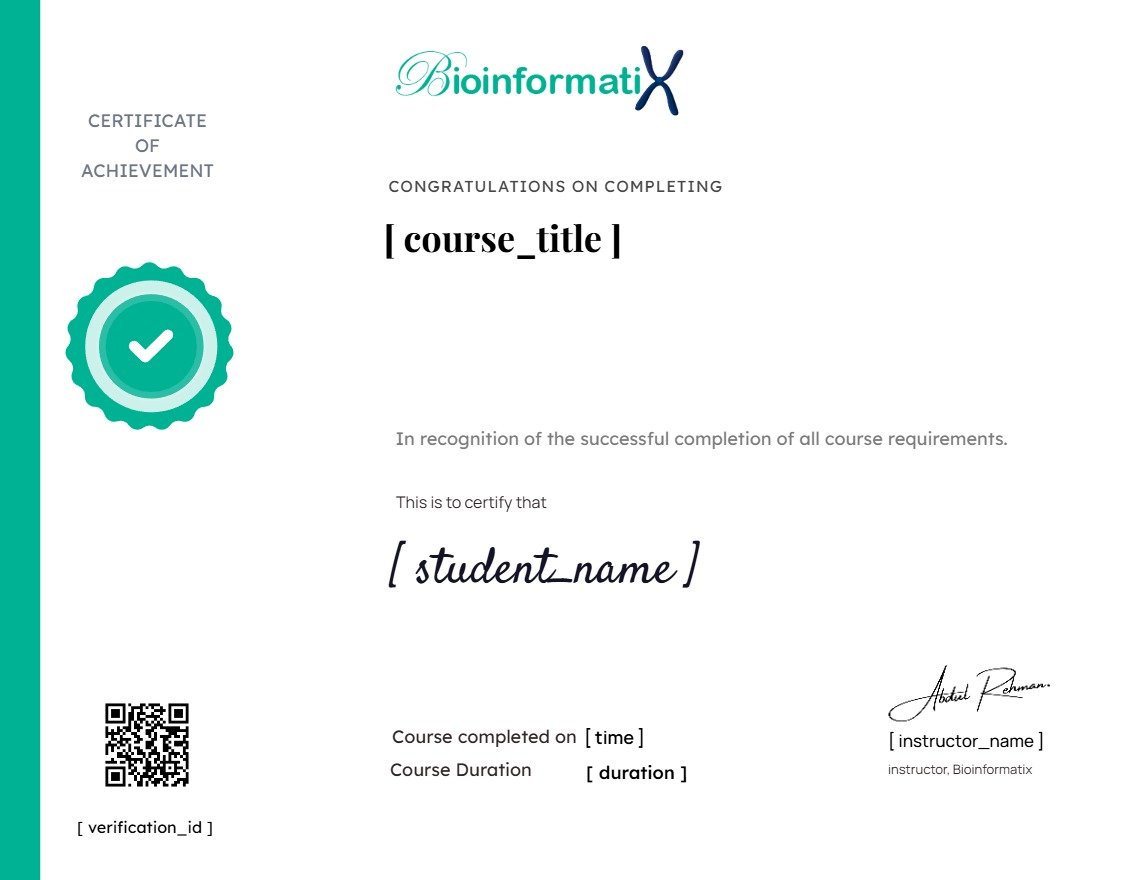
Get Certified in Bioinformatics
Showcase your achievement with a certificate recognized by students and researchers worldwide.
Student Ratings & Reviews

Your Instructor

Abdul Rehman Ikram
Bioinformatician | Data Analyst | Computational BiologistAbdul is a distinguished bioinformatician, data analyst, and computational biologist known for his exceptional contributions to the field of biomedical research. With a passion for integrating technology and biology, Abdul has carved a niche for himself, leveraging cutting-edge computational techniques to unravel complex biological data.
Driven by a curiosity to decode the complexities of life, Abdul believes in the power of interdisciplinary approaches. He is committed to mentoring the next generation of scientists, fostering a culture of innovation and continuous learning.