Protein Bioinformatics Masterclass: Sequence Analysis, Structure Prediction, Modeling & Proteomics
About Course
Protein Bioinformatics Masterclass: Sequence Analysis, Structure Prediction and Modeling
Proteins are the molecular machines that drive virtually every biological process, making their analysis essential in modern life sciences, biotechnology, drug discovery, and biomedical research. Understanding how proteins function, evolve, interact, and fold into complex three-dimensional structures is a critical skill for today’s bioinformaticians and researchers.
This comprehensive Protein Bioinformatics Masterclass is designed to take you from the fundamentals of protein sequence analysis to advanced structural and functional interpretation. Throughout the course, you will learn how to analyze protein sequences, identify conserved motifs and domains, investigate evolutionary relationships through phylogenetic analysis, predict physicochemical properties, and determine protein localization using industry-standard bioinformatics tools and databases.
The course also provides in-depth training in protein structure prediction and modeling. You will explore homology modeling, comparative modeling, AI-powered structure prediction methods such as AlphaFold, and de novo modeling approaches. Additionally, you will learn how to visualize and interpret protein structures using professional molecular visualization software.
To complete the protein analysis workflow, the course covers pathway enrichment and proteomics analysis, enabling you to understand how proteins participate in biological systems, signaling pathways, and cellular networks. By integrating sequence analysis, structural bioinformatics, and functional interpretation, this course provides a complete framework for studying proteins from sequence to biological function.
Whether you are a student, researcher, biotechnology professional, or aspiring bioinformatician, this course will equip you with practical skills that can be directly applied to academic research, thesis projects, publications, and industry-based bioinformatics workflows.
What You’ll Learn
✔ Protein sequence analysis and annotation
✔ Motif and domain identification
✔ Phylogenetic and evolutionary analysis
✔ Protein physicochemical property analysis
✔ Protein localization prediction
✔ Homology and comparative modeling
✔ AI-based protein structure prediction
✔ Protein structure validation and interpretation
✔ Protein visualization and structural analysis
✔ Functional enrichment and pathway analysis
✔ Proteomics data interpretation
✔ Real-world protein bioinformatics workflows
Who This Course Is For
- Bioinformatics students and professionals
- Biotechnology and molecular biology students
- MSc and PhD researchers
- Computational biology enthusiasts
- Wet-lab scientists transitioning to bioinformatics
- Researchers working with protein and proteomics data
- Anyone interested in structural bioinformatics and protein analysis
Tools and Databases Covered
- NCBI
- UniProt
- BLAST
- Pfam
- InterPro
- Conserved Domain Database (CDD)
- Clustal Omega
- MEGA
- SWISS-MODEL
- AlphaFold
- PyMOL
- STRING
- DAVID
- KEGG
- ProtParam
- ProtComp
Course Content
Introduction to Protein Bioinformatics
Course Introduction
05:22
Protein Sequence Analysis
Functional Annotation
Evolutionary Analysis
Protein Characterization
Structural Bioinformatics
Structural Visualization
Functional Interpretation and Proteomics
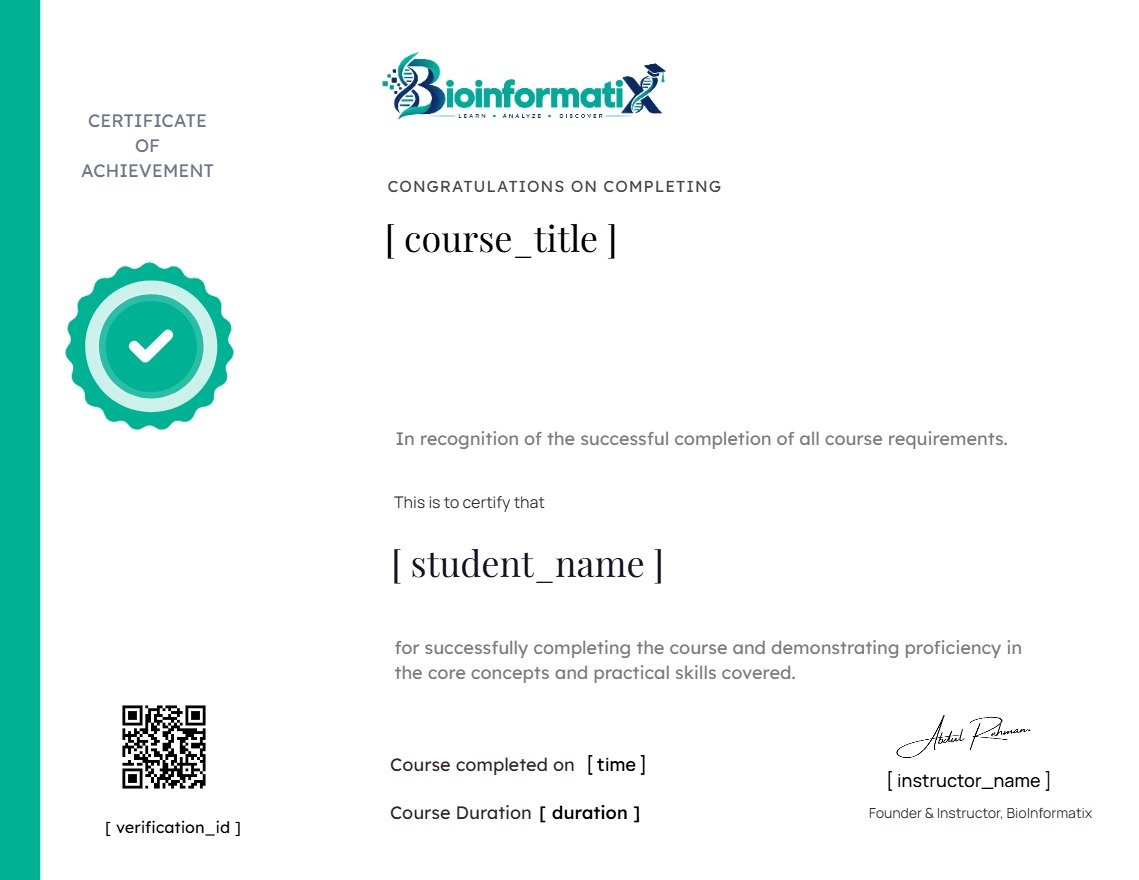
Get Certified in Bioinformatics
Showcase your achievement with a certificate recognized by students and researchers worldwide.
Student Ratings & Reviews

Your Instructor

Abdul Rehman Ikram
Bioinformatician | Data Analyst | Computational BiologistAbdul is a distinguished bioinformatician, data analyst, and computational biologist known for his exceptional contributions to the field of biomedical research. With a passion for integrating technology and biology, Abdul has carved a niche for himself, leveraging cutting-edge computational techniques to unravel complex biological data.
Driven by a curiosity to decode the complexities of life, Abdul believes in the power of interdisciplinary approaches. He is committed to mentoring the next generation of scientists, fostering a culture of innovation and continuous learning.