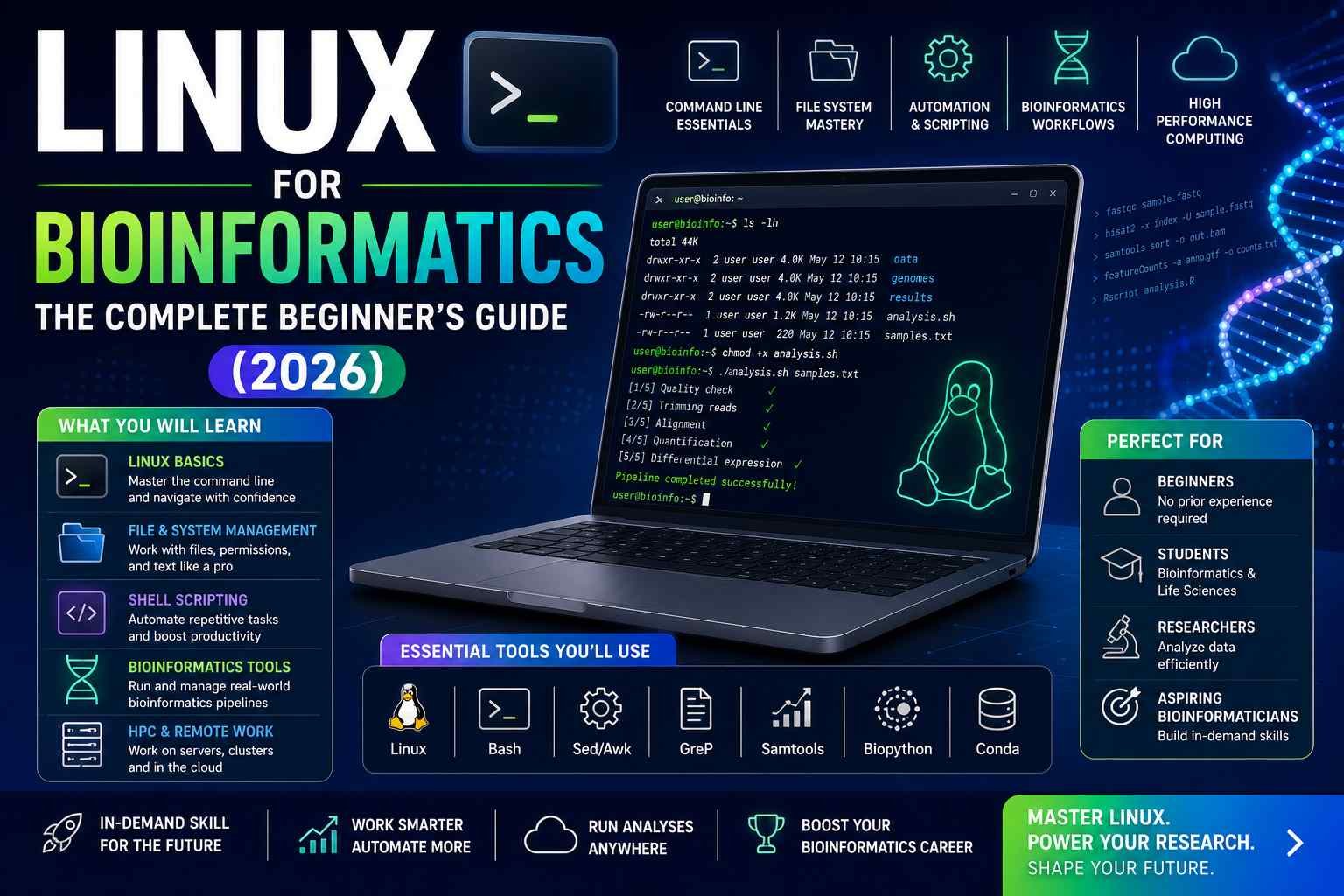
Linux for Bioinformatics is one of the most important skills every aspiring bioinformatician should learn. Most modern bioinformatics software, sequencing pipelines, and computational biology workflows are designed to run on Linux operating systems. Whether you’re analyzing genomic data, processing RNA-Seq experiments, performing genome assembly, or running machine learning models, Linux provides the flexibility and performance required for large-scale biological data analysis.
If you’re new to Linux, don’t worry. This guide explains why Linux is essential in bioinformatics, the commands you should learn, practical applications, and the best learning path for beginners.
Why Is Linux Important in Bioinformatics?
Modern sequencing technologies generate enormous datasets that require efficient processing.
Linux has become the preferred operating system because it offers:
- High performance
- Stability
- Powerful command-line tools
- Easy workflow automation
- Excellent support for bioinformatics software
- Compatibility with research servers and cloud computing platforms
Most research laboratories, universities, and biotechnology companies use Linux for computational biology projects.
Can You Learn Bioinformatics Without Linux?
Technically yes but only to a limited extent.
Many beginner-friendly tools offer graphical interfaces, but advanced analyses almost always require Linux.
Examples include:
- RNA-Seq analysis
- Genome assembly
- Variant calling
- Metagenomics
- ChIP-Seq analysis
- Single-cell RNA sequencing
- Antimicrobial resistance analysis
Learning Linux early makes it much easier to work with these advanced workflows.
Basic Linux Commands Every Bioinformatician Should Know
Start with the essential commands:
File and Directory Navigation
pwdlscd
These commands help you move through directories and locate files.
File Management
Learn how to:
- Create directories
- Copy files
- Move files
- Rename files
- Delete files
Proper file organization is essential when working with sequencing datasets.
Viewing File Contents
Useful commands include:
catlessheadtail
These allow you to inspect FASTA, FASTQ, GFF, and other biological file formats.
Searching Files
Commands such as:
grepfindlocate
help identify genes, sequences, or files within large datasets.
File Permissions
Understanding permissions helps you safely work on shared research servers.
Important commands include:
chmodchown
Compression Commands
Sequencing datasets are often compressed.
Learn how to use:
gzipgunziptarzipunzip
Common Bioinformatics File Formats
Linux users frequently work with files such as:
- FASTA
- FASTQ
- BAM
- SAM
- VCF
- GFF
- BED
- CSV
- TSV
Understanding these formats is an important part of becoming a bioinformatician.
Linux Tools Used in Bioinformatics
Many popular bioinformatics tools run on Linux, including:
- FastQC
- fastp
- BWA
- HISAT2
- STAR
- Bowtie2
- SAMtools
- BCFtools
- GATK
- FreeBayes
- SPAdes
- Prokka
- MACS2
These tools are used in genomics, transcriptomics, metagenomics, and microbial genomics.
Learn Linux with Our Free Course
If you’re starting from scratch, we recommend completing our free course:
Linux Command Line Essentials for Bioinformatics
This beginner-friendly course covers:
- Linux basics
- File management
- Directory navigation
- Shell commands
- Working with biological datasets
- Practical command-line exercises
Course Link:
https://bioinformatix.co/courses/linux-command-line-essentials-for-bioinformatics/
It provides the foundation you’ll need before working with advanced bioinformatics pipelines.
Combine Linux with Python and R
Linux becomes even more powerful when combined with programming.
Our premium course:
Learn Bioinformatics Data Analysis: Master Python, Linux and R Scripting
teaches how to integrate Linux with Python and R to analyze biological datasets, automate workflows, and build reproducible bioinformatics pipelines.
Course Link:
Linux Applications in Different Bioinformatics Fields
RNA-Seq Analysis
RNA sequencing workflows rely heavily on Linux for:
- Quality control
- Read trimming
- Sequence alignment
- Gene quantification
- Differential expression analysis
Learn practical RNA-Seq analysis with our course:
Hands-on RNA-Seq Analysis: Crash Course from FASTQ to DEGs
https://bioinformatix.co/courses/hands-on-rna-seq-analysis-crash-course-from-fastq-to-degs/
Genome Assembly
Genome assembly tools are almost exclusively Linux-based.
Our course:
Learn Genome Assembly and Annotation in Prokaryotes and Eukaryotes
covers genome assembly pipelines, quality assessment, and annotation.
https://bioinformatix.co/courses/learn-genome-assembly-and-annotation-in-prokaryotes-and-eukaryotes/
Variant Calling
Variant calling requires Linux-based tools such as BWA, SAMtools, BCFtools, and GATK.
Develop practical skills through our course:
Learn Variant Calling: NGS Data Analysis
Metagenomics
Metagenomic analysis relies on Linux environments for processing large sequencing datasets.
Our course:
Master Metagenomics and Microbiome Data Analysis Using Linux
provides hands-on training using real microbial sequencing data.
https://bioinformatix.co/courses/master-metagenomics-and-microbiome-data-analysis-using-linux/
Antimicrobial Resistance Analysis
Linux is widely used for antimicrobial resistance detection pipelines.
Our course:
Learn Antimicrobial Resistance Detection & Analysis Using Linux
covers practical AMR analysis workflows.
https://bioinformatix.co/courses/learn-antimicrobial-resistance-detection-analysis-using-linux/
Recommended Learning Roadmap
If you’re new to bioinformatics, follow this sequence:
Step 1
Start with our free course:
Roadmap to Bioinformatics: A Beginner’s Guide to Careers, Skills & Learning Path
Step 2
Learn Linux fundamentals.
Complete:
Linux Command Line Essentials for Bioinformatics
Step 3
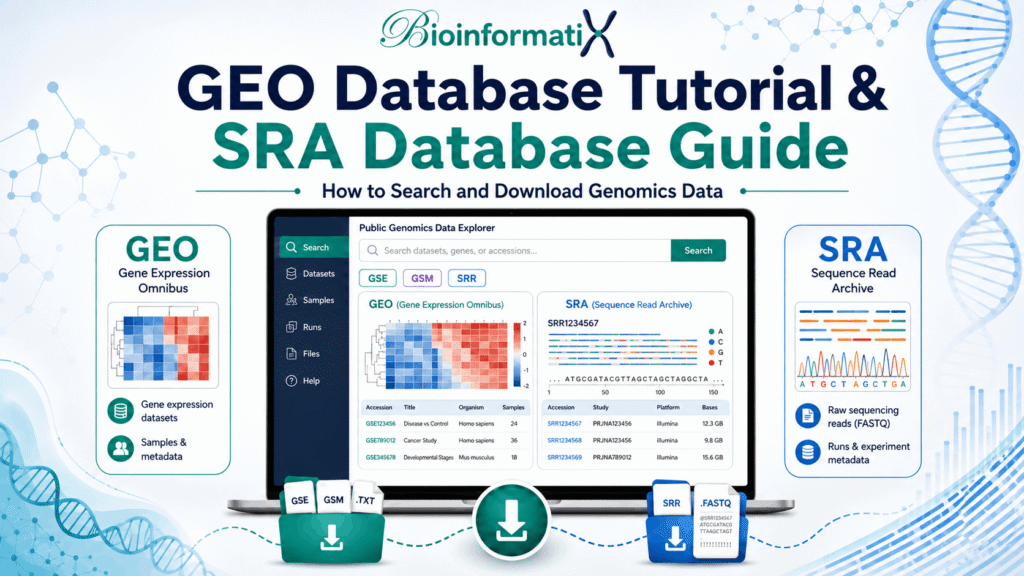
Understand biological databases.
Complete:
Introduction to Biological Databases for Bioinformatics
https://bioinformatix.co/courses/introduction-to-biological-databases-for-bioinformatics/
Step 4
Learn Python and R alongside Linux.
Complete:
Learn Bioinformatics Data Analysis: Master Python, Linux and R Scripting
Step 5
Apply your skills to real-world bioinformatics projects.
Complete:
Learn Bioinformatics: Beginner to Master Through Real-World Projects
Career Opportunities
Linux skills are highly valued in:
- Academic research
- Biotechnology
- Pharmaceutical companies
- Genomics laboratories
- Healthcare
- Precision medicine
- Agricultural biotechnology
Employers often expect bioinformaticians to be comfortable using the Linux command line.
Final Thoughts
Learning Linux for Bioinformatics is one of the best investments you can make as an aspiring bioinformatician. Almost every modern bioinformatics workflow depends on Linux, making it an essential skill for research and industry.
Start with basic command-line skills, practice regularly, and gradually work with real sequencing datasets. Combined with biology, Python, R, and statistics, Linux will provide a strong foundation for building a successful career in bioinformatics.